Lesson 18
Subject: Physics
Age range: 14-16
Resource type: Lesson (complete)




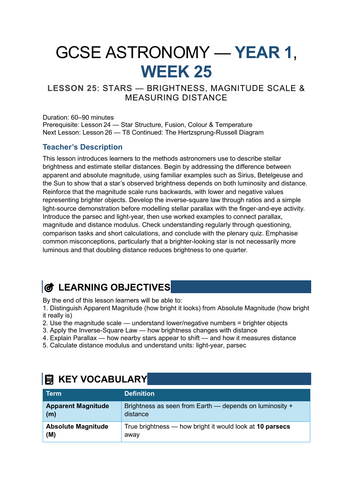
This lesson introduces learners to the methods astronomers use to describe stellar brightness and estimate stellar distances. Begin by addressing the difference between apparent and absolute magnitude, using familiar examples such as Sirius, Betelgeuse and the Sun to show that a star’s observed brightness depends on both luminosity and distance. Reinforce that the magnitude scale runs backwards, with lower and negative values representing brighter objects. Develop the inverse-square law through ratios and a simple light-source demonstration before modelling stellar parallax with the finger-and-eye activity. Introduce the parsec and light-year, then use worked examples to connect parallax, magnitude and distance modulus. Check understanding regularly through questioning, comparison tasks and short calculations, and conclude with the plenary quiz. Emphasise common misconceptions, particularly that a brighter-looking star is not necessarily more luminous and that doubling distance reduces brightness to one quarter.
A bundle is a package of resources grouped together to teach a particular topic, or a series of lessons, in one place.
Something went wrong, please try again later.
This resource hasn't been reviewed yet
To ensure quality for our reviews, only customers who have purchased this resource can review it
Report this resourceto let us know if it violates our terms and conditions.
Our customer service team will review your report and will be in touch.