


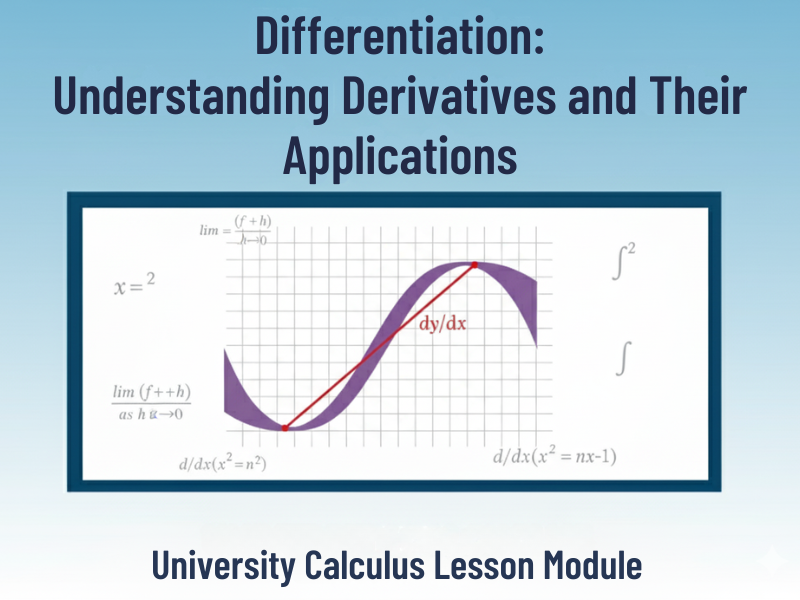
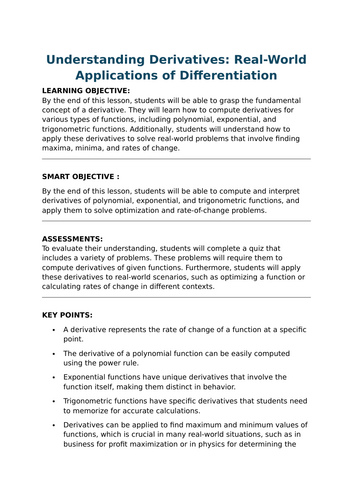
Dive deep into one of the most powerful ideas in mathematics — Differentiation — and help your students master the concept of derivatives as the foundation of Calculus I.
This comprehensive and interactive lesson plan introduces learners to the world of change, motion, and optimization, connecting mathematics to real-world phenomena in physics, economics, and everyday life.
Whether you’re teaching first-year university students or advanced high school learners, this resource is designed to make calculus intuitive, structured, and practical. Students will not only learn how to compute derivatives but also why they matter — understanding the story behind every equation.
**Why This Lesson?
-
Bridges Theory and Real Life:
Students don’t just memorize formulas — they see how derivatives describe real changes: how fast a car moves, how profits rise or fall, and how nature evolves over time. -
Step-by-Step Clarity:
The lesson breaks down every concept with clear explanations, guided examples, and gradual progression, ensuring that learners understand each rule — from the power rule to trigonometric differentiation. -
Critical Thinking & Application:
Beyond computation, students tackle optimization problems and rate-of-change applications, gaining the analytical skills they’ll need in physics, engineering, and economics. -
Engaging Assessment Structure:
Includes multiple-choice and free-response questions, a guided practice section, and real-world problem-solving tasks to test understanding and boost retention. -
Aligned With Academic Standards:
Carefully designed to meet key calculus standards such as HSA-APR.B.3, HSA-APR.C.5, and HSF-IF.B.6, ensuring it fits perfectly into university and advanced secondary curricula.
**What’s Inside This Lesson:
-
Comprehensive Learning Objective:
Students understand and compute derivatives of polynomial, exponential, and trigonometric functions while exploring their practical uses in optimization and change analysis. -
Interactive Opening:
A real-world introduction about speed, motion, and change to connect abstract math to daily experiences. -
Detailed Guided Practice:
Includes step-by-step examples (like finding the derivative of 𝑓(𝑥)=𝑥3+2𝑥2−𝑥f(x)=x3+2x2−x) and explanation of common mistakes students make when interpreting derivatives. -
Independent Practice & Homework:
A variety of computation and word problems to help students build confidence and fluency. -
Assessment Tools:
Ten multiple-choice questions and free-response exercises designed to challenge students’ reasoning and strengthen their problem-solving skills.
Perfect For:
-
University (Year 1) Calculus I Courses
-
Advanced 12th Grade Math Classes
-
STEM programs that integrate mathematics with physics or economics
-
Tutors & Instructors seeking a ready-to-teach calculus resource
-
Students preparing for college-level calculus or AP exams
Something went wrong, please try again later.
This resource hasn't been reviewed yet
To ensure quality for our reviews, only customers who have downloaded this resource can review it
Report this resourceto let us know if it violates our terms and conditions.
Our customer service team will review your report and will be in touch.
£0.00