


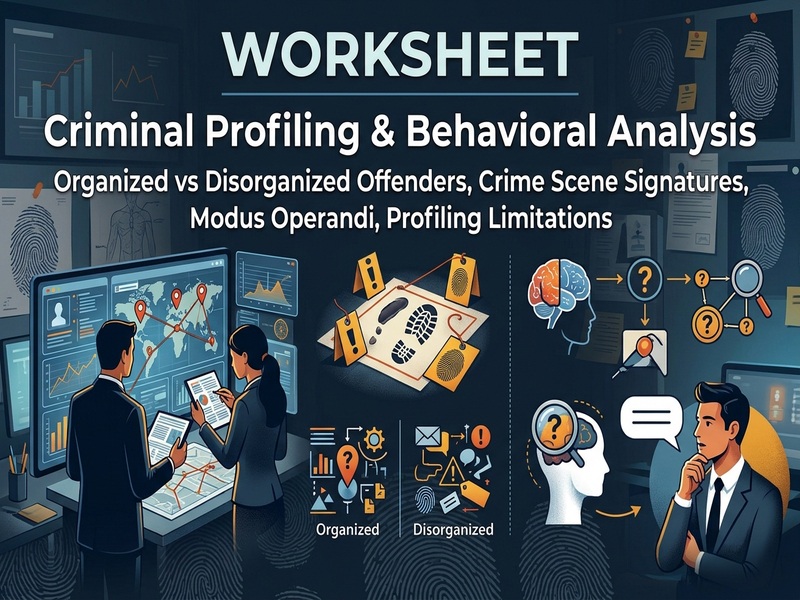
Bring authentic Forensic Psychology and Behavioral Evidence Analysis (BEA) into your classroom with this comprehensive, no-prep 62-page Criminal Profiling & Behavioral Analysis Curriculum Unit!
Move your students beyond sensationalized TV crime dramas and into the real-world analytical frameworks used by law enforcement and forensic psychologists. Designed for Upper High School (Grades 10–12), CTE Law Enforcement/Criminal Justice, Forensic Science, and AP Psychology, this turnkey resource guides students through the psychology of violent crime—from deconstructing Organized vs. Disorganized Offender Typologies to distinguishing dynamic Modus Operandi (MO) from static Crime Scene Signatures (CSS), while critically evaluating Profiling Limitations, Cognitive Biases, and Investigative Ethics.
Whether you need a complete 2- to 3-week Forensic Science unit, engaging crime scene case study packets, or high-rigor sub plans, this 62-page textbook-and-workbook hybrid has everything you need!
WHAT’S INCLUDED IN THIS 62-PAGE CURRICULUM UNIT:
Part 1: Foundational Theory Textbook Readings (Pages 1–14)
Introduction & Methodology: Deconstructing Criminal Behavior, Inductive vs. Deductive Reasoning, and Behavioral Evidence Analysis.
Chapter 1: The Dichotomy of Offender Typology: Organized vs. Disorganized Offenders & Mixed/Hybrid Spectrums (Includes illustrative cases: “The Architect” & “The Wanderer”).
Chapter 2: Modus Operandi (MO): The Functional Signature of a Crime—Target selection, entry, precautions, and how MOs evolve, adapt, or degrade (Includes cases: “The Midnight Tagger” & “The Shadow Burglar”).
Chapter 3: Crime Scene Signature: The Psychological Expression—Ritualistic behavior, overkill, staging, trophy-taking, undoing, and MO vs. Signature (Includes case: “The Rose Petal Strangler”).
Chapter 4: The Boundaries & Limitations of Profiling—Art vs. science, confirmation bias, investigative tunnel vision, empirical validation challenges, ethical considerations, and “The Whispering Woods Predator” evolving narrative case study.
Part 1 Review: Chapter Comprehension & Critical Thinking (Page 15)
12 rigorous, open-ended analytical questions spanning Chapters 1–4.
Teacher Implementation Guide & Pacing Calendar (Pages 16–17)
Includes a suggested 10-Day (2- to 3-Week) Pacing Guide, student response instructions, print-saving tips, and an academic content advisory.
Part 2: 10-Part Applied Student Workbook & Case Files (Pages 18–37)
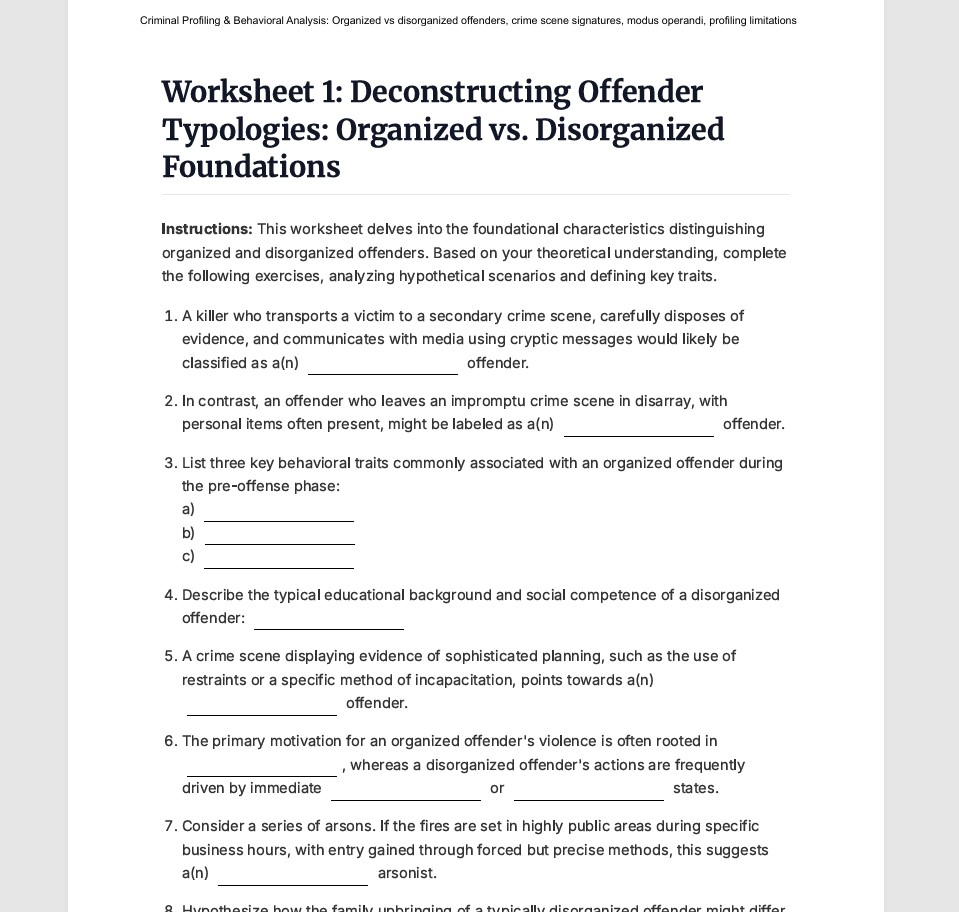
Worksheet 1: Deconstructing Offender Typologies: Organized vs. Disorganized Foundations
Worksheet 2: Analyzing Crime Scene Characteristics: Organized Offenses
Worksheet 3: Analyzing Crime Scene Characteristics: Disorganized Offenses
Worksheet 4: The Modus Operandi (MO): Consistency and Evolution
Worksheet 5: Distinguishing MO from Crime Scene Signatures (CSS)
Worksheet 6: Applied Case Study Analysis: The “Nightfall” Incident
Worksheet 7: The Concept of Crime Scene Signatures: Psychological Needs
Something went wrong, please try again later.
This resource hasn't been reviewed yet
To ensure quality for our reviews, only customers who have purchased this resource can review it
Report this resourceto let us know if it violates our terms and conditions.
Our customer service team will review your report and will be in touch.
$45.00