


A clear, step-by-step GCSE Science guide to finding resultant vectors using Pythagoras’ Theorem. Includes formulas, examples, and memory tips.
Overview
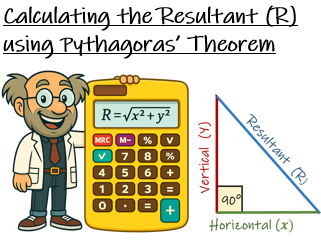
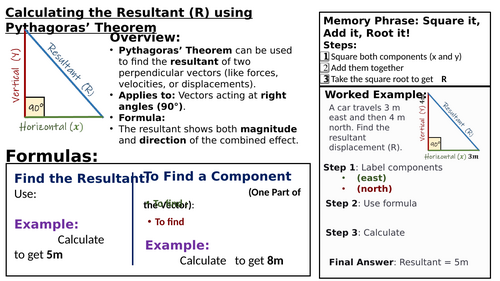
This resource provides a clear, step-by-step visual guide to calculating resultant vectors using Pythagoras’ Theorem — ideal for GCSE Science and Physics lessons. It helps students understand how to find the resultant of two perpendicular vectors (such as forces, velocities, or displacements) using simple geometry.
The sheet breaks down the process with:
A labelled right-angled triangle showing vector components.
Worked examples that model good exam technique.
A memory phrase (“Square it, Add it, Root it!”) to reinforce the method.
Space for guided or independent practice.
Students learn how to:
Identify horizontal and vertical vector components.
Apply Pythagoras’ Theorem to find the magnitude of a resultant.
Calculate missing components in vector problems.
Describe both the direction and magnitude of a resultant vector.
This resource supports key learning in forces and motion, resultant vectors, and geometry in physics, and is suitable for both Foundation and Higher tiers.
Get this resource as part of a bundle and save up to 38%
A bundle is a package of resources grouped together to teach a particular topic, or a series of lessons, in one place.
Something went wrong, please try again later.
This resource hasn't been reviewed yet
To ensure quality for our reviews, only customers who have purchased this resource can review it
Report this resourceto let us know if it violates our terms and conditions.
Our customer service team will review your report and will be in touch.
£2.00