


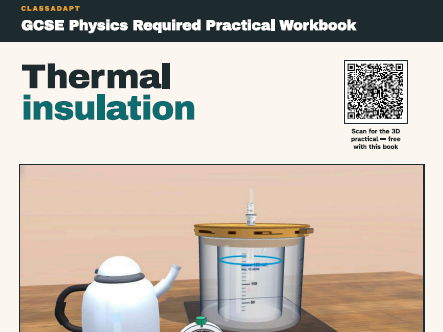
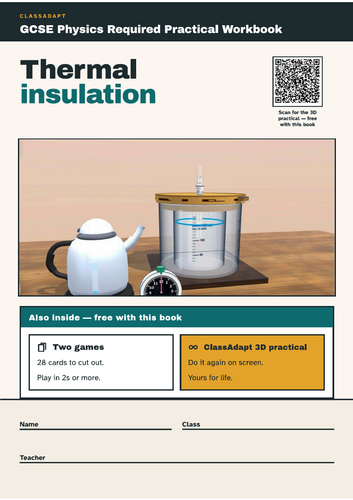
A 20-page printable A4 workbook that takes pupils through the GCSE Physics thermal insulation required practical one small step at a time. Pupils test four packings (nothing, cotton wool, scrunched paper and bubble wrap) to find out which keeps hot water warm for longest. It’s built for pupils who need more structure, with short sentences, an 8-step tick-box method, word banks, sentence starters and worked examples throughout.
Includes free lifetime access to the ClassAdapt Thermal Insulation simulation
What’s inside
Hook (p2): A plate at 1,500 °C, with only one layer of cloth between it and a hand. Pupils do the practical to find out why the hand is fine.
Eight pairs game (p4): 16 squares to cut out and play as pairs, matching each piece of apparatus to its job. Pupils who would rather not cut can draw lines instead.
Four words and the apparatus (p5): Thermal insulator, temperature drop, rate of cooling and fair test, with a labelled diagram of the apparatus.
Eight steps (p6): A tick-box method in the right order, packing the gap while it is still cold.
Your results (p7): A results table for all four packings, with the first row already filled in.
Class data (p8): A full set of readings for classes with no computers or equipment.
Three variables (p9): Independent, dependent and control variables, with a word bank.
Your graph (p10): Pre-scaled axes to plot the Nothing and bubble wrap cooling curves, with a key.
Find the drop (p11): Δθ = start temperature − end temperature for each packing, followed by a sentence naming the best insulator.
Rate of cooling (p12): A worked example, then a guided calculation in °C each minute.
Fast, then slow (p13): Why water cools more slowly as it gets closer to room temperature, and why it never drops below about 20 °C.
Which one won? (p14): Pupils rank the four packings and write a three-sentence conclusion, including why trapped air helps.
Exam questions (p15): 9 marks in total, with sentence starters.
How did I do? (p16): A self-assessment checklist.
Spare graph (p17): Blank axes so pupils can plot all four packings.
Cut-and-sort group game (p18): 12 cards for pairs, threes or fours, sorted into Risk and safety, Practical procedure, and Errors and improvements.
Full teacher answer key (p19): Includes mark schemes and notes on how the simulation works.
Written by a qualified physics teacher, with input from a current an examiner.
Something went wrong, please try again later.
This resource hasn't been reviewed yet
To ensure quality for our reviews, only customers who have purchased this resource can review it
Report this resourceto let us know if it violates our terms and conditions.
Our customer service team will review your report and will be in touch.
£5.00