


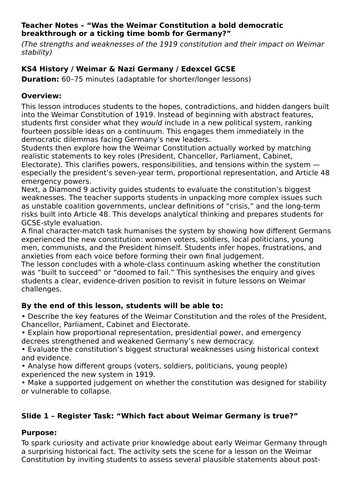
A fully resourced, interactive GCSE lesson on the strengths and weaknesses of the Weimar Constitution of 1919. Students investigate whether Germany’s new democratic system after WWI was a bold breakthrough or whether hidden flaws made future instability inevitable. Through engaging, enquiry-led activities, students explore how the constitution worked, who held power, and why historians still debate its long-term impact.
The lesson includes:
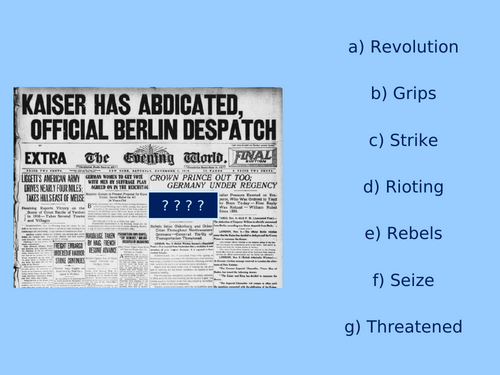
• A visual register starter with a surprising historical fact to introduce the Weimar context
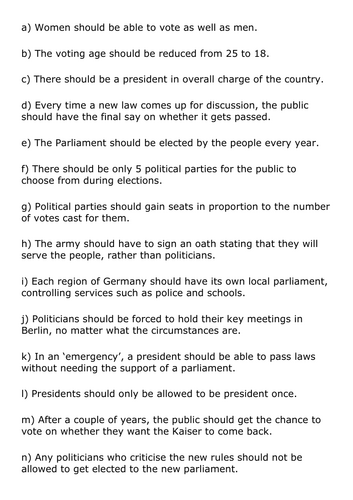
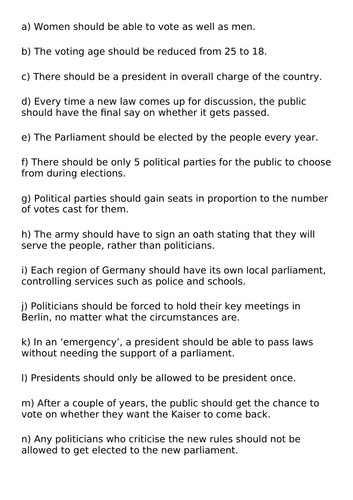
• A continuum activity where students rank fourteen possible constitutional features
• A structured “What Would You Include?” discussion linking values to democratic design
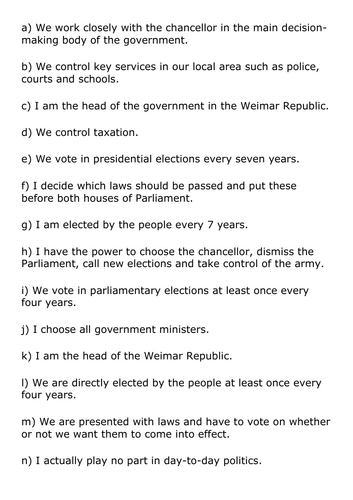
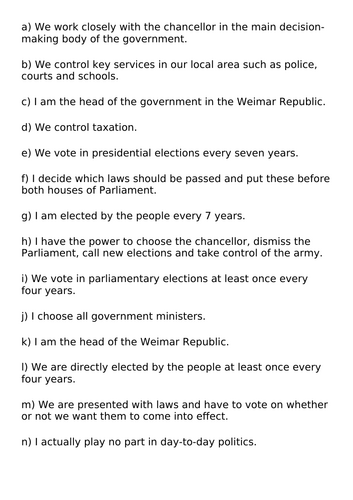
• A grouping activity matching fourteen real constitutional statements to five roles
• A high-quality Diamond 9 task evaluating the constitution’s most serious weaknesses
• Clear teacher-led modelling of the President, Chancellor, Parliament, Cabinet and Electorate
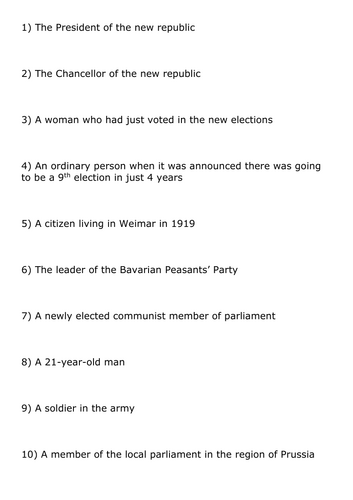
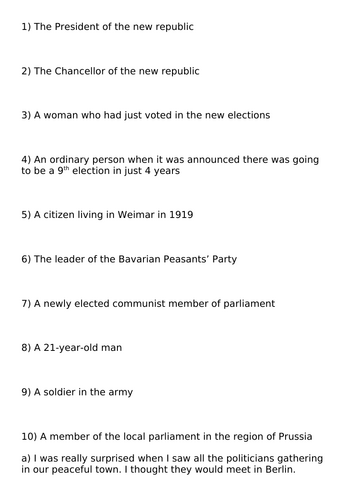
• A character match-up revealing how ten different Germans experienced the new democracy
• A whole-class judgement continuum plenary: Was the Constitution built to succeed or doomed to fail?
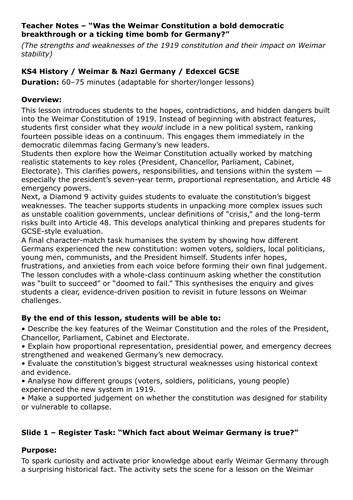
• Full teacher notes for every slide, including Purpose, Guidance, Insight and Differentiation
All worksheets, role cards, Diamond 9 cards and detailed teacher notes are included.
Designed for Edexcel GCSE History (Weimar & Nazi Germany) but easily adaptable for AQA, OCR or Eduqas.
Ideal for developing inference, judgement, and evaluative skills while helping students understand how the Weimar Constitution balanced democratic ambition with structural vulnerabilities — and why its design continues to divide historians.
Get this resource as part of a bundle and save up to 33%
A bundle is a package of resources grouped together to teach a particular topic, or a series of lessons, in one place.
Bundle
Early Weimar Germany 1918–29: Complete 9-Lesson GCSE Enquiry Bundle (Edexcel / AQA / OCR)
A fully resourced, nine-lesson GCSE bundle covering the early years of the Weimar Republic, 1918–29. Through engaging enquiry questions, rich visual activities and structured evaluative tasks, students investigate how Germany navigated collapse, revolution, crisis, recovery and cultural transformation after the First World War. Each lesson provides a complete, interactive sequence with printable resources, cut-out cards and detailed teacher notes (Purpose, Guidance, Insight, Differentiation and Timing). Designed for Edexcel GCSE (Weimar & Nazi Germany) but easily adaptable for AQA, OCR and Eduqas. The bundle includes: 1. The Kaiser’s Abdication, 1918 – Enquiry Lesson Students examine how a leader who promised glory ended up fleeing his own country. Includes a visual register starter, Kaiser quotations task, nine-option causes ranking activity, voice-matching enquiry and a structured two-part plenary. 2. How Six Politicians Saved Germany in 1918–19 – Decision-Making Enquiry A full WWYD-style simulation exploring how Germany avoided full-scale revolution. Includes decision-making tasks inside the Reichstag, crisis dilemmas, a military scenario, business and workers’ perspectives, and a consolidation ranking plenary. 3. The Weimar Constitution, 1919 – Strengths, Weaknesses & Was It Built to Fail? Students investigate whether the new constitution was a bold democratic breakthrough or a structural time bomb. Includes ranking tasks, constitutional role-matching, Diamond-9 evaluation and a whole-class judgement plenary. 4. The Treaty of Versailles, 1919 – Why Germans Hated the Peace Settlement Students explore whether the Treaty was a fair attempt at stability or a calculated humiliation that fuelled resentment and future conflict. Includes striking political cartoons, a paired discussion task, a competitive quiz, treaty-term match-up and a reflective judgement plenary. 5. Weimar 1919–22: Challenges, Extremism & Stability – Full Enquiry Lesson A full investigation of early political instability, extremist threats and government responses. Includes metaphor-based starters, quizzes, political Diamond-9 ranking, a major living-graph activity and a judgement plenary. 6. Hyperinflation 1923 – WWYD Simulation & Evaluation Lesson Students examine whether hyperinflation was unavoidable or worsened by Weimar decisions. Includes a mystery starter, Cold War–style recap, WWYD simulation, character match-up, ranking tasks and a forward-looking plenary. 7. Stresemann: Hero of Weimar Germany or Overrated Statesman? An enquiry into how far Stresemann truly strengthened Germany. Includes an image starter, mood analysis, continuum tasks, BBC clip questions, consolidation quiz and a structured debate plenary. 8. Did Weimar Society Become Fairer in the 1920s? – Social Change Enquiry Students explore how far different groups — especially women — experienced genuine progress. Includes an image starter, AFL mapping, continuum tasks, satirical source analysis, inference modelling and an evaluative judgement activity. 9. Was Weimar Culture a ‘Golden Age’? – Cultural Enquiry Lesson A rich investigation into Weimar art, architecture, nightlife and film to judge whether culture liberated or divided Germany. Includes prediction tasks, image inference, sorting activities, a paired-reaction task and a reflective plenary. Ideal for developing: • Inference • Interpretation • Decision-making • Source analysis • Causation • Continuum judgement • Evaluative reasoning Perfect for deepening students’ understanding of the political, economic, social and cultural forces that shaped early Weimar Germany — and why the Republic remained so fragile throughout the 1920s.
£28.00
Bundle
Early Weimar Germany 1918–23: Six Complete Enquiry Lessons on Crises, Extremism & Hyperinflation
A complete set of six high-quality enquiry lessons exploring the dramatic early years of the Weimar Republic, 1918–1923. Students investigate how Germany moved from defeat and revolution to political extremism and economic collapse — and whether these crises were survivable or signs of deeper weaknesses in the new democracy. Each lesson uses the distinctive Asa Merrin approach: enquiry-led learning, immersive activities, inference-rich tasks, clear modelling, and structured evaluation. This bundle provides everything needed to build deep understanding and strong GCSE-level historical thinking. The six lessons include: • How six politicians saved Germany (1918–19) — WWYD crisis simulations on the creation of Weimar • Hyperinflation 1923 — decision-making enquiry, character match-up, headline evaluation • The Kaiser’s Abdication — dramatic narrative enquiry exploring November 1918 • Treaty of Versailles — why Germans hated the settlement & how it shaped early instability • The Weimar Constitution — strengths, weaknesses and whether it was built to fail • Weimar Republic 1919–22 — extremism, uprisings and the struggle for stability (full enquiry) Each lesson features: • A clear enquiry question with conceptual depth • Engaging starters (image inference, metaphors, recap quizzes, WWYD choices) • Highly structured modelling and guided reasoning • Inference, explanation and evaluation tasks • Challenge & Support differentiation on every slide • Full teacher notes (Purpose, Guidance, Insight, Differentiation) • Professional, consistent visuals across the series Designed for Edexcel GCSE (Weimar & Nazi Germany) but easily adaptable for AQA, OCR and Eduqas. Ideal for teachers who want a ready-made sequence that builds powerful thinking skills while helping students truly understand why early Weimar Germany was so unstable.
£18.00
Something went wrong, please try again later.
This resource hasn't been reviewed yet
To ensure quality for our reviews, only customers who have purchased this resource can review it
Report this resourceto let us know if it violates our terms and conditions.
Our customer service team will review your report and will be in touch.
£4.50