Sets and Venn Diagrams: Exam Practice (Year 10, IGCSE Edexcel Maths)
This booklet contains 28 Pearson Edexcel IGCSE past-paper questions on sets and Venn diagrams, sorted from easiest to hardest. There are 114 marks in total. Each question shows its marks, its grade and the exam paper it came from, and has a square grid for your working.
Start with the three-question starter on the front page. Your score tells you which section to begin with.
Green – Practice (Grade 4–5, questions G1 to G6, 20 marks): listing the members of sets and reading a Venn diagram.
Amber – Further Practice (Grade 5–6, questions A1 to A8, 30 marks): completing two-set Venn diagrams from set notation and working with described sets.
Red – Further Developing Understanding (Grade 6–7, questions R1 to R7, 25 marks): three sets, including n( ) notation, shading regions and building a diagram from information.
TIF – Problem Solving (Grade 7–8, questions T1 to T4, 24 marks): longer three-set problems with probability and algebra.
TIEF – Hard Challenge (Grade 8–9, questions E1 to E3, 15 marks): the three hardest questions.
Year 10 Maths Homework: Index Notation (Negative and Fractional Powers)
This homework practises the index work we have been doing in class: evaluating numbers with zero, negative and fractional powers, and simplifying algebraic expressions that have negative and fractional powers. It follows the Edexcel IGCSE style, and it should be done without a calculator.
Start with the four starter questions on page 1. Your score tells you which level to begin at:
Green (Grade 5–6): practice with negative and fractional powers and simple algebra.
Amber (Grade 6–7): further practice with fractions to negative powers and brackets with fractional powers.
Red (Grade 7–8): harder algebraic fractions, expanding brackets and solving a power equation.
TIF (Grade 8–9): problem-solving questions.
TIEF (Grade 9): three hard challenge questions.
Changing the Subject of a Formula (Year 10, IGCSE Edexcel Higher)
This worksheet builds your skills in rearranging formulas where the subject appears more than once, including formulas with squares, cubes, square roots and cube roots. It is split into five colour-coded levels, so you can start where you feel confident and work your way up.
Green (Grade 6): The subject appears twice. Collect the terms with the subject on one side, then factorise.
Amber (Grade 7): The subject is squared or cubed. Factorise out x² or x³, then take the square root (±) or cube root.
Red (Grade 8): Formulas with square roots and cube roots. Square or cube both sides first, then collect terms and factorise.
TIF (Grade 8–9): Exam-style problem-solving questions, including intersecting chords, spotting a mistake in someone’s working and a “show that” proof.
TIEF (Grade 9): Three challenging real-life problems: a pendulum clock, a spherical water tower and a wind turbine.
Show every step of your working in the grid below each question, one step per line. When you have finished a level, check your answers using the worked solutions.
Surds – Differentiated Worksheet with Worked Solutions (Pearson Edexcel IGCSE 9–1, Higher Tier)
This worksheet develops the surds content of the Pearson Edexcel International GCSE (4MA1) Higher Tier specification. Students start with simplifying surds and build up to exam-style problems in shape and real-life contexts. The pack has two PDFs: the student worksheet and a separate set of full worked solutions. It works well for classwork, homework, independent revision and exam preparation.
The worksheet has five colour-coded levels, each on its own page with a matching border and a clear grade label, so students know how hard the work is before they begin. Every question has a square grid for working out and an answer line, and all the questions are designed to be answered without a calculator.
Green – Practice (Grade 5): six questions on simplifying surds such as √50 and √48, multiplying surds, and adding and subtracting surds after simplifying them.
Amber – Further practice (Grade 6): six questions on expanding single and double brackets containing surds, including a difference of two squares and squaring a bracket, with answers in the form a + b√n.
Red – Developing understanding (Grade 7): six questions on rationalising the denominator. They move from simple denominators such as 6/√3 to denominators of the form 3 − √5 and √7 + 2, which need the conjugate.
TIF – Problem solving (Grade 8): six exam-style shape problems where students find an exact height, width, radius or length:
the width of a rectangle and the height of a triangle, both needing rationalising
the radius of a circle
the radius and curved surface area of a cylinder
the hypotenuse of a triangle with surd sides
the height and area of an equilateral triangle
TIEF – Real-life challenge (Grade 9): four illustrated problems that show where surds appear in everyday life:
the √2 ratio behind A4 and A5 paper
the gradient and exact length of a wheelchair ramp
the dimensions of a solar panel
the radius of a pizza with double the area
The worked solutions show one step per line going down the page, and give each part of an answer on its own line so students can follow every stage of the method. They highlight key techniques such as finding the largest square factor, using the conjugate to rationalise, recognising the difference of two squares, and giving exact answers in simplest surd form.
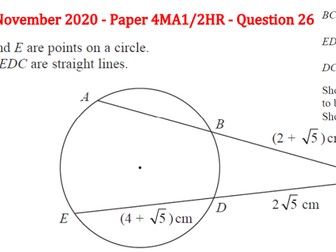
Intersecting Chords – Differentiated Worksheet with Worked Solutions (Pearson Edexcel IGCSE 9–1, Higher Tier)
This worksheet develops the internal and external intersecting chord theorems from the Pearson Edexcel International GCSE (4MA1) Higher Tier specification. Students start with simple chords crossing inside a circle and work up to multi-mark exam-style questions involving quadratics and surds. The full worked solutions come as a separate PDF, which makes the pack useful for classwork, homework, independent revision and exam preparation.
The worksheet has five colour-coded levels, each on its own page with a matching border and a clear grade label, so students know how hard the work is before they begin. Every question has an exam-style diagram marked “Diagram NOT accurately drawn”, a square grid for working out and an answer line.
Green – Practice (Grade 5–6): four questions on chords intersecting inside a circle, using AP × PB = CP × PD with whole-number lengths.
Amber – Further practice (Grade 6–7): three questions on chords that meet outside the circle, where students must add the outside part and the chord to get the whole line, plus one inside-circle question with decimals.
Red – Developing understanding (Grade 7): four questions where students form and solve equations in x. Two lead to linear equations and two to quadratics, where students must reject the negative root.
TIF – Problem solving (Grade 8): four exam-style questions with marks shown:
finding the radius from a diameter and a crossing chord
a “show that” quadratic answered to 3 significant figures
a six-mark question combining the internal and external theorems with a circle centre O
a question where the chord segments are given as a ratio
TIEF – Challenge (Grade 9): four exam-style questions with surds. Students rationalise denominators, use the difference of two squares, solve a quadratic by completing the square, and give exact answers in the form a + b√3.
The worked solutions set out every step for all 20 questions. They show how to set up each equation from the correct theorem, handle quadratics and surds, and give answers to the required accuracy. They also highlight common mistakes, such as using only the outside part of the line instead of the whole line in external chord questions, and not rejecting negative lengths.
The Disease paper is a Year 8 Science revision assessment on Disease and Pathogens, written in the style of ExamPro exam questions. It’s worth 54 marks and comes as two separate PDFs: an 8-page question paper and a 3-page mark scheme. It’s based on your Disease lesson slides.
It checks whether students can explain what pathogens are, how they cause disease and how communicable diseases spread. It covers the lesson’s success criteria: defining a pathogen, naming the four types of pathogen and their diseases, communicable and non-communicable diseases, how diseases are transmitted, and applying this to real examples such as COVID-19.
How it’s organised
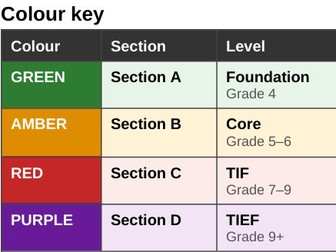
The paper is split into four colour-coded sections that match the lesson’s grade bands. Students start at Green and work up as far as they can.
Green, Section A (Foundation, Grade 4), 13 marks. Recall and identification: defining a pathogen, naming bacteria, virus, fungus and protist from pictures, choosing true statements about microorganisms, which pathogen causes influenza, HIV, cholera, rose black spot and malaria, sorting seven diseases into communicable and non-communicable, and two ways pathogens spread.
Amber, Section B (Core, Grade 5–6), 15 marks. Describing how pathogens cause and spread disease: putting the stages of infection in order, how each type of pathogen causes disease, the difference between communicable and non-communicable diseases, how each of the five diseases is spread, and what a vector is (the mosquito for malaria).
Red, Section C (TIF, Grade 7–9), 16 marks. Explaining and applying: correcting the “all bacteria are pathogens” and “malaria must be bacteria” misconceptions, why you don’t feel ill straight away with flu, identifying a mystery disease from clues (cholera), and the “How did COVID-19 reach Dubai?” plenary turned into exam questions.
Purple, Section D (TIEF, Grade 9+ extension), 10 marks. Applying knowledge to new situations: the Dubai Health Emergency question on why knowing both the pathogen and how it spreads matters for controlling an outbreak, and a 6-mark question on which method of transmission is hardest to control.
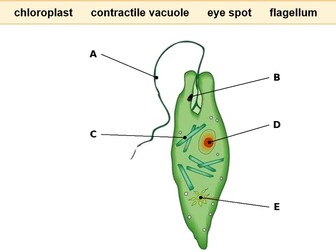
Year 8 Science revision assessment on Unicellular and Multicellular Organisms, written in the style of ExamPro exam questions. It’s worth 57 marks over 12 pages, with 8 pages of questions and 4 pages of mark scheme. It’s based on your lesson slides and the Amoeba and Euglena information sheet.
It checks whether students can compare unicellular and multicellular organisms and explain how unicellular organisms like Amoeba and Euglena survive. It covers the lesson’s success criteria: naming examples, identifying structures, comparing the two groups, linking structure to survival, and explaining how diffusion limits cell size.
How it’s organised
The paper is split into four colour-coded sections that match the lesson’s grade bands. Students start at Green and work up as far as they can.
Green, Section A (Foundation, Grade 4), 17 marks. Recall and identification: matching cell parts to their functions, the meaning of “unicellular”, sorting organisms into unicellular and multicellular, completing sentences about multicellular organisms, labelling an Amoeba diagram, where Euglena live, and naming binary fission.
Amber, Section B (Core, Grade 5–6), 17 marks. Describing and comparing: labelling a Euglena diagram, completing a comparison table, and describing how an Amoeba feeds, how a Euglena moves towards light, what the contractile vacuole does, the stages of binary fission, and two differences between Amoeba and Euglena.
Red, Section C (TIF, Grade 7–9), 14 marks. Explaining and calculating: why Euglena need chloroplasts, and why multicellular organisms survive losing some cells but unicellular organisms don’t. It also includes a surface area to volume calculation with cubes and a 4-mark explanation of why Amoebas can’t grow to the size of whales, using the words diffusion, surface area, volume and distance.
Purple, Section D (TIEF, Grade 9+ extension), 9 marks. Applying knowledge to new situations: predicting and explaining how Euglena respond in a half-covered test tube, and a 6-mark “Lost in the Pond” question on whether an Amoeba or a Euglena is more likely to survive a week in a dark pond.
Year 8 Science revision assessment on Fungi, Bacteria and Protists, written in the style of ExamPro exam questions. It’s worth 57 marks and comes as two separate PDFs: an 8-page question paper and a 4-page mark scheme. It’s based on your Fungi, Bacteria and Yeast lesson slides, the budding and binary fission support slides, and the ordering worksheet.
It checks whether students can explain how the structures of bacteria, fungi and protists help them survive, and how yeast and bacteria reproduce. It covers the lesson’s success criteria: recalling examples, identifying cell parts, describing budding and binary fission, explaining what key structures do, everyday uses of microbes, and calculating population growth from a graph.
How it’s organised
The paper is split into four colour-coded sections that match the lesson’s grade bands. Students start at Green and work up as far as they can.
Green, Section A (Foundation, Grade 4), 15 marks. Recall and identification: sorting mushroom, Salmonella, Amoeba, yeast, E. coli, algae and mould into bacteria, fungi or protists, which microbe makes bread rise, a food made using bacteria, labelling a bacterial cell, naming binary fission, and completing sentences about binary fission.
Amber, Section B (Core, Grade 5–6), 15 marks. Describing structures and reproduction: labelling a yeast cell, giving the functions of the flagellum, mitochondrion and contractile vacuole, and putting the stages of budding and binary fission in order (from your worksheet). It also asks for one similarity and one difference between the two processes, and why asexual reproduction produces identical cells.
Red, Section C (TIF, Grade 7–9), 17 marks. Explaining and calculating: a population growth graph where students describe the pattern, calculate the increase, calculate the rate of growth, predict the population and link the curve to binary fission. It also includes calculating how many bacteria grow on rice left out for 4 hours, why this is dangerous, and which microbe is best adapted to rotting fruit.
Purple, Section D (TIEF, Grade 9+ extension), 10 marks. Applying knowledge to new situations: a 6-mark question on whether a lab should grow bacteria or yeast to get microorganisms as quickly as possible, and a 4-mark question on harmful algal blooms (red tides) in UAE waters, covering why they spread so fast and how to reduce them.
Surface Area of a Cylinder – Differentiated Worksheet with Worked Solutions (KS3 and GCSE)
This worksheet takes students from finding surface area using a net through to working backwards from a given surface area and solving multi-step real-life problems. It suits KS3 and GCSE Foundation and Higher students. The worked solutions come as a separate document, which makes the pack useful for classwork, homework, intervention and revision.
The worksheet has five colour-coded levels, so students can start where they need to and move up as their confidence grows. Each level is on its own page with a matching coloured border, which makes it easy to print only the levels a class or student needs. Every question has a square grid for working out and a clear answer line, and the cylinders are coloured to help students tell the circular faces from the curved surface.
Green (Practice): four cylinder nets with no scaffolding. Students find the area of the two circles and the rectangle, and two of the nets give the diameter rather than the radius.
Amber (Further practice): four cylinders with whole-number measurements, some giving the radius and some the diameter. The cylinders are drawn upright, lying down and tilted, so students learn to spot the radius and height whatever the orientation.
Red (Further developing understanding): four cylinders in different positions with decimal radii and diameters, some in centimetres and some in metres. This builds accuracy and careful rounding.
TIF (Problem solving): six questions where students work backwards to find a missing height, length or radius. They cover:
working from a total surface area given as a decimal or in terms of π
working from a curved surface area
an algebraic question where the height is a multiple of the radius
two illustrated real-life problems: painting the inside of an open farm water tank, where only one circle is used, and an advert wrapped around a shopping-mall pillar, which uses the curved surface only
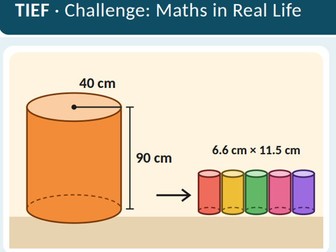
TIEF (Real-life challenge): one extended, illustrated problem about painting a water tank on a villa roof in Dubai. Students choose which surfaces to include, account for two coats, convert area into litres of paint, and compare tin sizes and prices to find the cheapest way to buy the paint.
The worked solutions set out every step for all 19 questions. They show exact answers in terms of π alongside decimal answers, keep full calculator values until the final step, and highlight common pitfalls such as forgetting to halve the diameter, including both circles on an open tank, or rounding down the number of paint tins.
Skills covered: surface area of cylinders, circumference and area of circles, nets of 3D shapes, working with π, rearranging to find unknown lengths, unit conversion, rounding, and problem solving in context.
Volume of a Cylinder – Differentiated Worksheet with Worked Solutions (KS3 and GCSE)
This printable resource helps students build confidence in finding the volume of a cylinder, from first practice through to real-life problem solving. It suits KS3 learners meeting the topic for the first time and GCSE students (Foundation and Higher) who need consolidation, exam-style practice or revision. Each level is colour-coded, so students can start at the right point and work their way up, which makes it easy to use in mixed-ability classes.
The worksheet has five levels. Green (Practice) gives straightforward questions using V = πr²h, with dimensions given as either the radius or the diameter. Amber (Further Practice) adds decimal measurements, cylinders standing up and lying on their side, everyday contexts such as tins, logs and fuel tanks, and rounding to 3 significant figures. Red (Further Developing Understanding) moves on to half cylinders, quarter cylinders and a three-quarter cylinder in different orientations, so students have to reason about fractions of a full cylinder. TIF (Problem Solving) asks students to work backwards from a given volume to find a missing height or radius. This includes rearranging formulae, using square and cube roots, and comparing two cylinders with equal volume. TIEF (Challenge) has two multi-step real-life problems, a rooftop water tank and a juice factory filling cans. These involve converting to litres, deciding when to round down, and working with money.
Every question has a colourful labelled diagram and a squared grid for working, which encourages clear, well-set-out methods. A separate answer booklet gives full worked solutions showing every step, from substitution to the rounded final answer. It also includes a teacher note on common rounding mistakes, so it works well for self-assessment, peer marking or homework.
The resource is ideal for classwork, homework, intervention, revision lessons or independent practice. It covers key skills in the KS3 and GCSE curriculum: volume of prisms, rounding to decimal places and significant figures, rearranging formulae, and applying maths to real-world contexts.
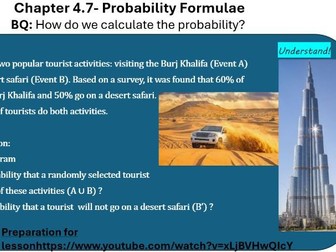
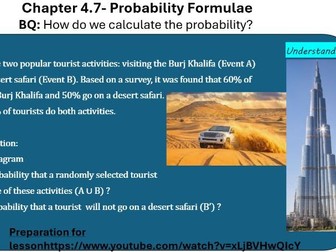
This lesson introduces the key probability formulae required for Edexcel A-Level Statistics, linking them to real-life applications such as weather forecasting, medical testing, quality control, insurance, and sports analytics. Students begin with a starter activity that revisits prior knowledge of probability and explores how probabilities are used to support decision-making in everyday situations. The lesson develops understanding of probability notation and the main formulae, including the complement rule, addition laws for mutually exclusive and non-mutually exclusive events, multiplication laws for independent events, and conditional probability. Visual representations such as Venn diagrams and probability trees are used to help students organise information, identify relationships between events, and select appropriate methods. Students then apply these formulae through progressively challenging practice questions and Edexcel-style examination problems, supported by fully worked solutions that model clear reasoning and effective exam technique. By the end of the lesson, students will be able to confidently choose and apply the correct probability formula in a range of statistical contexts and examination scenarios.
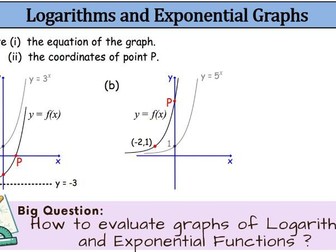
The graph has been translated, stretched, or reflected from the parent function. The asymptote moves according to the transformation, and the graph retains its characteristic exponential or logarithmic shape.
Trigonometry application questions based on angle of elevation and angle of depression with link to real life examples. Differentiated questions, treasure hunt activity, plenary and a lesson plan included.