

html, 3.52 KB
html, 3.52 KB
key, 13.57 MB
key, 13.57 MB
pptx, 15.2 MB
pptx, 15.2 MB
key, 20.04 MB
key, 20.04 MB
pptx, 22.44 MB
pptx, 22.44 MB
doc, 178 KB
doc, 178 KB
pdf, 161.34 KB
pdf, 161.34 KB

Fully editable P16.3 Planets, Satellites & Orbits lessons for AQA GCSE Physics (Triple & Combined Science).
Help students understand how gravity controls motion in space through clear PowerPoints, scaffolded worksheets, retrieval practice, and model answers—all written precisely to the AQA specification and ready to teach immediately.

Includes Free AI Long-Answer Marking, where students can submit extended-response answers online and receive instant, AQA-aligned feedback to improve structure, reasoning, and use of scientific terminology.

What’s Included:

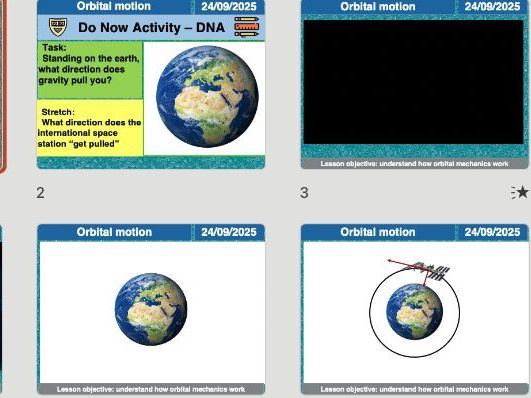
Editable PowerPoints with visuals, animations, and orbit simulations.

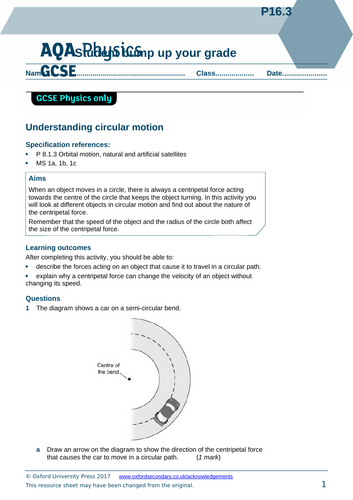
Printable & editable worksheets (Foundation → Higher tier).

Exam-style questions with mark schemes and model answers.

Retrieval starters, AfL checkpoints, and exit tickets for ongoing assessment.

Homework and revision quizzes (ready to print or upload).

Comprehensive answer keys for all activities.

Bonus: Free AI Long-Answer Marking – students receive instant feedback aligned with AQA marking standards.

Topics Covered (P16.3 Planets, Satellites & Orbits):

The difference between planets, moons, and artificial satellites.

The gravitational force that keeps objects in orbit.

Understanding orbital speed, radius, and period.

The inverse relationship between orbital radius and velocity.

Circular motion and centripetal force in gravitational systems.

Geostationary vs polar orbits and their real-world uses.

Applications: communications, GPS, and Earth observation.

Exam-style reasoning, data analysis, and calculation tasks.

Why Teachers Love This Resource:

No-prep, no-stress: ready to deliver immediately.

Curriculum-true: written precisely for AQA GCSE Physics (8463 & 8464).

Exam-success focus: strengthens reasoning, maths, and scientific explanation.

Differentiated: includes scaffolded and higher-tier challenge tasks.

Versatile: ideal for classroom lessons, homework, or revision.

Format:

PPTX slides | DOCX/PDF worksheets & assessments | Fully editable | Print-friendly

Spec & Tiers:
AQA GCSE Physics (8463) & AQA Combined Science Trilogy (8464)
Suitable for Foundation and Higher tiers (clearly signposted).

Get this resource as part of a bundle and save up to -7%

A bundle is a package of resources grouped together to teach a particular topic, or a series of lessons, in one place.

Bundle

AQA GCSE Physics P16 – Space Physics | Complete 5-Lesson Bundle, Worksheets, Assessments & Free AI Marking

Deliver the complete P16 Space Physics topic for AQA GCSE Physics (Triple Science) with this ready-to-teach, fully editable bundle. Each lesson is sequenced for clarity and packed with stunning visuals, scaffolded worksheets, retrieval practice, and model answers—giving students a strong grasp of the solar system, stellar evolution, and the expanding universe. Includes ✨ Free AI Long-Answer Marking via, where students can type in extended-response answers and receive instant, AQA-aligned feedback to improve reasoning, structure, and scientific communication. Lessons Included (P16 – Space Physics): P16.1 – Formation of the Solar System P16.2 – The Life History of a Star P16.3 – Planets, Satellites & Orbits P16.4 – Red-Shift & The Expanding Universe P16.5 – The Big Bang & Evidence for Expansion What’s Included: Editable PowerPoints (clear explanations, diagrams & timelines) Printable & editable worksheets (Foundation → Higher tier) Exam-style questions with mark schemes & model answers Retrieval starters, AfL checkpoints, and exit tickets Homework & revision quizzes (ready to print or upload) Comprehensive answer keys for every activity ✨ Bonus: Free AI Long-Answer Marking – students receive instant, detailed feedback aligned with AQA mark schemes Topics Covered (P16 Space Physics): Formation of the solar system from dust and gas clouds The life cycle of stars – nebula → main sequence → giant/supernova → white dwarf or black hole Gravity and orbital motion in planets, moons & satellites Orbital speed, radius & centripetal force relationships Red-shift & cosmic expansion Evidence for the Big Bang theory and ongoing expansion of the universe Real-world applications: communication satellites, telescopes & exoplanet discovery Why Teachers Love This Bundle: No-prep, no-stress: ready to teach immediately Curriculum-true: written precisely for AQA GCSE Physics (8463) Exam-success focus: builds conceptual understanding and reasoning Differentiated: includes scaffolded and higher-tier challenge tasks Visually engaging: stunning images and space diagrams enhance recall Format: PPTX slides | DOCX/PDF worksheets & assessments | Fully editable | Print-friendly Spec & Tiers: AQA GCSE Physics (8463 – Triple Science only) Suitable for Foundation and Higher tiers (clearly signposted)

£8.00

Reviews

Something went wrong, please try again later.

This resource hasn't been reviewed yet

To ensure quality for our reviews, only customers who have purchased this resource can review it

Report this resourceto let us know if it violates our terms and conditions.
Our customer service team will review your report and will be in touch.