


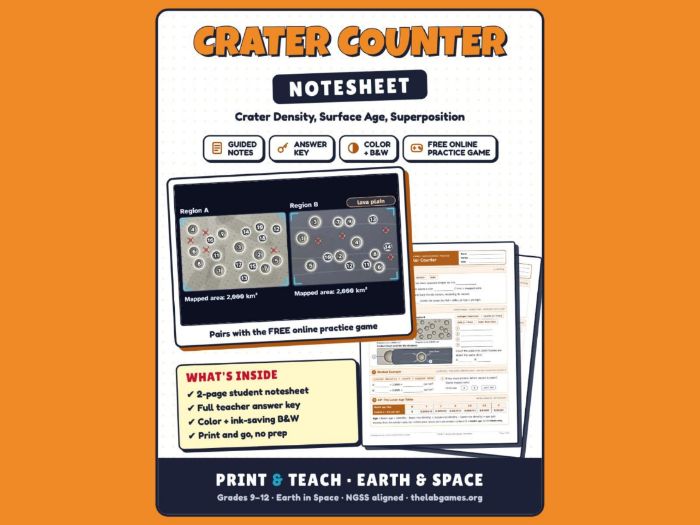
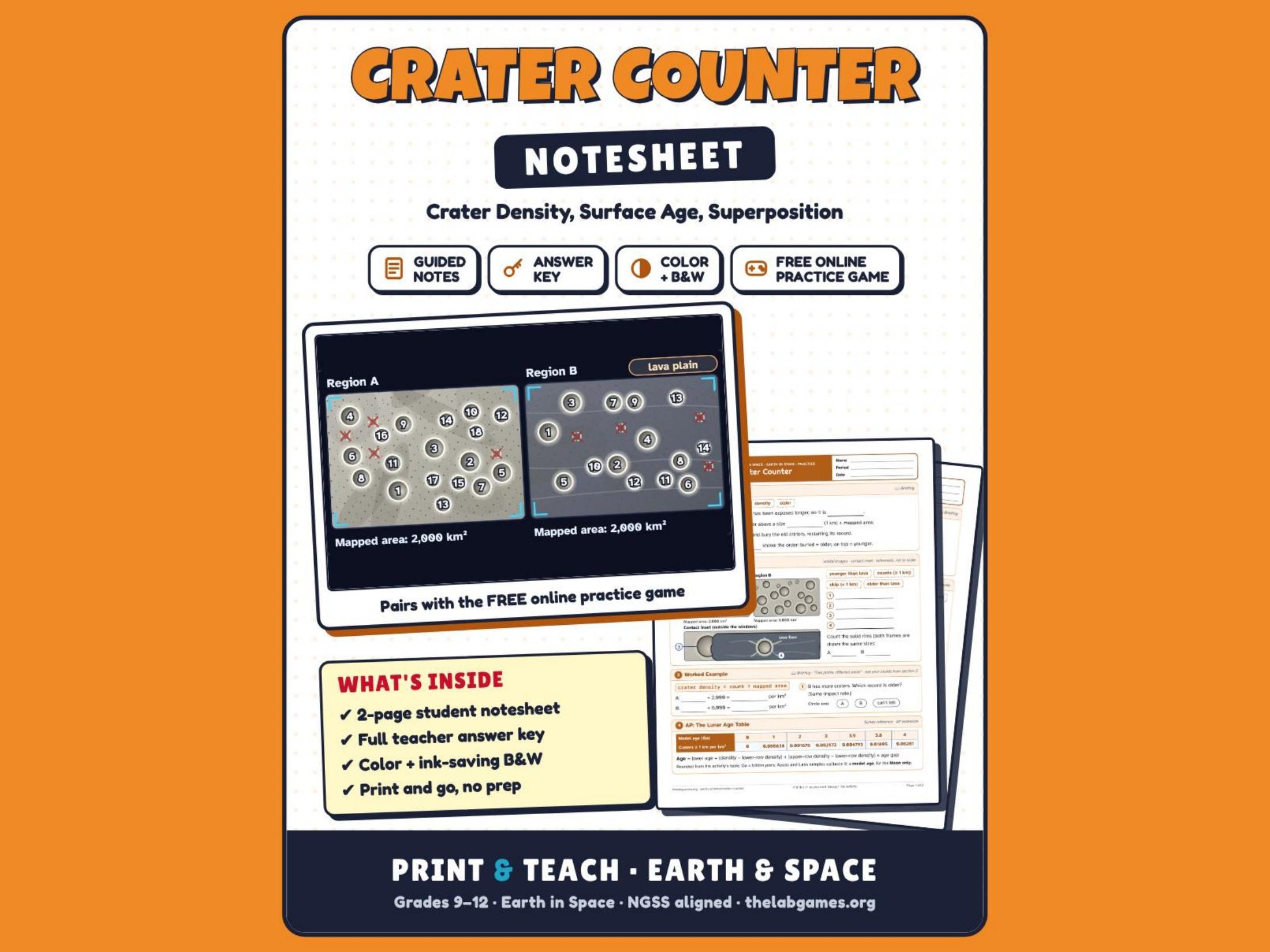
Teach students how scientists read the age of a planet’s surface from its craters. In this roomy, student-friendly 2-page notesheet, students fill in the background on crater density, size cutoffs, lava resurfacing and superposition, label a survey monitor of two orbital images and a lava contact (craters that count, craters to skip, a crater older than the lava and one younger), count the craters and work out which surface is older from crater density rather than raw counts. On page 2 they work four survey orders on the Moon and Mars: a density comparison, a lava-resurfaced plain, a contact to put in order, and an AP order that interpolates a lunar model age from a crater-density table.
It pairs with Crater Counter, a free online practice game at thelabgames.org where students count craters in orbital images of the Moon and Mars, compare crater densities and read lava contacts to date surfaces. Use it in class, for absent-student makeups, or on sub days. A complete teacher key is included.
What’s Included
- Student notesheet (2 pages) in full color AND black & white
- Teacher answer key (red answers) in full color AND black & white
What Students Do
- Background fill-in: older surfaces collect more craters, crater density, the size cutoff, lava resurfacing and superposition
- The Survey Monitor: label a counted crater, a skipped small crater, a crater buried by lava and a crater on top of the lava, then count the solid rims in two regions
- Worked Example: turn two counts into crater densities and decide which surface record is older
- AP Lunar Age Table: read a crater-density table calibrated by Apollo and Luna samples and its interpolation rule
- Survey Orders: compare two regions, judge a lava plain, order the events at a lava contact, and (AP) find a lunar model age
- Key Ideas: why more craters does not always mean older, and why the lunar table cannot date Mars
- My Runs: a log for tracking practice scores
Skills & Standards
- Impact craters, crater counting, crater density (craters per km²), completeness cutoff, relative surface age, lava resurfacing, lunar maria, superposition, Moon and Mars surfaces, lunar model ages and interpolation (AP)
- Supports NGSS HS-ESS1-6
- Grades 9–12 Earth and Space Science (with an AP extension order)
Great For
- Earth in Space and planetary science units
- Relative dating and geologic time lessons
- Absent-student makeups
- Sub plans
- Test review
Something went wrong, please try again later.
This resource hasn't been reviewed yet
To ensure quality for our reviews, only customers who have purchased this resource can review it
Report this resourceto let us know if it violates our terms and conditions.
Our customer service team will review your report and will be in touch.
$2.49