


This lesson follows the AQA Combined Science Trilogy specification (spec link: part of 6.3.1.1) or P6.1 in the Kerboodle book, but is also suitable for Separate Science GCSE Physics students.
What’s Included: (26 slides)
- Do now retrieval & thinking task – recap of SI units for mass and volume, and the equipment used to measure them
- Worked examples – step-by-step density calculations for both regular and irregular objects, including converting between units (kg/m³ and g/cm³)
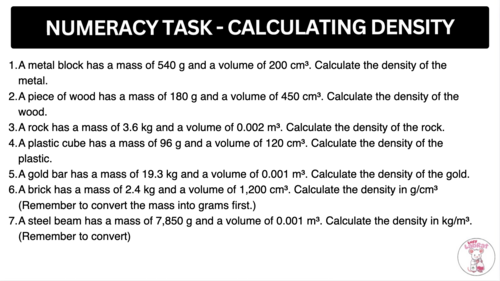
- Numeracy tasks – calculating density from mass and volume, then rearranging the equation to find mass or volume instead
- Sink or float theory – comparing an object’s density to water to predict whether it will sink, float, or suspend, with a mini whiteboard check
- Diagram-based numeracy check – calculating the density of labelled cuboids, with a sink/float extension task
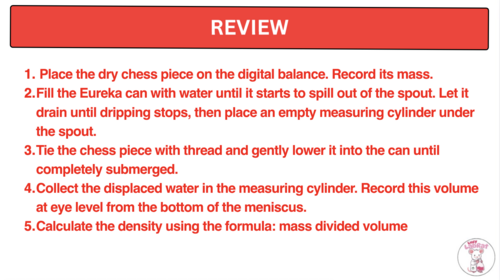
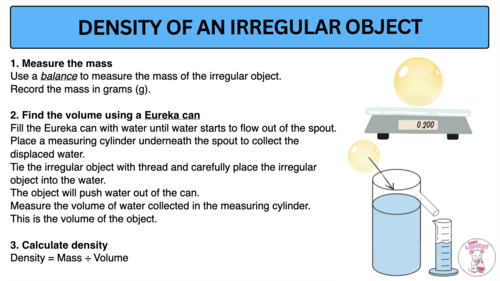
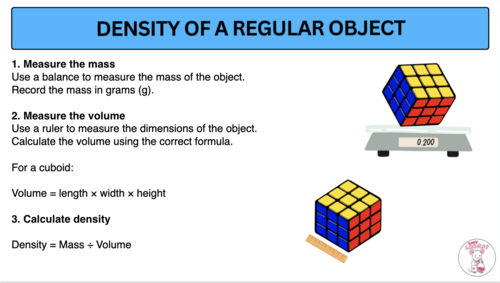
- Required practical methods – measuring the density of a regular object (ruler and balance) and an irregular object (displacement/Eureka can)
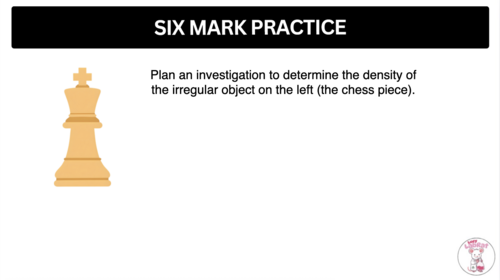
- Six mark practice – planning a full investigation to find the density of an irregular object (chess piece), with a model answer
- Common experimental errors – parallax error, taring the balance, and splashing/displacement mistakes
- Tiered practice questions – low, medium, and high demand exam-style questions, including anomalous result analysis
- Homework task – applying density to real-world contexts (steel ships), with mark allocations
Answer slides included for all structured questions and review tasks.
If you have any feedback, please contact: lucylabrat@gmail.com
HAPPY TEACHING!
Something went wrong, please try again later.
This resource hasn't been reviewed yet
To ensure quality for our reviews, only customers who have purchased this resource can review it
Report this resourceto let us know if it violates our terms and conditions.
Our customer service team will review your report and will be in touch.
£1.50