



43 Articles with questions
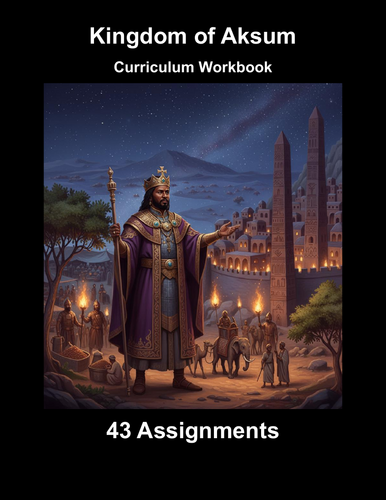
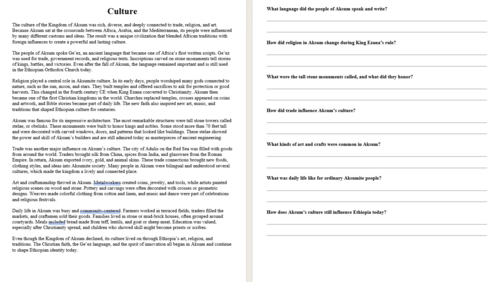
The Kingdom of Aksum Curriculum Workbook is a comprehensive learning resource designed to guide middle school students and learners with diverse needs through the fascinating history and culture of Aksum. This workbook contains informative articles, thought-provoking questions, and answer keys covering topics such as Geography, Government, Culture, Daily Life, Religion, Social Classes, Food & Agriculture, Education, Arts & Entertainment, Clothing, Technology & Science, Trade & Commerce, Military & Warfare, Literature, and the roles of men and women.
The historical timeline is explored in detail, from the founding of Aksum around 100 CE, the reigns of early kings like Gdrt and Endubis, and Aksum’s rise as a major Red Sea power, through the conversion of King Ezana to Christianity, the construction of stone churches and obelisks, King Kaleb’s military campaigns, and the eventual decline of the kingdom by the 9th century CE. Each section encourages critical thinking and comprehension, helping students understand Aksum’s enduring legacy in African and world history.
43 Assignments
Overview
Geography
Government
Culture
Daily Life
Religion
Social Classes
Food & Agriculture
Education
Arts & Entertainment
Clothing
Technology & Science
Trade & Commerce
Military & Warfare
Literature
Men’s Roles
Women’s Roles
Founding of Aksum (around 100 CE)
Rise of Early Aksumite Kings (100–200 CE)
King Gdrt (Gadarat) reigns (early 2nd century CE)
Trade with South Arabia (2nd century CE)
King Endubis begins coin minting (around 270 CE)
King Aphilas (around 290 CE)
Aksum becomes a major Red Sea power (3rd century CE)
King Ousanas (Ezana’s father) reigns (early 4th century CE)
Reign of King Ezana (c. 320–360 CE)
Ezana converts to Christianity (around 330 CE)
Saint Frumentius becomes first bishop of Aksum (330s CE)
Construction of stone churches and obelisks (4th century CE)
Control of Red Sea trade continues (4th–5th centuries CE)
Rise of King Kaleb (early 6th century CE)
Kaleb’s invasion of Himyar (around 525 CE)
Victory at the Battle of Zafar (525 CE)
Loss of control in Arabia (530s CE)
Trade routes shift to Persian control (6th century CE)
Arab expansion across the Red Sea (7th century CE)
Decline of coastal ports like Adulis (7th century CE)
Relocation of Aksumite capital (7th–8th centuries CE)
End of Aksumite coin minting (around 640 CE) – Marks the end of Aksum’s major trade economy.
Agricultural decline due to soil exhaustion (8th century CE).
Aksum fades as a political power (8th–9th centuries CE)
Rise of the Zagwe Dynasty (around 900 CE)
Legacy
Something went wrong, please try again later.
This resource hasn't been reviewed yet
To ensure quality for our reviews, only customers who have purchased this resource can review it
Report this resourceto let us know if it violates our terms and conditions.
Our customer service team will review your report and will be in touch.
$29.99