

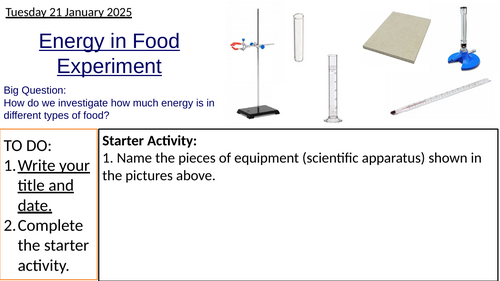

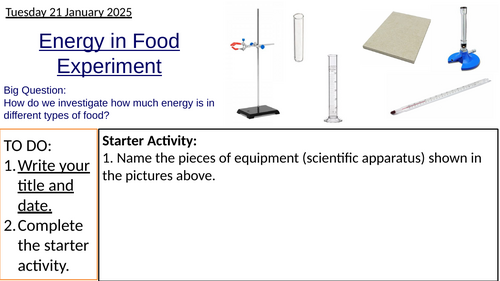
This PowerPoint resource provides an engaging middle school science lesson focusing on the investigation of energy content in different types of food. It offers a hands-on approach to understanding energy transfer, scientific methods, and the interpretation of experimental results.
Key learning objectives:
- Designing and conducting an experiment to measure the energy content of various foods by observing temperature changes in water.
- Understanding variables in scientific experiments: independent, dependent, and control.
- Interpreting data through bar graphs and drawing conclusions from experimental results.
Resource features:
The lesson begins with a thought-provoking starter activity to activate prior knowledge. Students identify scientific apparatus and answer preliminary questions about the experiment setup.
Core topics include:
Energy Measurement in Food:
Introduces the concept of burning food under a boiling tube containing water to measure the energy released, with the rise in water temperature serving as an indicator.
Experiment Setup and Safety:
Details the use of equipment such as a mounted needle, Bunsen burner, thermometer, and boiling tube, with an emphasis on safety procedures like using goggles and handling hot objects carefully.
Variables and Methodology:
Students identify variables:
Independent Variable: Type of food burned.
Dependent Variable: Temperature change in water.
Control Variables: Volume of water, starting water temperature, distance between food and boiling tube.
Step-by-step guidance is provided for writing a method using precise instructions and scientific language.
Interactive activities:
- Predicting which food will release the most energy and completing data tables during the experiment.
- Plotting temperature changes in bar graphs and answering questions about data trends.
- Reflecting on experimental limitations, such as incomplete burning of food or inconsistent starting water temperatures, and suggesting improvements like repeating trials and controlling variables.
The lesson concludes with an evaluation section where students summarize findings, address reliability concerns, and write a concise conclusion about which food had the highest energy content.
File details:
This editable ‘.pptx’ file aligns with middle school science curricula. Updated in January 2025, it features clear visuals, interactive tasks, and guided instructions, making it an essential resource for teaching experimental design and energy transfer concepts.
Something went wrong, please try again later.
This resource hasn't been reviewed yet
To ensure quality for our reviews, only customers who have purchased this resource can review it
Report this resourceto let us know if it violates our terms and conditions.
Our customer service team will review your report and will be in touch.
£2.00