


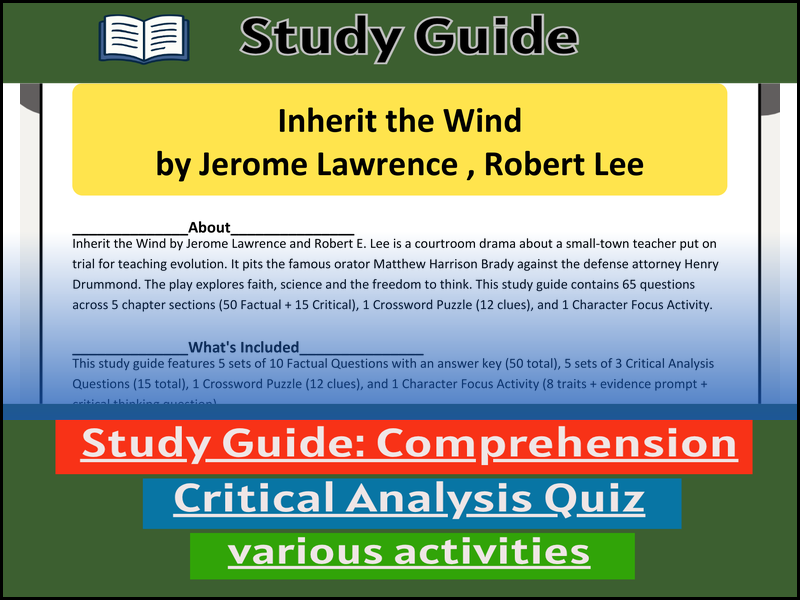

Inherit the Wind
by Jerome Lawrence , Robert Lee
About_
Inherit the Wind by Jerome Lawrence and Robert E. Lee is a courtroom drama about a small-town teacher put on
trial for teaching evolution. It pits the famous orator Matthew Harrison Brady against the defense attorney Henry
Drummond. The play explores faith, science and the freedom to think. This study guide contains 65 questions
across 5 chapter sections (50 Factual + 15 Critical), 1 Crossword Puzzle (12 clues), and 1 Character Focus Activity.
What’s Included_
This study guide features 5 sets of 10 Factual Questions with an answer key (50 total), 5 sets of 3 Critical Analysis
Questions (15 total), 1 Crossword Puzzle (12 clues), and 1 Character Focus Activity (8 traits + evidence prompt +
critical thinking question).
Target Grades_
Grades 9-11
Teacher Note_
This guide gives your students a clear path into a rich, challenging play, building comprehension with factual
questions before inviting deeper critical thinking. It encourages them to weigh evidence, question assumptions and
discuss big ideas respectfully. We hope it saves you valuable preparation time so you can focus on the lively
conversations this play inspires.
A Play Inspired by a Real Trial
Inherit the Wind is a play written by Jerome Lawrence and Robert E. Lee in the 1950s. It was inspired by the 1925 Scopes
“Monkey Trial” in Tennessee, in which a teacher was put on trial for teaching evolution. The authors changed the names and
details, setting the story in a fictional town called Hillsboro.
Science, Faith and Free Thought
The play explores a conflict between a literal reading of the Bible and the scientific theory of evolution proposed by Charles
Darwin. It also asks bigger questions about who gets to decide what ideas people may learn or say. Students should think
about the difference between belief, evidence and the freedom to question.
Reading a Courtroom Drama
Because the play unfolds mostly in a courtroom and a town square, much of the story is told through speeches, questions and
arguments. Pay attention to how characters use humor, emotion and persuasion. Stage directions also describe the crowd, the
heat and the setting, all of which shape the mood.
Something went wrong, please try again later.
This resource hasn't been reviewed yet
To ensure quality for our reviews, only customers who have purchased this resource can review it
Report this resourceto let us know if it violates our terms and conditions.
Our customer service team will review your report and will be in touch.
£2.90