


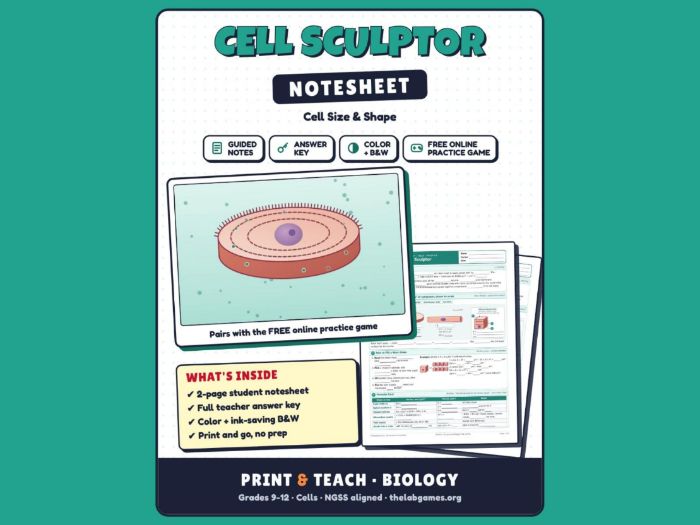
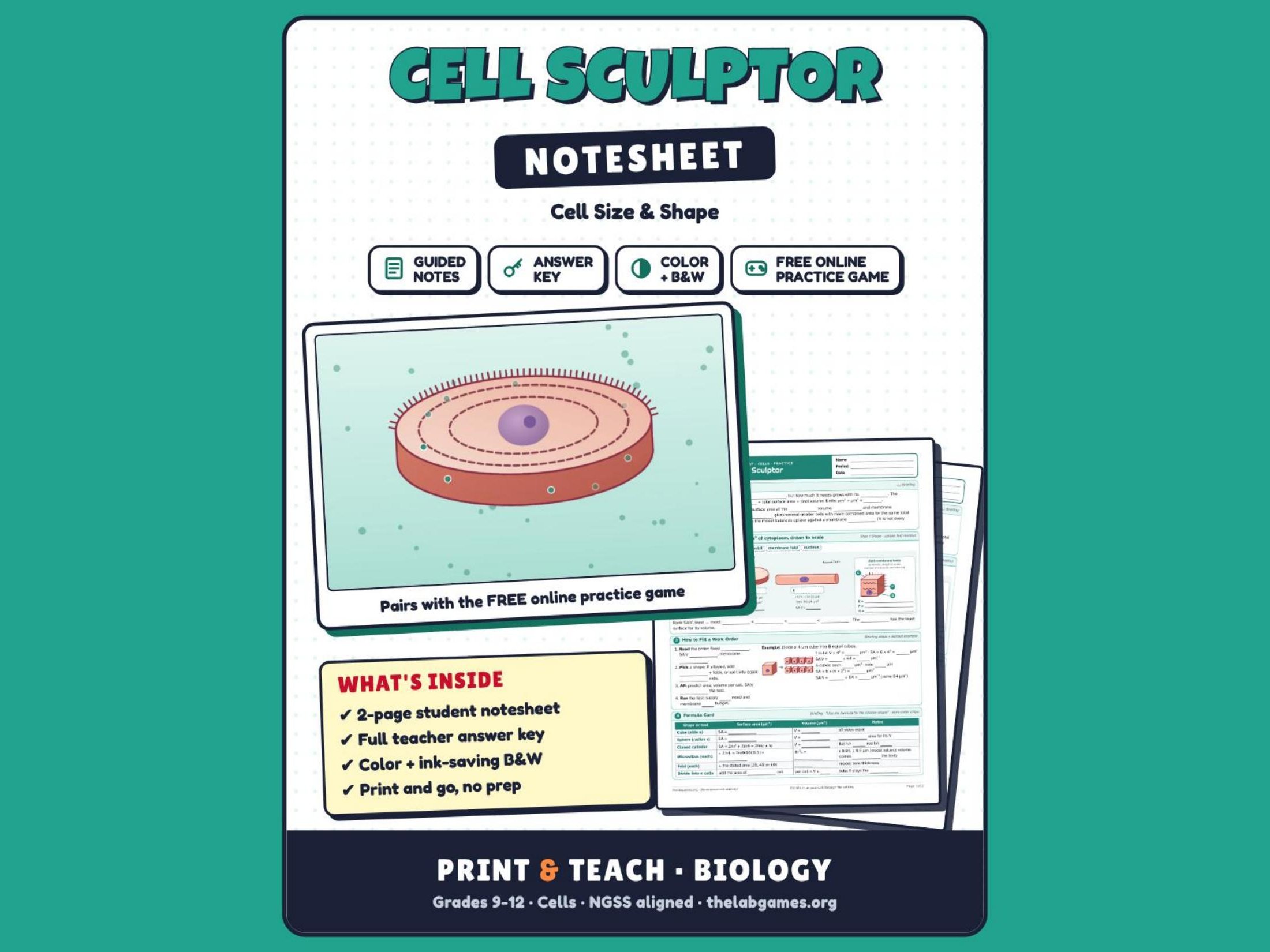
Students learn why cells stay small and how shape, microvilli, membrane folds and cell division change a cell’s surface-area-to-volume ratio (SA:V). They compare four model cells drawn to scale with the same 64 µm³ of cytoplasm (cube, sphere, flat disc and rod), finish a worked example where one 4 µm cube divides into eight 2 µm cubes and SA:V doubles, and complete a formula card for every shape and tool. Page 2 has real work orders from the game: pick the shape that meets the SA:V need without going over the membrane budget, divide cells, add microvilli and folds, and an AP section that predicts total area, volume per cell and SA:V with exact geometry.
It pairs with the free online Cell Sculptor practice game at thelabgames.org, where students design model cells for research clients and run an uptake test. Good for class, makeups and sub days.
What’s Included
- Student notesheet (2 pages) in full color AND black & white
- Teacher answer key (red answers) in full color AND black & white
What Students Do
- Complete fill-in background notes on surface area, volume, SA:V and its units (µm⁻¹)
- Name four to-scale model cells of equal volume, label microvilli, a membrane fold and the nucleus, find each SA:V and rank the shapes
- Finish the briefing’s steps and the 4 µm cube to eight 2 µm cubes worked example
- Complete a formula card: cube, sphere, closed cylinder, microvillus, fold and division
- Solve seven practice orders: choose a shape, check a cube by hand, stay under the membrane budget, divide into equal cells, choose how many cells, add microvilli and folds, and record the measured SA:V
- AP: predict total area, volume per cell and SA:V for divided cubes, divided spheres and a flat cell with microvilli
- Review common mistakes as fill-in key ideas and log their game runs
Skills & Standards
- Surface area to volume ratio, why cells are small, cell shape and structure-function
- Microvilli, membrane folds and cell division as ways to raise SA:V
- Surface area and volume of cubes, spheres and cylinders; units
- Supports NGSS HS-LS1-2
- AP Biology extension: exact predictions of area, volume per cell and SA:V
- Grades 9-12 Biology and AP Biology
Great For
- Guided notes alongside the online game
- Absent-student makeups
- Sub plans
- Cell structure unit review
- Math-in-science practice
Something went wrong, please try again later.
This resource hasn't been reviewed yet
To ensure quality for our reviews, only customers who have purchased this resource can review it
Report this resourceto let us know if it violates our terms and conditions.
Our customer service team will review your report and will be in touch.
$2.49