


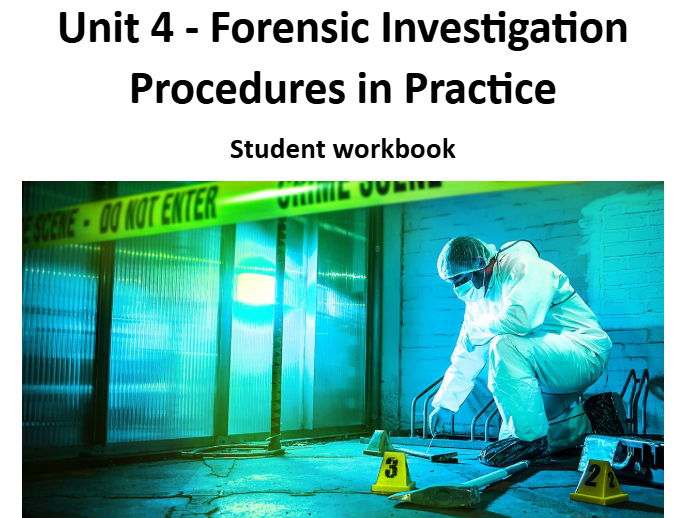
This resource description is designed for a TES (Times Educational Supplement) listing, highlighting the practical and immersive nature of the “Cracking the Case” handbook for forensic science education.
Resource Title: Cracking the Case: Forensic Investigation Student Workbook (BTEC Level 3 Unit 4)
Resource Description
Engage your students in a thrilling, hands-on forensic investigation with this comprehensive student workbook. This resource is meticulously designed to support Unit 4: Forensic Investigation Procedures in Practice. Students step into the shoes of a Forensic Science Unit (FSU) team to solve the mysterious disappearance and discovery of remains in a decommissioned college science laboratory.
The handbook provides a realistic narrative involving a missing student, Jordan Taylor, and three potential suspects with distinct motives and suspicious backgrounds. It guides learners through the entire investigative process, from initial scene management to advanced laboratory analysis.
Key Features & Activities:
- Immersive Crime Scene Narrative: Includes detailed background information, victim profiles, and retrospective police missing person reports to set the stage.
- Scene Management & Documentation: Practical templates for risk assessments (SOGRA), crime scene photography logs, and evidence packaging logs.
Biological Evidence Analysis: Step-by-step procedures for:
- Blood Grouping: Testing samples from the scene against suspects using Anti-A, Anti-B, and Anti-Rh serums.
- Presumptive Saliva Testing: Analyzing amylase presence on evidence.
- DNA Profiling: Using gel electrophoresis results to match hair and glove samples to suspects.
Trace & Physical Evidence:
- Fingerprint Analysis: Dusting, lifting, and analyzing minutiae (loops, whorls, arches).
- Forensic Anthropology: Estimating victim stature (height) using femur length measurements and mathematical formulas.
- Hair and Fibre Microscopy: Comparing scene samples against suspect references.
- Digital & Documentary Evidence: Analyzing suspect internet search histories (e.g., searches for “how to make someone drowsy”) and lab safety logs to identify intent and opportunity.
- Toxicology Lab: Performing presumptive tests (pH, solubility, Benedict’s) and confirmatory chromatography to identify unknown substances found in a syringe
Something went wrong, please try again later.
This resource hasn't been reviewed yet
To ensure quality for our reviews, only customers who have purchased this resource can review it
Report this resourceto let us know if it violates our terms and conditions.
Our customer service team will review your report and will be in touch.
£5.00