


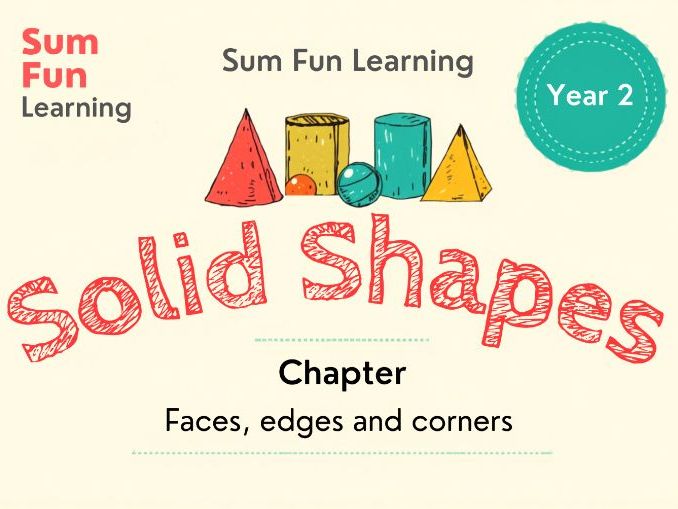
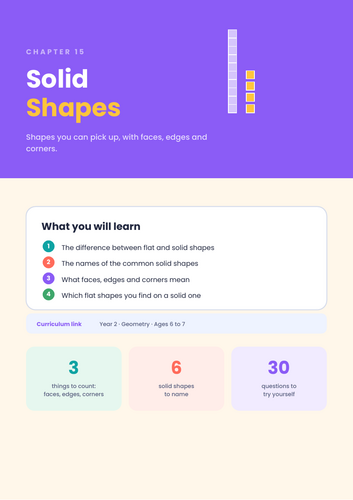
This chapter covers the difference between a flat shape and a solid one, the names of six solids (cube, cuboid, sphere, cylinder, cone and pyramid), what faces, edges and corners actually mean, and which flat shapes turn up on the faces of a solid. Each solid is tied to a real object a child will recognise: a dice, a cereal box, a ball, a tin, a party hat, a tent.
The central idea is hidden faces. A drawing of a cube shows three faces and hides three more, so children counting from a picture almost always answer 3 instead of 6. This is taught directly, with a page showing seen, hidden and total, and a strategy of turning a real object while touching each face.
Includes a worked explanation, a tips page on telling an edge from a face and a cube from a cuboid, common misconceptions addressed head on (counting only the visible faces, calling a cuboid a cube, mixing up a circle and a sphere, counting edges as corners), and 30 questions across three sections: warm up, getting stronger and challenge, moving from naming solids to worded reasoning problems.
Answers included, with a star chart for pupils to track progress and a confidence check-in at the end. A short note for the adult explains why a real box in the hand fixes the hidden-faces problem faster than any explanation.
Written by a qualified teacher with over ten years’ classroom experience, aligned to the UK National Curriculum for Year 2 geometry, properties of shapes (ages 6 to 7).
Supplied as a printable PDF. Suitable for whole-class teaching, small-group intervention, tutoring or home learning.
Something went wrong, please try again later.
This resource hasn't been reviewed yet
To ensure quality for our reviews, only customers who have purchased this resource can review it
Report this resourceto let us know if it violates our terms and conditions.
Our customer service team will review your report and will be in touch.
£1.00