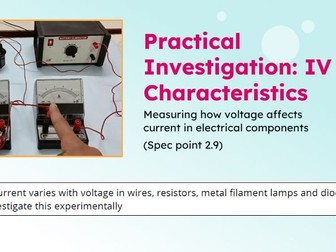
IGCSE Physics: Core Practical — IV Characteristics | Edexcel Modular | Unit 2 | L4Quick View
groggsy

IGCSE Physics: Core Practical — IV Characteristics | Edexcel Modular | Unit 2 | L4

(0)
IGCSE Physics: Core Practical — IV Characteristics | Edexcel Modular | Unit 2 | L4 This lesson covers spec point 2.9 — investigating how current varies with voltage for a fixed resistor, a filament lamp and a diode. PowerPoint includes: • Retrieval starter reviewing V = IR and circuit components from L3 • Direct Instruction (I Do) — IV graph shapes for resistor, lamp and diode explained and annotated; method modelled step by step; ammeter in series and voltmeter in parallel confirmed; reversing connections explained; safety precautions noted • Guided Practice (We Do) — identify the component from its IV graph shape; explain what the shape tells you about resistance; describe how the investigation should be carried out • Independent Practice (You Do) — students conduct the investigation, collect results for all three components, plot IV graphs and write conclusions • Review and Reflect — evaluation questions on accuracy, anomalies and improvements Practical Sheet includes: • Variables identification table (independent, dependent, control) • Circuit diagram drawing box • Step-by-step method box (student-completed) • Results tables for all three components • Three pre-scaled graph grids (resistor, lamp, diode) with axes labelled • Conclusion section with guided prompts per component • Evaluation questions on sources of error and improvements • Full mark scheme for teacher use
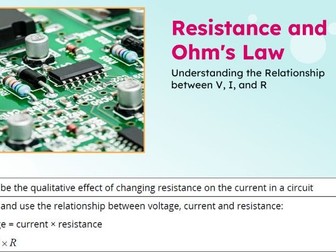
IGCSE Physics: Resistance and V = IR | Edexcel Modular | Unit 2 | L3Quick View
groggsy

IGCSE Physics: Resistance and V = IR | Edexcel Modular | Unit 2 | L3

(0)
IGCSE Physics: Resistance and V = IR | Edexcel Modular | Unit 2 | L3 This lesson covers spec points 2.10 and 2.13 — describing the qualitative effect of changing resistance on current in a circuit, and knowing and using V = IR to calculate voltage, current and resistance. PowerPoint includes: • Retrieval starter reviewing current and charge from L2 • Direct Instruction (I Do) — voltage defined as energy transferred per unit charge; resistance defined as opposition to current flow; V = IR introduced with all three rearrangements; worked examples calculating voltage, current and resistance; qualitative relationship between R and I explained at constant voltage • Guided Practice (We Do) — three calculations: find voltage; find current; find resistance; predict the qualitative effect on current of increasing resistance • Independent Practice (You Do) — V = IR calculations in real-world contexts; rearrangement tasks; explain and predict questions • Review and Reflect — 3 MCQs and exit ticket Activity Sheet includes: • Formula box: V = IR • 10 exam-style questions covering all three rearrangements, qualitative resistance questions and real-world contexts • Stretch question requiring multi-step reasoning linking resistance change to current and voltage consequences • Full mark scheme for teacher use
IGCSE Physics: Charge and Q = It | Edexcel Modular | Unit 2 | L2Quick View
groggsy

IGCSE Physics: Charge and Q = It | Edexcel Modular | Unit 2 | L2

(0)
IGCSE Physics: Charge and Q = It | Edexcel Modular | Unit 2 | L2 This lesson covers spec points 2.14, 2.15 and 2.16 — knowing that current is the rate of flow of charge, using Q = It to calculate charge, current and time, and understanding that current in a solid metal conductor is a flow of negatively charged electrons. PowerPoint includes: • Retrieval starter reviewing circuit symbols and current from L1 • Direct Instruction (I Do) — charge defined and linked to current; Q = It introduced in words and symbols; each variable defined with units; worked examples calculating charge, current and time; electron flow explained and distinguished from conventional current direction • Guided Practice (We Do) — three calculations: find charge from current and time; find current from charge and time; find time for a given charge to flow • Independent Practice (You Do) — Q = It calculations in real-world contexts; rearrangement tasks; explain why current in a metal wire is a flow of electrons, not protons • Review and Reflect — 3 MCQs and exit ticket Activity Sheet includes: • Formula box: Q = It • 10 exam-style questions covering charge calculations, all three rearrangements, and electron flow explanations • Stretch question combining Q = It with E = QV to find energy transferred • Full mark scheme for teacher use
IGCSE Physics: Mains Electricity and Plugs | Edexcel Modular | Unit 2 | L11Quick View
groggsy

IGCSE Physics: Mains Electricity and Plugs | Edexcel Modular | Unit 2 | L11

(0)
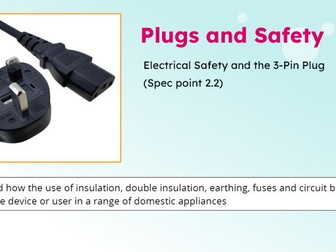
IGCSE Physics: Mains Electricity and Plugs | Edexcel Modular | Unit 2 | L11 This lesson covers spec point 2.2 — knowing the structure of a 3-pin plug including wire colours and roles, and describing insulation, double insulation and earthing as safety measures. PowerPoint includes: • Retrieval starter reviewing AC/DC and mains supply from L10 • Direct Instruction (I Do) — plug structure described; live (brown), neutral (blue) and earth (green/yellow) wires identified with roles; fuse in the live wire explained; earth wire protection mechanism modelled step by step; insulation and double insulation explained; plastic-cased appliances discussed • Guided Practice (We Do) — three tasks: name the wire colours and roles; explain the role of the earth wire; explain why a plastic-cased drill doesn’t need an earth wire • Independent Practice (You Do) — wire colour and role identification; earth wire and fuse protection explanations; double insulation questions • Review and Reflect — 3 MCQs and exit ticket Activity Sheet includes: • Wire table (colour, voltage, role) for students to complete — scaled to fit within the question box • 10 exam-style questions covering plug wiring, the earth/fuse protection sequence, insulation, double insulation and domestic hazards • Stretch question: swapped live and neutral wires — will the lamp work? why is it still dangerous? why does the fuse offer less protection? • Full mark scheme for teacher use
IGCSE Physics: AC and DC Electricity | Edexcel Modular | Unit 2 | L10Quick View
groggsy

IGCSE Physics: AC and DC Electricity | Edexcel Modular | Unit 2 | L10

(0)
IGCSE Physics: AC and DC Electricity | Edexcel Modular | Unit 2 | L10 This lesson covers spec point 2.6 — describing the difference between AC and DC, stating the voltage and frequency of the UK mains supply, and interpreting and sketching oscilloscope traces for both. PowerPoint includes: • Retrieval starter reviewing P = IV and energy from L9 • Direct Instruction (I Do) — DC defined (one direction, constant); AC defined (periodically reverses); UK mains values stated (230 V, 50 Hz); oscilloscope traces explained and annotated; DC trace = horizontal line; AC trace = sinusoidal wave; frequency defined qualitatively; why AC is used for the national grid introduced • Guided Practice (We Do) — identify AC or DC from a trace description; sketch the trace for a given source; state the UK mains values • Independent Practice (You Do) — AC/DC identification; trace sketching in books; comparison table; national grid justification • Review and Reflect — 3 MCQs and exit ticket Activity Sheet includes: • Comparison table for students to complete (direction, trace, source, frequency) for DC and AC • 10 exam-style questions covering definitions, UK mains values, trace interpretation, frequency and national grid application • Stretch question: oscilloscope settings, time base effect and comparing AC and DC traces from the same source • Full mark scheme for teacher use
IGCSE Physics: Power and Energy - P = IV and E = IVt | Edexcel Modular | Unit 2 | L9Quick View
groggsy

IGCSE Physics: Power and Energy - P = IV and E = IVt | Edexcel Modular | Unit 2 | L9

(0)
IGCSE Physics: Power and Energy - P = IV and E = IVt | Edexcel Modular | Unit 2 | L9 This lesson covers spec points 2.4 and 2.5 — knowing and using P = IV to calculate power, current and voltage, and using E = IVt to calculate energy transferred. PowerPoint includes: • Retrieval starter reviewing E = QV from L8 • Direct Instruction (I Do) — power defined as rate of energy transfer; unit watt defined (1 W = 1 J/s); P = IV introduced with all three rearrangements; E = IVt derived from P = IV and E = Pt; worked examples; kW conversion included; fuse selection using I = P/V modelled • Guided Practice (We Do) — three calculations: find power; find current; find energy transferred over a given time • Independent Practice (You Do) — P = IV and E = IVt in real-world contexts; kW conversion; fuse selection tasks; efficiency context • Review and Reflect — 3 MCQs and exit ticket Activity Sheet includes: • Formula box: P = IV; E = IVt • 10 exam-style questions covering all rearrangements of P = IV, E = IVt, kW conversion and fuse selection • Stretch question: motor efficiency — calculate power, current, useful energy output and explain wasted energy • Full mark scheme for teacher use
IGCSE Physics: Unit 2 - Electricity | Complete Unit Bundle | Edexcel ModularQuick View
groggsy

IGCSE Physics: Unit 2 - Electricity | Complete Unit Bundle | Edexcel Modular

(0)
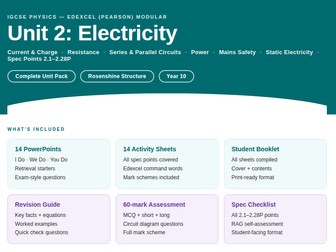
IGCSE Physics: Unit 2 — Electricity | Complete Unit Bundle | Edexcel Modular This is the complete resource bundle for Unit 2: Electricity of the Edexcel International GCSE Physics (Modular) specification. It covers all 14 lessons across spec points 2.1–2.28P and includes everything needed to teach, practise and assess the full unit. What’s included: 14 lesson PowerPoints — each built around the 60-minute DES Lesson Cycle (Smart Start retrieval → Direct Instruction → Guided Practice → Independent Practice → Review and Reflect). Every PowerPoint includes exam-style MCQs and an exit ticket. 14 activity sheets — exam-style independent practice questions with full mark schemes. Questions use Edexcel command words throughout. L4 is a full core practical investigation sheet with variables, method, results tables, graph grids, conclusion and evaluation. Physics-only lessons (L13–L14, spec points 2.22P–2.28P) are clearly labelled. Student Activity Booklet — all 14 activity sheets compiled into a single student-facing booklet, ready to print and issue as a unit workbook. Mark Scheme Booklet — all 14 mark schemes compiled for teacher use. Unit Assessment — 60-mark end-of-unit test covering the full spec in mixed MCQ and short/extended answer format, with full mark scheme. Includes circuit diagrams for Q12 (series) and Q13 (parallel), and a full investigation question (Q20) with circuit diagram drawing task, method question, results table, graph grid and resistance calculation from gradient. Revision Guide — 16-page topic-grouped revision resource covering all eight topic areas with key terms tables, equations, worked examples, examiner tips and practice questions with answers. Specification Checklist — student-facing RAG checklist covering every spec point from 2.1 to 2.28P. Lessons covered: L1 Circuit Symbols and Current (FREE) · L2 Charge and Q = It · L3 Resistance and V = IR · L4 Core Practical: IV Characteristics · L5 Thermistors and LDRs · L6 Series Circuits · L7 Parallel Circuits · L8 Energy in Circuits: E = QV · L9 Power and Energy · L10 AC and DC · L11 Mains Electricity and Plugs · L12 Fuses and Circuit Breakers · L13 Static Electricity · L14 Electrostatic Applications and Dangers Specification: Edexcel International GCSE Physics (Modular) — Unit 2, spec points 2.1–2.28P Year group: Year 10 Total marks in assessment: 60
IGCSE Physics: Electrostatic Applications and Dangers | Edexcel Modular | Unit 2 | L14 | Physics onlQuick View
groggsy

IGCSE Physics: Electrostatic Applications and Dangers | Edexcel Modular | Unit 2 | L14 | Physics onl

(0)
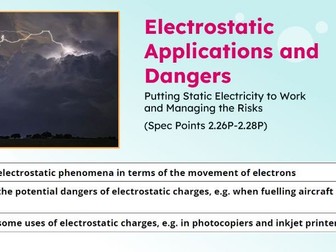
IGCSE Physics: Electrostatic Applications and Dangers | Edexcel Modular | Unit 2 | L14 | Physics only This lesson covers spec points 2.26P–2.28P — explaining the dangers of electrostatic charge during aircraft and tanker fuelling, and describing how static electricity is used in inkjet printers and photocopiers. Physics only. PowerPoint includes: • Retrieval starter reviewing charging and forces from L13 • Direct Instruction (I Do) — fuelling danger explained: friction → charge build-up → spark → explosion; bonding strap mechanism explained; inkjet printer: charging of droplets, deflection plates, steering to paper; photocopier: drum charged, light removes charge, toner attracted to charged areas, fused by heat • Guided Practice (We Do) — three tasks: explain why charge builds up during fuelling; explain how a bonding strap prevents a spark; describe how an inkjet printer prints a character • Independent Practice (You Do) — fuelling danger and prevention; inkjet and photocopier descriptions; compare the two applications • Review and Reflect — 3 MCQs and exit ticket Activity Sheet includes: • Physics only labelled in header and footer • 10 exam-style questions covering fuelling dangers, bonding straps, inkjet printer operation, photocopier operation and a comparison between the two • Stretch question: compare inkjet and photocopier use of static electricity; explain why controlled charge is essential; explain why aircraft fuelling is more dangerous than car fuelling • Full mark scheme for teacher use
IGCSE Physics: Static Electricity | Edexcel Modular | Unit 2 | L13 | Physics onlyQuick View
groggsy

IGCSE Physics: Static Electricity | Edexcel Modular | Unit 2 | L13 | Physics only

(0)
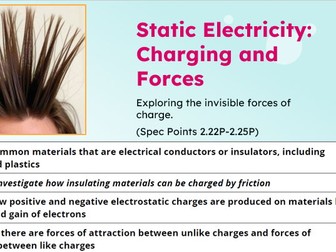
IGCSE Physics: Static Electricity | Edexcel Modular | Unit 2 | L13 | Physics only This lesson covers spec points 2.22P–2.25P — identifying conductors and insulators, describing charging by friction in terms of electron transfer, explaining how objects become positively or negatively charged, and describing the forces between charged objects. Physics only. PowerPoint includes: • Retrieval starter reviewing atomic structure and charge from prior learning • Direct Instruction (I Do) — conductors and insulators distinguished; charging by friction explained in terms of electron transfer; positive and negative charge produced by loss and gain of electrons; protons confirmed as fixed; like charges repel, unlike charges attract; charged objects attract neutral objects via induction; earthing explained • Guided Practice (We Do) — explain how a plastic rod becomes charged when rubbed; state the charge on the cloth; describe the force between two charged objects in given scenarios • Independent Practice (You Do) — charging explanations; charge identification from attraction/repulsion evidence; earthing questions • Review and Reflect — 3 MCQs and exit ticket Activity Sheet includes: • Physics only labelled in header and footer • 10 exam-style questions covering conductors/insulators, charging by friction, positive/negative charge, force descriptions and earthing • Stretch question: neon atom — normal charge, gains electrons, charge on two such atoms and the force between them • Full mark scheme for teacher use
IGCSE Physics: Fuses and Circuit Breakers | Edexcel Modular | Unit 2 | L12Quick View
groggsy

IGCSE Physics: Fuses and Circuit Breakers | Edexcel Modular | Unit 2 | L12

(0)
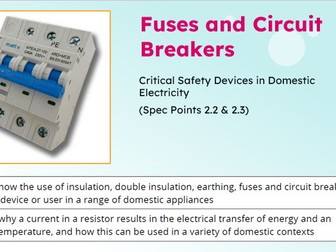
IGCSE Physics: Fuses and Circuit Breakers | Edexcel Modular | Unit 2 | L12 This lesson covers spec points 2.2 and 2.3 — explaining the heating effect of current, describing how fuses and circuit breakers work, and selecting appropriate fuse ratings using P = IV. PowerPoint includes: • Retrieval starter reviewing plug wiring and safety from L11 • Direct Instruction (I Do) — heating effect of current explained qualitatively; fuse mechanism described step by step; fuse selection using I = P/V modelled; circuit breaker mechanism described (electromagnet or bimetallic strip); advantages of circuit breakers over fuses; RCCB introduced as protecting against electric shock • Guided Practice (We Do) — three tasks: explain how a fuse works; select the correct fuse rating for a given appliance; state one advantage of a circuit breaker over a fuse • Independent Practice (You Do) — fuse mechanism; fuse selection calculations; circuit breaker vs fuse comparison; heating effect as hazard and safety feature • Review and Reflect — 3 MCQs and exit ticket Activity Sheet includes: • Formula box: P = IV • 10 exam-style questions covering the heating effect, fuse mechanism, fuse selection calculations, circuit breaker advantages and the RCCB • Stretch question: oven — calculate operating current, justify fuse rating, explain fault protection and suggest why modern homes use circuit breakers • Full mark scheme for teacher use
IGCSE Physics: Parallel Circuits | Edexcel Modular | Unit 2 | L7Quick View
groggsy

IGCSE Physics: Parallel Circuits | Edexcel Modular | Unit 2 | L7

(0)
IGCSE Physics: Parallel Circuits | Edexcel Modular | Unit 2 | L7 This lesson covers spec points 2.7, 2.17 and 2.18 — knowing that voltage is the same across each branch of a parallel circuit, that total current is the sum of branch currents, and explaining why parallel circuits are used for domestic lighting. PowerPoint includes: • Retrieval starter reviewing series circuit rules from L6 • Direct Instruction (I Do) — parallel circuit defined; voltage rule stated and explained; current rule stated: I_total = I₁ + I₂; current calculated for each branch using I = V/R; junction rule explained; domestic lighting application revisited and justified • Guided Practice (We Do) — three tasks: state voltage across each branch; calculate branch currents; find total current • Independent Practice (You Do) — parallel circuit calculations; explain why a broken branch doesn’t affect others; compare series and parallel • Review and Reflect — 3 MCQs and exit ticket Activity Sheet includes: • Formula box: V₁ = V₂ = V_supply; I_total = I₁ + I₂ • Circuit drawing tasks in Q5 and Q8, with vertical-resistor parallel circuit diagrams in the mark scheme • 10 exam-style questions covering voltage and current rules, branch calculations, domestic lighting and circuit comparison • Stretch question: three-branch parallel circuit — calculate all branch currents, total current, and justify that total resistance is less than the smallest branch resistance • Full mark scheme with circuit diagrams for teacher use
IGCSE Physics: Series Circuits | Edexcel Modular | Unit 2 | L6Quick View
groggsy

IGCSE Physics: Series Circuits | Edexcel Modular | Unit 2 | L6

(0)
IGCSE Physics: Series Circuits | Edexcel Modular | Unit 2 | L6 This lesson covers spec points 2.17 and 2.19 — knowing that current is the same at every point in a series circuit, and knowing how to calculate total voltage and total resistance for components in series. PowerPoint includes: • Retrieval starter reviewing V = IR and resistance from L3 • Direct Instruction (I Do) — series circuit defined; current rule stated and explained; voltage sharing rule explained with worked example; total resistance = R₁ + R₂; full worked example calculating total resistance, current and individual voltages; voltage check using conservation of energy • Guided Practice (We Do) — three calculations: find total resistance; find current; find voltage across individual components • Independent Practice (You Do) — series circuit calculations; predict effects of adding or removing components; explain what happens when a bulb breaks • Review and Reflect — 3 MCQs and exit ticket Activity Sheet includes: • Formula box: V = IR; V_total = V₁ + V₂; R_total = R₁ + R₂ • Circuit diagram drawing tasks in Q5 and Q8 (with mark scheme diagrams) • 10 exam-style questions with progressive difficulty covering all series circuit rules, calculations and multi-step problems • Stretch question: variable resistor controlling lamp brightness — calculate maximum and minimum current and voltage • Full mark scheme with circuit diagrams for teacher use
IGCSE Physics: Energy in Circuits - E = QV | Edexcel Modular | Unit 2 | L8Quick View
groggsy

IGCSE Physics: Energy in Circuits - E = QV | Edexcel Modular | Unit 2 | L8

(0)
IGCSE Physics: Energy in Circuits - E = QV | Edexcel Modular | Unit 2 | L8 This lesson covers spec points 2.20 and 2.21 — understanding that one volt is one joule per coulomb, and knowing and using E = QV to calculate energy, charge and voltage. PowerPoint includes: • Retrieval starter reviewing Q = It and parallel voltage from L7 • Direct Instruction (I Do) — the volt defined as J/C; E = QV introduced in words and symbols; all three rearrangements shown; worked examples calculating energy, charge and voltage; link to conservation of energy in series circuits • Guided Practice (We Do) — three calculations: find energy; find charge; find voltage; chain problem combining Q = It with E = QV • Independent Practice (You Do) — E = QV calculations; chain problems; explain the volt as J/C in context • Review and Reflect — 3 MCQs and exit ticket Activity Sheet includes: • Formula box: E = QV • 10 exam-style questions covering all three rearrangements, chain problems (Q = It then E = QV), and explain responses using the J/C definition • Stretch question: phone charger — find total charge, charging time and compare slow vs fast charger • Full mark scheme for teacher use
IGCSE Physics: Thermistors and LDRs | Edexcel Modular | Unit 2 | L5Quick View
groggsy

IGCSE Physics: Thermistors and LDRs | Edexcel Modular | Unit 2 | L5

(0)
IGCSE Physics: Thermistors and LDRs | Edexcel Modular | Unit 2 | L5 This lesson covers spec point 2.11 — describing how the resistance of a thermistor changes with temperature and how the resistance of an LDR changes with light intensity, and applying this understanding to circuit contexts. PowerPoint includes: • Retrieval starter reviewing V = IR and resistance from L3 • Direct Instruction (I Do) — thermistor defined; resistance–temperature relationship stated; LDR defined; resistance–light intensity relationship stated; both contrasted with metal wire behaviour; applications introduced (fire alarms, automatic lighting, temperature sensors) • Guided Practice (We Do) — state how resistance changes in given scenarios; explain what happens to the current in a series circuit containing a thermistor when temperature changes; identify a suitable component for a given application • Independent Practice (You Do) — thermistor and LDR application questions; explain responses using V = IR; suggest and justify component choices • Review and Reflect — 3 MCQs and exit ticket Activity Sheet includes: • Circuit diagram of thermistor, lamp and battery in series (for Q8) • 10 exam-style questions covering thermistor and LDR behaviour, applications and circuit calculations using V = IR • Stretch question: LDR in series with a fixed resistor — calculate current in bright and dim light and explain the effect on voltage sharing • Full mark scheme for teacher use
IGCSE Physics: Acceleration | Edexcel Modular | Unit 1 | L5Quick View
groggsy

IGCSE Physics: Acceleration | Edexcel Modular | Unit 1 | L5

(0)
IGCSE Physics: Acceleration | Edexcel Modular | Unit 1 | L5 This lesson covers spec point 1.6 — knowing and using the relationship between acceleration, change in velocity and time taken. PowerPoint includes: • Retrieval starter reviewing speed calculations and distance–time graphs • Direct Instruction (I Do) — acceleration defined as rate of change of velocity; a = (v − u) / t introduced in words and symbols; worked examples calculating acceleration, deceleration and time; negative acceleration explained as deceleration • Guided Practice (We Do) — three calculations: find acceleration from a change in velocity; find time taken to reach a given speed; determine whether an object is accelerating or decelerating from data • Independent Practice (You Do) — acceleration calculations from real-world contexts (cars, rockets, cyclists); rearrangement for u and t • Review and Reflect — 3 MCQs and exit ticket calculation Activity Sheet includes: • Formula box: a = (v − u) / t • 10 exam-style questions covering acceleration calculations, rearranging for u and t, and interpreting motion descriptions • Stretch question requiring multi-step reasoning combining the acceleration and speed equations • Full mark scheme for teacher use
IGCSE Physics: Scalars and Vectors | Edexcel Modular | Unit 1 | L2Quick View
groggsy

IGCSE Physics: Scalars and Vectors | Edexcel Modular | Unit 1 | L2

(0)
IGCSE Physics: Scalars and Vectors | Edexcel Modular | Unit 1 | L2 This lesson covers spec points 1.13 and 1.14 — understanding how vector quantities differ from scalar quantities, and understanding that force is a vector quantity. PowerPoint includes: • Retrieval starter reviewing speed calculations from L1 • Direct Instruction (I Do) — scalar quantities defined (magnitude only); vector quantities defined (magnitude and direction); key examples of each introduced; force confirmed as a vector; speed vs velocity distinction made; distance vs displacement explained • Guided Practice (We Do) — classify a list of quantities as scalar or vector; explain the difference between speed and velocity in context; identify how direction matters for forces • Independent Practice (You Do) — exam-style classification questions; explain why the direction of a force matters; real-world vector contexts • Review and Reflect and exit ticket classification task Activity Sheet includes: • 10 exam-style questions covering the scalar/vector distinction, examples, speed vs velocity, and distance vs displacement • Table task: classify quantities and give units for each • Stretch question requiring students to explain why two forces of equal magnitude can have different effects depending on direction • Full mark scheme for teacher use
IGCSE Physics: Velocity-Time Graphs | Edexcel Modular | Unit 1 | L6Quick View
groggsy

IGCSE Physics: Velocity-Time Graphs | Edexcel Modular | Unit 1 | L6

(0)
IGCSE Physics: Velocity-Time Graphs | Edexcel Modular | Unit 1 | L6 This lesson covers spec points 1.7, 1.8 and 1.9 — plotting and explaining velocity–time graphs, determining acceleration from the gradient, and calculating distance from the area under the graph. PowerPoint includes: • Retrieval starter reviewing acceleration calculations and DT graph interpretation • Direct Instruction (I Do) — VT graph features explained with annotated examples; gradient = acceleration; area under graph = distance travelled; positive gradient, negative gradient and horizontal line identified and explained; area calculations for triangles, rectangles and trapeziums • Guided Practice (We Do) — calculate acceleration from a VT graph gradient; calculate distance for a constant-velocity section; calculate total distance for a multi-section journey • Independent Practice (You Do) — multi-section VT graph analysis; gradient and area calculations; sketch a VT graph from a written description of motion • Misconception check: VT graph vs DT graph — common student confusion addressed • Review and Reflect — Exit ticket graph analysis Activity Sheet includes: • Formula box: a = Δv / t; distance = area under graph • Annotated multi-section VT graph for reference • 10 exam-style questions covering gradient, area (triangle, rectangle, trapezium), graph description and sketching • Stretch question requiring full analysis of a complex multi-section VT graph including acceleration, deceleration and total distance • Full mark scheme for teacher use
IGCSE Physics: Core Practical — Investigating Motion | Edexcel Modular | Unit 1 | L4Quick View
groggsy

IGCSE Physics: Core Practical — Investigating Motion | Edexcel Modular | Unit 1 | L4

(0)
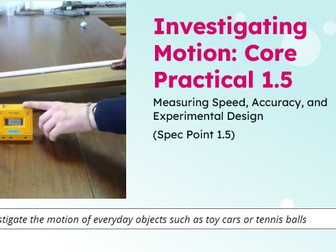
IGCSE Physics: Core Practical — Investigating Motion | Edexcel Modular | Unit 1 | L4 This lesson covers spec point 1.5 — investigating the motion of everyday objects such as toy cars or tennis balls. PowerPoint includes: • Retrieval starter reviewing DT graph features and speed calculations • Direct Instruction (I Do) — investigation method modelled step by step; equipment explained; ticker tape and light gate methods described; variables identified (distance, time); importance of repeat readings for reliability • Guided Practice (We Do) — worked example calculating speed from ticker tape dot spacing; identify anomalous results from a sample data set; plan how to improve reliability • Independent Practice (You Do) — students conduct the investigation, record results in the results table, calculate average speeds, and plot a distance–time graph from their data • Review and Reflect — evaluation questions on accuracy, anomalies and improvements Practical and Activity Sheet includes: • Results table with distance intervals, three time trials and mean time • Calculation section for average speed at each distance interval • Blank grid for plotting the distance–time graph with labelled axes • Evaluation questions covering repeat readings, sources of error and suggested improvements • Full mark scheme for teacher use
IGCSE Physics: Distance-Time Graphs | Edexcel Modular | Unit 1 | L3Quick View
groggsy

IGCSE Physics: Distance-Time Graphs | Edexcel Modular | Unit 1 | L3

(0)
IGCSE Physics: Distance-Time Graphs | Edexcel Modular | Unit 1 | L3 This lesson covers spec point 1.3 — plotting and explaining distance–time graphs. PowerPoint includes: • Retrieval starter reviewing the speed equation and scalar/vector distinction • Direct Instruction (I Do) — distance–time graph features explained with annotated examples; gradient = speed; horizontal line = stationary; steeper gradient = greater speed; how to calculate speed from gradient • Guided Practice (We Do) — describe the motion shown in a three-section DT graph; calculate speed from a given gradient; identify the fastest section and justify using gradient comparison • Independent Practice (You Do) — multi-section DT graph interpretation; sketch a DT graph from a written description of a journey; calculate average speed from graph data • Review and Reflect — 3 MCQs and exit ticket graph description Activity Sheet includes: • Labelled distance–time graph for interpretation questions • 10 exam-style questions covering graph description, gradient calculation, motion identification and graph sketching • Stretch question requiring students to compare two journeys on the same axes and explain the differences • Full mark scheme for teacher use
IGCSE Physics: v²=u²+2as | Edexcel Modular | Unit 1 | L7Quick View
groggsy

IGCSE Physics: v²=u²+2as | Edexcel Modular | Unit 1 | L7

(0)
IGCSE Physics: v²=u²+2as | Edexcel Modular | Unit 1 | L7 This lesson covers spec point 1.10 — using the relationship between final speed, initial speed, acceleration and distance moved. PowerPoint includes: • Retrieval starter reviewing acceleration calculations and VT graph area • Direct Instruction (I Do) — v² = u² + 2as introduced; each variable defined with units; equation linked to the area under a VT graph; worked examples calculating v, u, a and s with full substitution and rearrangement shown • Guided Practice (We Do) — three calculations: find final speed from rest over a known distance; find braking distance; find acceleration from initial and final speeds • Independent Practice (You Do) — real-world suvat problems including runway length, car braking distance and multi-step combinations with F = ma • Review and Reflect — 3 MCQs and exit ticket calculation Activity Sheet includes: • Formula box: v² = u² + 2as • 10 exam-style questions covering all four rearrangements and real-world contexts • Stretch question combining v² = u² + 2as with F = ma in a multi-step problem • Full mark scheme for teacher use
IGCSE Physics: Forces | Edexcel Modular | Unit 1 | L8Quick View
groggsy

IGCSE Physics: Forces | Edexcel Modular | Unit 1 | L8

(0)
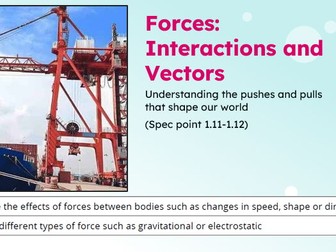
IGCSE Physics: Forces | Edexcel Modular | Unit 1 | L8 This lesson covers spec points 1.11, 1.12, 1.13 and 1.14 — describing the effects of forces between bodies, identifying types of force, and understanding the difference between scalars and vectors, including that force is a vector quantity. PowerPoint includes: • Retrieval starter reviewing scalars, vectors and speed calculations • Direct Instruction (I Do) — three effects of forces introduced (change in speed, direction, shape); contact vs non-contact forces distinguished; specific force types defined with examples (gravitational, electrostatic, magnetic, normal reaction, tension, friction); force confirmed as a vector • Guided Practice (We Do) — contact/non-contact classification table with blank version for students; identify force types from scenarios; draw labelled force diagrams for a book on a table, a moving car and a falling stone • Independent Practice (You Do) — force type identification; effects of forces questions; labelled force diagram tasks in real-world contexts • Review and Reflect — 3 MCQs and exit ticket Activity Sheet includes: • 10 exam-style questions covering effects of forces, force type identification and contact/non-contact classification • Force diagram drawing tasks for real-world objects • Stretch question requiring students to explain how a single force can produce more than one effect • Full mark scheme for teacher use