ArraysQuick View
nhastings1985

Arrays

(0)
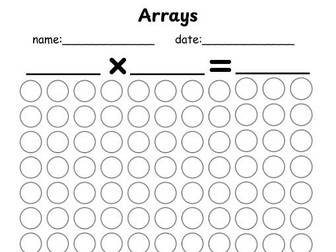
A flexible arrays worksheet that helps primary pupils explore multiplication by creating equal rows and columns, then recording the matching number sentence. This Arrays worksheet provides a simple, visual way for children to develop their understanding of multiplication through equal groups, rows and columns. The page features a large grid of blank circles that pupils can colour, shade or mark to create their own multiplication arrays. At the top of the worksheet, pupils are given spaces to record a multiplication calculation in the format ___ × ___ = ___. This allows children to connect the array they create with its corresponding multiplication number sentence, helping them move from a concrete or pictorial representation towards more abstract mathematical notation. The open-ended design makes the resource particularly versatile. Teachers can give pupils a specific multiplication fact to represent, ask children to create an array for a chosen number, or encourage them to investigate different ways of arranging the same total. The resource can be used to develop understanding of: Multiplication as equal groups Rows and columns in arrays Writing and interpreting multiplication number sentences Connecting pictorial representations to mathematical symbols Repeated addition Counting in equal steps Recognising and representing times-table facts Exploring how changing the number of rows or columns affects an array Developing multiplication fluency through visual models The worksheet can also support exploration of the commutative property of multiplication. For example, pupils could create an array with 3 rows of 4 and then consider how 4 rows of 3 represents the same total, helping them recognise the relationship between related multiplication facts. Because the circles are left blank, the sheet can be adapted easily for different levels of challenge. Younger pupils might colour small arrays and count the total objects, while more confident learners could represent larger multiplication facts, write repeated-addition calculations or compare different arrays with the same product. The clear black-and-white layout makes it suitable for whole-class maths lessons, independent work, maths interventions, times-table practice, assessment, homework or continuous provision. Spaces for pupils’ name and date make it easy to use as a standalone classroom activity. Ideal for KS1 and lower KS2, particularly when introducing multiplication or reinforcing the relationship between equal groups, arrays and multiplication calculations.
Number Bonds to Multiples of 10Quick View
nhastings1985

Number Bonds to Multiples of 10

(0)
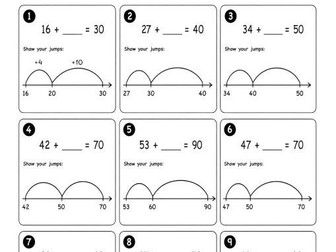
A number bonds worksheet that helps primary pupils find missing addends to multiples of 10 using number lines and a clear bridging-to-10 strategy. This Number Bonds to Multiples of 10 worksheet provides focused practice in finding the missing number in addition calculations, with pupils working towards multiples of 10 such as 30, 40, 50, 60, 70, 80, 90 and 100. The worksheet contains 12 questions, presented in a clear and consistent format. Each calculation asks children to find the missing addend, for example 16 + ___ = 30, 27 + ___ = 40 and 74 + ___ = 100. A key feature of the resource is its use of number lines and jumps. The first question models the strategy by showing a jump from 16 to 20 (+4) followed by a jump from 20 to 30 (+10). Pupils can then use the same approach for the remaining questions, first bridging to the nearest multiple of 10 and then jumping to the target number. This visual method helps children break larger number bonds into manageable steps, strengthening their understanding of place value, addition and complements. It also encourages pupils to see how known number facts can be used efficiently when calculating mentally. The worksheet is particularly useful for developing: Number bonds and addition fluency Finding missing numbers in equations Bridging through multiples of 10 Using a number line to represent calculations Mental addition strategies Understanding the relationship between the starting number, missing addend and total Confidence working with numbers up to 100 The questions gradually provide practice with different starting numbers and totals while maintaining the same visual structure, allowing pupils to concentrate on mastering the calculation strategy rather than learning a new question format each time. The simple black-and-white layout makes the resource suitable for classroom worksheets, maths interventions, independent practice, homework, morning work or revision. Dedicated spaces for pupils’ name and date also make completed sheets easy to organise and assess. Ideal for KS1 and lower KS2, particularly pupils who are learning to bridge through tens when adding or who benefit from a visual number-line representation before moving towards more abstract mental calculation.
Water Investigation PlanQuick View
nhastings1985

Water Investigation Plan

(0)
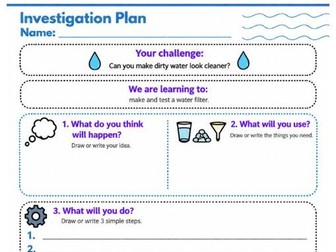
A colourful water filtration investigation worksheet that helps primary pupils plan, carry out and evaluate an experiment to make dirty water cleaner. This Water Investigation Plan provides a simple, child-friendly framework for exploring water filtration through a practical science investigation. Pupils are given the challenge: “Can you make dirty water look cleaner?” and are encouraged to design, make and test their own water filter. The resource guides children through the investigation step by step. Pupils can: Make a prediction about what they think will happen, using words or drawings. Choose and record equipment and materials needed to make their water filter. Plan a simple method by drawing or writing three steps. Design and label their water filter, showing how different materials will be arranged. Observe and compare results, deciding whether the water looked clearer before or after filtering. Record observations about what they noticed during the investigation. Evaluate their design, choosing whether their filter worked really well, a little bit or not yet. The combination of large drawing spaces, short questions, simple instructions, visual prompts and tick boxes makes the worksheet accessible to younger learners and pupils who may find extended writing challenging. Children can demonstrate their scientific thinking through both drawing and writing. This resource is particularly useful for teaching working scientifically, including making predictions, planning an investigation, observing changes, recording results and evaluating outcomes. It can also support discussions about materials, filtering, clean water and how water treatment works. Ideal for KS1 and lower KS2 science lessons, STEM activities, practical investigation days, small-group work or home learning. It could also be used alongside a teacher demonstration before pupils construct filters using materials such as gravel, sand, cotton wool or filter paper. Safety note: The activity demonstrates filtration and changes in the appearance of dirty water. Filtered water produced during a classroom investigation should not be drunk, as looking clear does not mean that the water is safe to consume.
Place Value HTOQuick View
nhastings1985

Place Value HTO

(0)
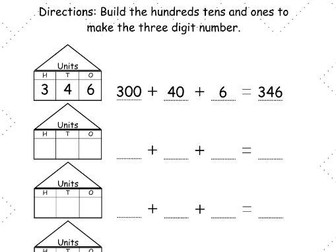
A place value worksheet that helps primary pupils partition three-digit numbers into hundreds, tens and ones using a clear visual representation. This Hundreds, Tens and Ones worksheet supports children in understanding the place value of digits within three-digit numbers. Pupils use the house-style H, T and O grids to build a number before partitioning it into hundreds, tens and ones. A worked example shows 346 = 300 + 40 + 6, clearly modelling how each digit represents a different value. The resource is ideal for developing place value, partitioning, expanded form and three-digit number recognition. The repeated structure provides plenty of space for pupils to create their own examples or complete numbers chosen by the teacher. Suitable for KS1 and lower KS2 maths lessons, independent practice, interventions, homework or assessment, particularly when introducing or reinforcing hundreds, tens and ones.
Repeated AdditionQuick View
nhastings1985

Repeated Addition

(0)
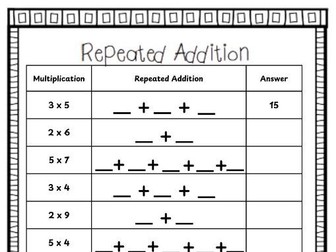
A repeated addition worksheet that helps primary pupils understand multiplication as equal groups and connect times-table facts with addition sentences. This Repeated Addition worksheet supports children in developing a clear understanding of the relationship between multiplication and repeated addition. Pupils are given multiplication calculations, including facts from the 2, 3 and 5 times tables, and complete the corresponding repeated-addition sentence before finding the answer. The first example, 3 × 5 = 15, provides a useful model before children complete the remaining questions independently. The structured table helps pupils connect three representations: multiplication, repeated addition and the final product. This resource is useful for developing multiplication fluency, equal-group understanding, repeated addition and times-table confidence. Its clear black-and-white format makes it suitable for KS1 and lower KS2 maths lessons, independent practice, interventions, homework or assessment.
Tessellation ArtQuick View
nhastings1985

Tessellation Art

(0)
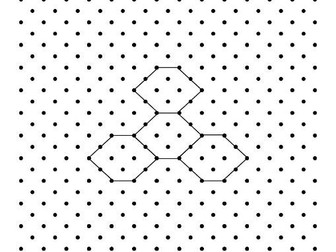
A tessellation art resource that helps primary pupils explore repeating geometric patterns by extending shapes across an isometric dot grid. This Tessellation Art resource provides four dot-grid templates featuring starter patterns made from different geometric shapes, including hexagonal forms, quadrilaterals, rectangles and triangles. Pupils can continue each design across the page to create their own repeating tessellation. The activity supports learning about 2D shapes, pattern, symmetry, spatial reasoning and tessellation, while also encouraging creativity and accurate use of lines and geometric forms. Ideal for KS1 and KS2 maths, geometry lessons, art and maths cross-curricular activities, early finisher tasks or independent challenges.
Place Value Worksheets | Hundreds Tens and OnesQuick View
nhastings1985

Place Value Worksheets | Hundreds Tens and Ones

(0)
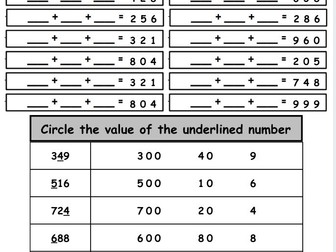
These engaging place value worksheets help children develop confidence with hundreds, tens and ones through partitioning numbers and identifying the value of underlined digits. The activities support understanding of 3-digit numbers using clear visual layouts and scaffolded practise questions. Included are: partitioning 3-digit numbers into hundreds, tens and ones place value matching activities identifying the value of underlined digits scaffolded independent practise questions visual H, T and O support throughout Perfect for First Level / KS1-2 / Year 2-3 maths lessons, numeracy groups, homework, interventions, early finisher tasks, or revision activities. Skills covered: place value partitioning numbers recognising hundreds, tens and ones reading and writing numbers number sense mental maths strategies This printable maths resource is ideal for classroom use, maths rotations, support for learners developing confidence with place value, and reinforcing understanding of 3-digit numbers in an engaging and accessible way.
Rounding to the Nearest 100 WorksheetsQuick View
nhastings1985

Rounding to the Nearest 100 Worksheets

(0)
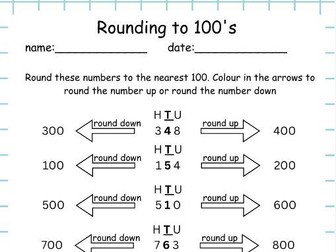
These engaging rounding worksheets help children practise rounding 3-digit numbers to the nearest 100 using visual prompts and place value understanding. Pupils decide whether to round the number up or down by identifying the nearest hundreds. Included are: scaffolded rounding to 100 activities visual arrow prompts for rounding up and down place value support using H, T and U independent practise questions opportunities for children to explain their thinking Perfect for First Level / KS2 / Year 3 maths lessons, numeracy groups, homework, interventions, early finisher tasks, or revision activities. Skills covered: rounding numbers place value recognising hundreds, tens and units estimating mental maths strategies comparing numbers This printable maths resource is ideal for classroom use, maths rotations, support for learners developing confidence with place value, and reinforcing rounding strategies in an engaging and accessible way.
Partitioning 2 Digit Numbers Addition WorksheetsQuick View
nhastings1985

Partitioning 2 Digit Numbers Addition Worksheets

(0)
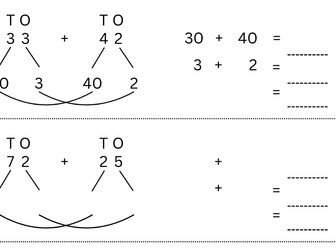
These differentiated partitioning worksheets help children practise adding 2-digit numbers by separating tens and ones before combining the totals. The resource supports early addition strategies and number understanding through clear visual partitioning models. Included are: scaffolded partitioning addition questions visual tens and ones layout independent practise calculations opportunities for whiteboard practise differentiated challenge sections Perfect for First Level / KS1 / Year 1-2 maths lessons, numeracy groups, homework, interventions, early finisher tasks, or revision activities. Skills covered: partitioning numbers place value adding tens and ones mental maths strategies number bonds two digit addition This printable maths resource is ideal for classroom use, maths rotations, support for struggling learners, and developing confidence with addition strategies.
Area of Rectangles Worksheets | Length x BreadthQuick View
nhastings1985

Area of Rectangles Worksheets | Length x Breadth

(0)
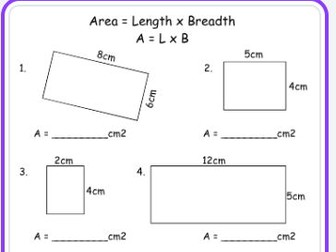
These area worksheets help children practise calculating the area of rectangles using the formula length × breadth. Pupils measure and multiply side lengths to find the area in square centimetres. Included are: scaffolded area questions clear examples using length × breadth rectangles in different orientations independent practise activities opportunities to apply multiplication skills in maths contexts Perfect for First Level / KS2 / Year 3-4 maths lessons, numeracy groups, homework, interventions, early finisher tasks, or revision activities. Skills covered: calculating area multiplication strategies measuring in centimetres understanding square centimetres applying mathematical formulae problem solving This printable maths resource is ideal for classroom use, maths rotations, support for learners developing confidence with measurement, and reinforcing understanding of area in an engaging and accessible way.