


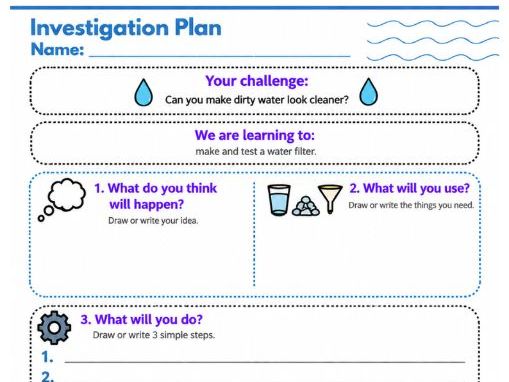
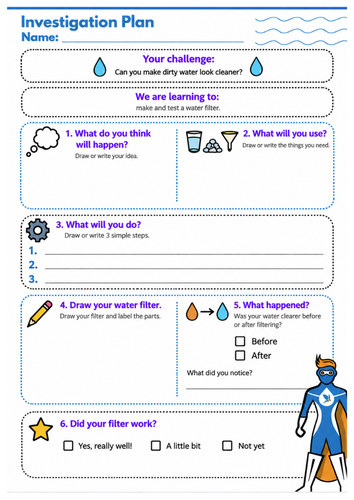
A colourful water filtration investigation worksheet that helps primary pupils plan, carry out and evaluate an experiment to make dirty water cleaner.
This Water Investigation Plan provides a simple, child-friendly framework for exploring water filtration through a practical science investigation. Pupils are given the challenge: “Can you make dirty water look cleaner?” and are encouraged to design, make and test their own water filter.
The resource guides children through the investigation step by step. Pupils can:
Make a prediction about what they think will happen, using words or drawings.
Choose and record equipment and materials needed to make their water filter.
Plan a simple method by drawing or writing three steps.
Design and label their water filter, showing how different materials will be arranged.
Observe and compare results, deciding whether the water looked clearer before or after filtering.
Record observations about what they noticed during the investigation.
Evaluate their design, choosing whether their filter worked really well, a little bit or not yet.
The combination of large drawing spaces, short questions, simple instructions, visual prompts and tick boxes makes the worksheet accessible to younger learners and pupils who may find extended writing challenging. Children can demonstrate their scientific thinking through both drawing and writing.
This resource is particularly useful for teaching working scientifically, including making predictions, planning an investigation, observing changes, recording results and evaluating outcomes. It can also support discussions about materials, filtering, clean water and how water treatment works.
Ideal for KS1 and lower KS2 science lessons, STEM activities, practical investigation days, small-group work or home learning. It could also be used alongside a teacher demonstration before pupils construct filters using materials such as gravel, sand, cotton wool or filter paper.
Safety note: The activity demonstrates filtration and changes in the appearance of dirty water. Filtered water produced during a classroom investigation should not be drunk, as looking clear does not mean that the water is safe to consume.
Something went wrong, please try again later.
This resource hasn't been reviewed yet
To ensure quality for our reviews, only customers who have purchased this resource can review it
Report this resourceto let us know if it violates our terms and conditions.
Our customer service team will review your report and will be in touch.
£1.50