Arrays
Subject: Mathematics
Age range: 5-7
Resource type: Worksheet/Activity


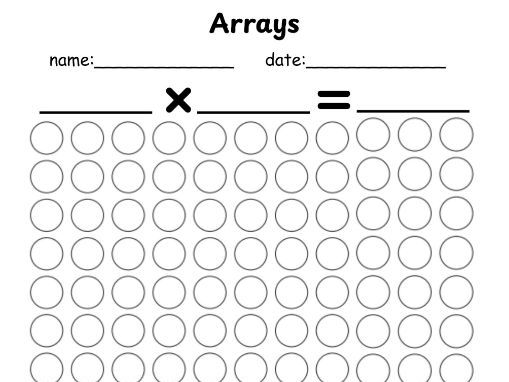

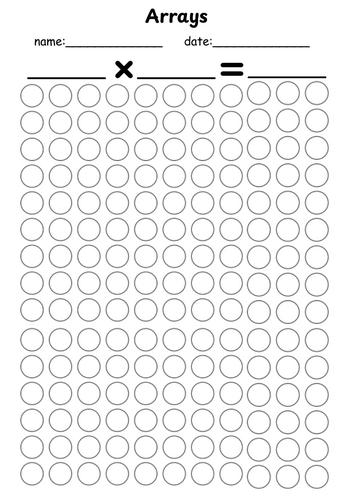
A flexible arrays worksheet that helps primary pupils explore multiplication by creating equal rows and columns, then recording the matching number sentence.
This Arrays worksheet provides a simple, visual way for children to develop their understanding of multiplication through equal groups, rows and columns. The page features a large grid of blank circles that pupils can colour, shade or mark to create their own multiplication arrays.
At the top of the worksheet, pupils are given spaces to record a multiplication calculation in the format ___ × ___ = ___. This allows children to connect the array they create with its corresponding multiplication number sentence, helping them move from a concrete or pictorial representation towards more abstract mathematical notation.
The open-ended design makes the resource particularly versatile. Teachers can give pupils a specific multiplication fact to represent, ask children to create an array for a chosen number, or encourage them to investigate different ways of arranging the same total.
The resource can be used to develop understanding of:
Multiplication as equal groups
Rows and columns in arrays
Writing and interpreting multiplication number sentences
Connecting pictorial representations to mathematical symbols
Repeated addition
Counting in equal steps
Recognising and representing times-table facts
Exploring how changing the number of rows or columns affects an array
Developing multiplication fluency through visual models
The worksheet can also support exploration of the commutative property of multiplication. For example, pupils could create an array with 3 rows of 4 and then consider how 4 rows of 3 represents the same total, helping them recognise the relationship between related multiplication facts.
Because the circles are left blank, the sheet can be adapted easily for different levels of challenge. Younger pupils might colour small arrays and count the total objects, while more confident learners could represent larger multiplication facts, write repeated-addition calculations or compare different arrays with the same product.
The clear black-and-white layout makes it suitable for whole-class maths lessons, independent work, maths interventions, times-table practice, assessment, homework or continuous provision. Spaces for pupils’ name and date make it easy to use as a standalone classroom activity.
Ideal for KS1 and lower KS2, particularly when introducing multiplication or reinforcing the relationship between equal groups, arrays and multiplication calculations.
Something went wrong, please try again later.
This resource hasn't been reviewed yet
To ensure quality for our reviews, only customers who have purchased this resource can review it
Report this resourceto let us know if it violates our terms and conditions.
Our customer service team will review your report and will be in touch.