 Quick View
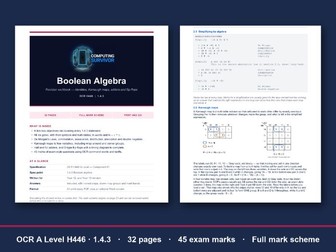
OCR A Level Boolean Algebra Workbook H446
A print-and-go OCR A Level workbook for H446 1.4.3 Boolean algebra: gates, laws, Karnaugh maps, adders and flip-flops, with a full mark scheme.
This workbook takes students from the six gates to a four-variable Karnaugh map and a D-type timing diagram, in OCR’s own notation, with every answer written out.
What’s inside (32 pages, PDF and editable Word)
A core knowledge recap:
all six gates with their symbols and truth tables, in words and in OCR’s ∧ ∨ ¬ ⊻ notation, with ≡ for equivalence and T/F truth tables read as 1/0
defining a problem in Boolean logic: a brief written in words turned into an expression, with a worked example
a table of laws with De Morgan’s proved by truth table, and three worked simplifications with every law named
Karnaugh maps in Gray code up to four variables, built from a truth table, with a wrap-around group drawn in and corner groups explained; four-variable maps are set both ways round, including OCR’s AB-across-the-top layout
half and full adders with the circuit and the equations
D-type flip-flops: the symbol with its edge-trigger triangle, the rising edge, and how they make a register
23 tick-box objectives covering every 1.4.3 statement, and a confidence tracker to finish.
25 key terms to write from memory, and 19 retrieval questions.
Seven application tasks in 18 parts:
a three-input truth table and a logic diagram to read
simplifications by algebra
a three-variable Karnaugh map to build from its truth table and group
a four-variable Karnaugh map that needs a corner group and a wrap-around
a design problem written up as an expression
a full adder truth table to complete
a clock, D and Q timing diagram to draw
45 marks of exam-style questions, including a banded 9-mark extended response on circuit design.
The mark scheme (pages 23 to 32)
Every answer is written out with its specification reference. Simplifications name each law at each step, the four-variable Karnaugh map groups and the timing diagram are drawn in, and the 9-marker has mark bands and indicative content. The answers come after everything a student writes on, so they lift out as whole sheets before you hand the workbook to a class. Any accepted notation is credited: words, ∧ ∨ ¬, or . + and overbar.
How teachers use it
As the unit’s revision booklet in Year 12, or as a Year 13 refresher before the Component 01 paper.
As homework in sections: recap, then key terms, retrieval, application and exam questions. Suggested times are printed for every section after the recap.
As a cover lesson for any section except Karnaugh maps, which need a lesson of their own: the recap is complete enough to work from alone.
Made by a practising computing teacher. The simplifications, Karnaugh map groupings and adder tables were checked exhaustively against their truth tables. A review helps other teachers find it.