


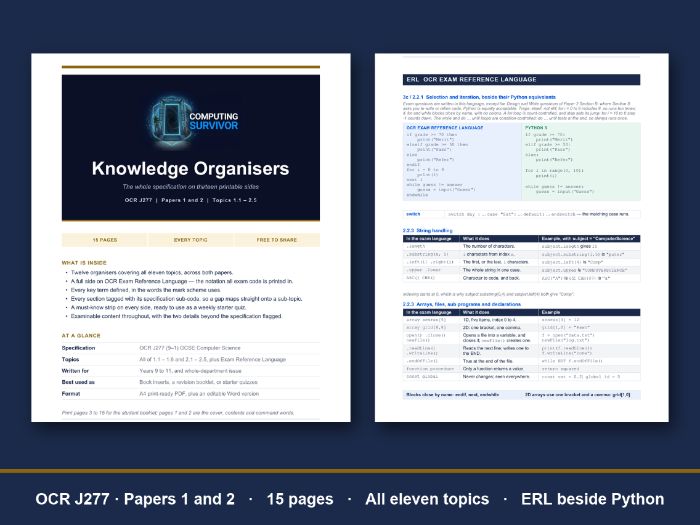

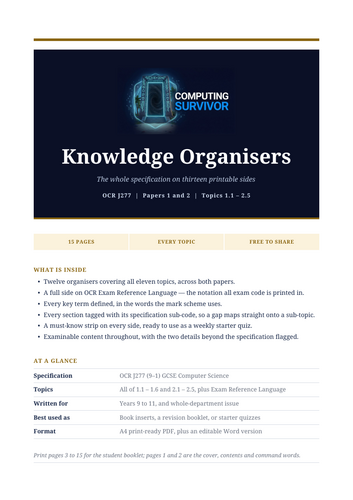
Knowledge organisers for the whole OCR J277 GCSE Computer Science spec: twelve A4 sides covering all eleven topics, plus a side on Exam Reference Language.
Memory and storage, and Networks, get two sides each, and Systems software shares one with Impacts. Each organiser fits on one side for the front of an exercise book, and the whole course prints as a thirteen-side revision booklet.
What’s inside (15 pages, PDF and editable Word)
- Twelve topic organisers covering 1.1 to 1.6 and 2.1 to 2.5, including 1.2.5 compression. Every section heading carries its specification sub-code, so a gap found in a book scrutiny maps straight onto the sub-topic to reteach.
- A full side on OCR Exam Reference Language, the notation exam questions are written in. Selection and iteration are set side by side with Python, followed by tables for string handling, arrays, files, sub programs, switch/case, ASC() and CHR(), const and global.
- A must-know strip on every organiser: two facts, one minute, ready to use as a weekly starter quiz.
- A command-word table with what each word asks for and its typical tariff.
- Worked examples where the marks are: denary to binary to hexadecimal, binary shifts, an image file-size calculation, a trace table, and a two-gate circuit with its full truth table. Linear and binary search are compared side by side.
- Diagrams: the six OCR flowchart symbols, the AND, OR and NOT gate symbols, and a worked logic circuit.
Checked against the specification
Everything is examinable J277 content. The two details that go beyond the specification (one register detail and a “how it works” column on storage) are flagged where they sit, so nobody revises something they will never be asked. Test data follows OCR’s own definitions: boundary data is on the very edge of being valid, and the values just outside it are invalid.
How teachers use it
- Look, cover, write, check: cover the right-hand column, write the definition, uncover and correct in a different colour.
- Book inserts: stick one side in the front of an exercise book at the start of each topic.
- Revision booklet: print pages 3 to 15 for Year 11 before mocks.
- Starters: read the must-know strip aloud and have the class write both facts from memory.
Specification coverage
Paper 1 (J277/01): systems architecture, memory and storage, data representation and compression, networks and protocols, network security, systems software, and ethical, legal, cultural and environmental impacts.
Paper 2 (J277/02): algorithms, programming fundamentals, producing robust programs, Boolean logic, and languages and IDEs.
Made by a practising computing teacher and written for Years 9 to 11. If it saves you an evening, a review helps other teachers find it.
Something went wrong, please try again later.
This resource hasn't been reviewed yet
To ensure quality for our reviews, only customers who have downloaded this resource can review it
Report this resourceto let us know if it violates our terms and conditions.
Our customer service team will review your report and will be in touch.
£0.00