

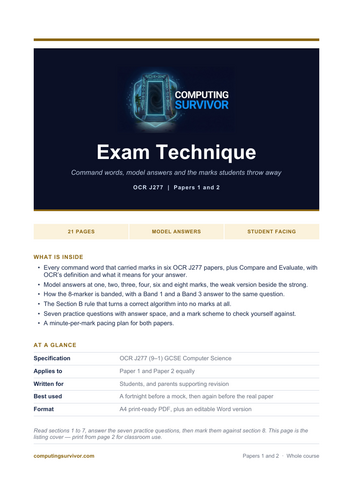

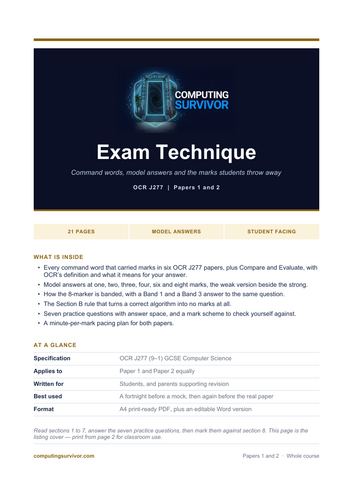
A J277 exam technique handbook: what each OCR command word wants, seven model answers with weak beside strong, and how the 8-marker is banded.
Most lost marks in J277 are not lost on content. They go on answering the topic instead of the question, one point on a four-mark question, “it is faster” with no subject, and prose where Section B wanted code. This handbook teaches the shape of the answer, using OCR’s own definitions and real J277 questions.
What’s inside (21 pages, PDF and editable Word)
- Command words, with OCR’s definitions: 21 of the 29 in OCR’s J277 list. That is every word that carried marks in six OCR J277 question papers, plus Compare and Evaluate. Each has OCR’s own definition, what it looks like in an answer box and, where it appeared, the range of marks it carried.
- Seven model answers, weak beside strong: a 1-mark State, 2-mark Describe, 3-mark Explain, 3-mark Calculate, 4-mark Describe, 6-mark Write (in OCR Exam Reference Language and in Python), and an 8-mark Discuss at Band 1 and at Band 3. The commentary says exactly where each mark is won or lost.
- The 8-mark question: the band descriptors in OCR’s wording with a plain-English gloss, a step-by-step method and a planning grid.
- Paper 2, Section B: the rule that turns a correct algorithm written in English into no marks, what counts as Exam Reference Language, and how Design, Write, Test and Refine questions differ.
- The marks students throw away every year: a table of the commonest mistakes, what each costs and what to do instead, drawn from OCR’s examiners’ reports.
- A worked trace table and a minute-by-minute pacing plan for 90 minutes.
- Seven practice questions (27 marks) with answer space, a mark scheme to check against, and a score table that points to what to revise next.
Where it comes from
The tariffs and examples come from genuine OCR material only: the J277/01 specimen, the 2020 practice papers for both components, the 2023 J277/02 practice paper, the June 2024 papers for both components, OCR’s mark schemes, and the 2022 to 2025 examiners’ reports. OCR’s command-word definitions are quoted from the specification.
Who it’s for
Written for students, and for parents supporting revision. Teachers use it as a Year 11 exam-technique unit, a fortnight before mocks and again before the real papers. It works just as well on the board: put the weak and strong answers side by side and ask the class where the marks are.
Made by a practising computing teacher. If it helps your Year 11s, a review helps other teachers find it.
Something went wrong, please try again later.
This resource hasn't been reviewed yet
To ensure quality for our reviews, only customers who have downloaded this resource can review it
Report this resourceto let us know if it violates our terms and conditions.
Our customer service team will review your report and will be in touch.
£0.00