Peppered moth caterpillars avoid detection by adopting a twig-like posture, remaining motionless during daylight.
Here are photographs showing larvae resting on hawthorn twigs. Students record the angle of rest and then determine if the angles of rest are similar.
This investigation and exercises deal with stimulus and response, innate and learned behaviour and their influences on survival, natural selection, anti-predator strategies. The exercises also prove useful in teaching research techniques e.g. Hypothesis testing, use of statistical tests, data representation and analysis.
This resource has been designed with year 5 and 6 pupils in mind and covers these lesson objectives:
*to understand why dogs bite
*to realise the importance of human interactions with dogs
*to realise dogs usually become aggressive to defend themselves and their possessions
*to understand that there is a graded ladder, or sequence, of aggression for both dogs and humans
*to understand that dog bites can be avoided
Written by Kendal Shepherd and adapted for classroom use by Jean Archer.
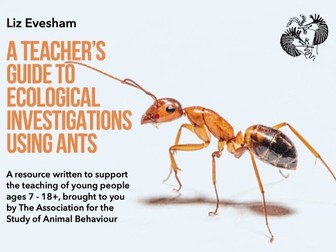
This resource requires students to calculate a test statistic from the following three tests; chi-square, Spearman rank correlation and standard error and 95% confidence limits. Designed to give students the opportunity to select the appropriate statistical test to apply to a certain set of data. Students collect data by observing film footage of the ants’ behaviour then analyse the data using the chi-square test and interpret the outcome in relation to their test statistic. There are notes with information on leaf-cutting ants and suggested answers for all tasks. Written by Richard Bottrill.
This practical teacher guide helps students develop key scientific enquiry and data-analysis skills through a range of engaging investigative activities. Students will have opportunities to follow instructions, design and carry out investigations, collect and present data, interpret results, evaluate the reliability and limitations of evidence, and consider ethical issues involved in the use of animals in scientific investigations.
The resource includes support for a range of commonly used statistical and ecological techniques, including Pearson’s Product Moment Correlation Coefficient - r, Spearman’s Rank Correlation Coefficient, the unpaired Student’s t-test, the Chi-squared test, the Lincoln Index, Percentage Frequency calculations, and Simpson’s Index of Diversity.
Ideal for developing Working Scientifically skills, this resource supports practical investigation, data handling, statistical analysis and evidence-based scientific thinking.
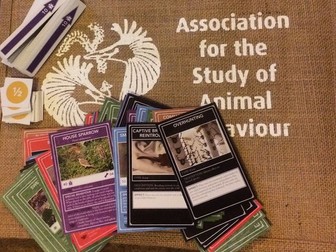
Eco-Divo is an educational card game you can play in two ways. Learn about ecosystems and biodiversity. Explore the fascinating natural history of organisms in the United Kingdom. Discover species interactions, human impacts and diversity while competing or collaborating in building a fascinating food web. Classify diverse species within their groups. Look out for special animal behaviours that will add a twist to the show. This game can be played with or without a teacher and with family and friends.
Will you unfold an intricate food relationship or destroy the ecosystem?
This game it suited to A level students and Higher Level GCSE students. Instructions for the game are found within the pack of cards. Also included is a starter or plenary activity worksheet with answers.
Acknowledgements: Created by Cedric Tan, Ada Grabowska, David Pigot and Alison Poole, University of Oxford
Visual designs by Celeste Tan. Many thanks to Cedric Tan for developing this game on behalf of ASAB and to Amy Hong, Kiyono Sekii, Jennifer Spencer and Kim Jacobsen for their suggestions on improving the preliminary version of the game.
Produced by The Manchester Museum for AS/A2 students of Psychology and is focused on human fears of animals. Human fear/phobia of objects or situations is a topic on the AS/A2 specifications of the examination boards and our resource specifically targets those of Edexcel and the Welsh Board as the Bennet-Levy and Marteau study (1984) is one of the key studies students need to be familiar with. The resource suggests a suitable practical investigation for AS/A2 students to carry out on human fears of animals. Written by Michael Dockery.
'Showing off&' outlines aposematism and batesian mimicary. Different modes of communication used by animals are described, as well as, aspects of learning. An experiment using chicks shows that at least one aspect of aposematic signals has evolved to aid learning. The resource has four differentiated worksheets: two are suitable for foundation students and the other two for higher students. This is an ASAB Education resource by Dr. Nicola Marples, Mick Hoult and Dr. Michael Dockery.
This is the latest Association for the Study of Animal Behaviour resource. The pdf contains lesson plans, background information, and materials to make it easy. Using role play students learn about baboon social structure, observation techniques in the field, paternity testing using DNA profiles, as well as, stress related disease using blood cortisol concentrations. Written by Paul Weeks.
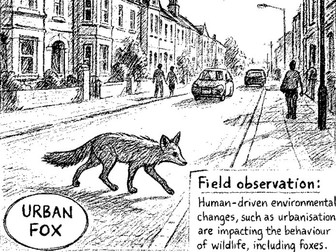
Stories, key environmental messages and activities, including the use of trail cameras, are all found this this brilliant booklet produced by The British Carnivore Project.
Urban tails explores urban wildlife, particularly foxes, through the conversations and experiences of two young characters, Alice and Jack, while promoting environmental awareness and conservation.
Several themes are covered: Urban wildlife and their natural behaviours, human interactions and the importance of coexistence, the impacts of feeding wildlife, coexistence strategies for urban living, and our connections with wildlife as the seasons change.
The script like stories and eco-challenges make this an ideal resource for a science club, cross curricular event or environmentally themed days.
The British Carnivore Project is a nationwide programme that centres around research, education, and knowledge exchange. Thier goal is to understand the impact of environmental changes, such as climate and urbanisation, on the behaviour and cognition of wild carnivores in the UK, and how this, in turn, shapes people’s relationship with these animals and nature more broadly.
Their primary study species include red foxes (Vulpes vulpes) and European badgers (Meles meles) from over 300 urban and rural locations throughout England, Scotland and Wales, and pine martens (Martes martes) throughout the Scottish Highlands.
An animal behaviour investigation for years 5 and 6 - `Do moth caterpillars move in a straight line when
they seek a refuge?`
This resource includes the necessary background information, lesson plan and video of the results. Young people can collect data from the video link and process the results in order to answer the question above.
Written by Michael Dockery and Tor Yip.
A Key Stage Three Scheme of Work using animal behaviour, hamsters, maggots, barnacles, baboons, cuckoos and students, to teach practical skills, data analysis, adaptation, habitats, learning, conditioning, natural selection, DNA profiling and field work. A set of seven lessons , this resource has been written by Paul Weeks (Oxford High School) for The Association for the Study of Animal Behaviour.
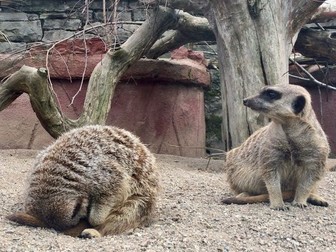
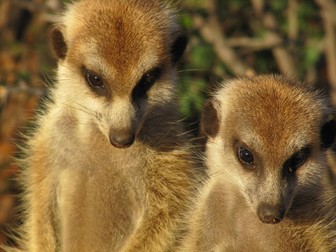
This resource provides educators with a comprehensive teaching pack to enable them to conduct behavioural observations in the classroom with students, through the medium of meerkat. The resource is designed to run as a complete programme of study for A-level students / further education students or higher education students with limited prior experience of studying animal behaviour. The activities start at a basic level and progressively get more advanced, using various statistical techniques to analyse the the collected data.
An activity for GCSE pupils to illustrate the flow of energy through trophic levels using live locusts. This is a practical where students follow the change in mass of animals over time, and then compare it to the mass of food they are given.
Locusts make superb study animals for a wide range of topics at A-level. Living locusts can be used for a variety of respiration experiments whilst dissecting locusts is a fascinating way of illustrating an invertebrate gas exchange mechanism. It is less obvious, however, how locusts could be used at KS4. This resource introduces a new way of incorporating a display of live locusts into a GCSE topic: the flow of energy through trophic levels. This resource provides direct experimental and observational evidence of the inefficiency of energy transfer. Locusts are ideal animals for this protocol as they are easy to keep, grow very rapidly (hoppers become adults in only 3 weeks) and their food is either free (grass) or cheap (lettuce).
This series of lesson plans are designed to enable pupils (primarily KS1, but with the potential for adaptation for KS2 year groups) to investigate the behavioural and emotional aspects of searching for and finding food.
There are five activities investigating foraging, feeding, senses and adaptation. The games require students to work scientifically, collect and record data. Students will also need to demonstrate teamwork, cooperation and communication.
Included are suggestions for assemblies and links to to other themes. Understanding foraging behaviour not only informs us about the behaviour of animals in natural environments but also allows us to understand and improve the welfare of animals living in captivity.
This resource was written for ASAB by primary school teacher Naomi Latham. Grants are available to teachers who would like to develop animal behaviour resources for us.
A game for primary school pupils to explore the use of smell in social interactions. Students have to find their peers by smell alone! Fun, engaging and physical - a brilliant introduction into the animal kingdom. Could be part of a lesson on scientific work/scientists, animals, senses or adaptation and evolution.
A Manchester Museum Science teaching resource for Key Stage 2 pupils - Life processes and living things. From the dark corridors and dusty cabinets in the far recesses of the museum that the public rarely see, secrets are revealed in creative, mathematical and scientific presentations. A unique and free resource for teachers who have a love of heritage, science and the extraordinary. A decision by the Department of Entomology at
Manchester Museum to give old and archived material a new lease of life in service to the local community, has led to the production of this unusual resource.
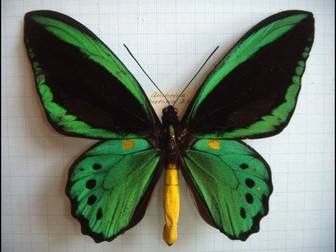
Pupils can use this resource to make careful observations of animals, for example, of the differences between male and female insects and when determining the sizes (wingspans) of moths and butterflies. There are opportunities for young people to estimate the number of objects in a group. This resource also covers adaptation, ecology and behaviour of insects.
Finally there are insights for pupils into how scientists in museums maintain and preserve their collections of animals, especially those the public do not normally see. There are illustrations of how entomological research is undertaken, as well as, a chance for pupils to consider some of the ethical issues that are associated with the establishment of museum collections of animals and the implications for insect conservation.
Worksheets with a short biography of each of these brilliant women. There is also an attached task. For support with the bird nesting activity, you can find further details here: [https://www.asab.org/educationprimary]
How do you like your eggs in the morning?
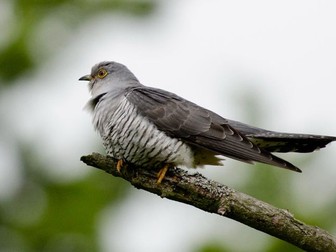
This resource uses the cuckoo/host example of co-evolution to provide an original approach to teaching natural selection, as well as providing opportunities for developing other key scientific skills such as experimental design and research. Will your eggs survive? Or will they be ousted?
Designed for key stage three and written for The Association for the Study of Animal Behaviour (ASAB) by Paul Weeks (Royal Society of Biology Teacher of the Year 2015). This resource is a fun activity, for a whole class, to demonstrate natural selection and evolution in action.
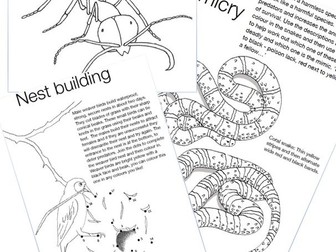
This book/set of worksheets contains thirteen pages of scientific colouring joy. Learn about murmurations, vigilance behaviour, nesting, mimicry and all about how bees find food and then tell all their co-workers.