Plenaries on a PlateQuick View
mikegershon

Plenaries on a Plate

(332)
With Plenaries on a Plate, you will never have to plan a plenary again! The contents page shows 168 numbered dots. Click on a dot and get a plenary - every one is different. They are appropriate for all subjects and for Key Stages 2-5. In addition, all the plenaries can be used regardless of what has gone before in the lesson. Help your learners review and revisit the lesson content. No planning required – just jump in and choose a plenary. Possibly the simplest method ever invented for adding effective, meaningful plenaries into your lessons. Scroll through and pick out plenaries you like, or select at random using the specially designed contents page. Examples of some of the plenaries: What three things have you learned today? How has today’s lesson altered your knowledge or understanding? How might you alter today’s lesson for future learners? In what ways has your mind been changed by today’s lesson? How did you feel at the beginning, middle, and end of the lesson? Create a short television advert ‘selling’ today’s learning Explain what we have learned today without using words Write a message to an alien explaining what you have learned today Construct a timeline showing your learning through the lesson What difficulties have you encountered today? How did you deal with them? Pick one thing you have done today and identify how you could do it better How does today’s lesson connect to your existing knowledge? How would you describe your learning today? What image could you draw to show your learning today? Plan your own lesson covering what we have studied
The Differentiation DeviserQuick View
mikegershon

The Differentiation Deviser

(278)
The Differentiation Deviser presents 80 strategies, activities and techniques for differentiating, all of which can be used across the Key Stages and the curriculum. Every entry is clearly explained and accompanied by an image to aid understanding and recall. These are practical, low-planning techniques for differentiation and adaptive teaching. Easily find ways to scaffold, model and support learners who are struggling to access the learning. Suitable for primary and secondary. New and familiar strategies you can deploy in your teaching. Increase personalisation in your classroom without having to create lots of extra resources or plan multiple lessons and activities. Some of the Strategies, Activities and Techniques Included Simple Language Keyword Discussion Exemplify Confidence Indicators Expert Corner Model Answers Open Activities Stepped Activities Pace Yourself Buzz Groups Question Range Open and Closed Learners Ask Questions Structure Guidelines Planning Pro-Forma
EAL ToolkitQuick View
mikegershon

EAL Toolkit

(226)
The EAL Toolkit provides over 50 strategies for helping learners across the Key Stages who are learning English as an additional language. Each strategy is explained and accompanied by an illustration to aid memory. The strategies are non-subject and non-age specific. No more searching for EAL ideas now they are all in one place! Build your confidence and skillset around teaching EAL learners. Dozens of strategies to support EAL learners in primary and secondary classrooms. Increase engagement and enjoyment of EAL learners in your lessons. Discover techniques you can use with EAL learners, whether they are only just starting to learn English, or are already fluent. Enjoy finding new ways to make your EAL learners feel fully included in the lessons you plan – and in wider school life. Example Strategies You’ll Find Inside Buddy Up Picture Rules Rehearsal Concrete Starters Support the Teacher Thinking Time Pre-Highlight First Language Allocate Roles Plenary Prime Barrier Games Belonging Language Types Thinking Together Linguistic Diversity
The Bloom Buster: Improve Questioning, Planning and AssessmentQuick View
mikegershon

The Bloom Buster: Improve Questioning, Planning and Assessment

(172)
The Bloom Buster will help you improve your lesson planning, questioning and activity development. Take full advantage of the power and scope of Bloom’s Taxonomy. Discover 90 keywords, covering all six levels, with 450 exemplar questions and tasks. Suitable for primary and secondary. Simplify your planning, vary the focus of your lessons, and weave challenge into any activity. Master the taxonomy and unlock its benefits for the learners you teach. Some of The Keywords Included in the Resource Knowledge: Arrange, Define, List, Name, Order, Repeat, Retain Comprehension: Characterise, Classify, Discuss, Express, Illustrate, Sort, Translate Application: Apply, Choose, Employ, Interpret, Perform, Sketch, Solve Analysis: Analyse, Categorize, Differentiate, Examine, Investigate, Question, Test Synthesis: Combine, Create, Devise, Hypothesise, Merge, Plan, Unite Evaluation: Appraise, Critique, Defend, Grade, Justify, Rank, Value
The PhilosophiserQuick View
mikegershon

The Philosophiser

(42)
The Philosophiser has 168 philosophical questions that challenge learners to analyse, critique and reflect. Learners can select questions at random by clicking a button on the contents page. The Philosophiser promises hours of critical thinking around the biggest questions! Suitable for secondary (mainly KS4 and KS5). Browse for questions that pique your interest or use the contents page to choose at random. Develop philosophical debates in your classroom with little or no planning required. Get learners thinking about some of the biggest debates and most important concepts in the history of philosophy. Example Questions Include Why is there something rather than nothing? Can you prove you are not a figment of my imagination? What is the nature of justice? Are there different types of knowledge? Does the universe have purpose? To what extent are our actions determined? Are you the same person now as you were twenty minutes ago? What is knowledge? Does language condition our thinking? Is it possible to be objective? Do ideas exist outside of physical reality? What are the limits of tolerance? What are the characteristics of personhood? Do human beings have autonomy? Is there an ultimate truth?
Make Your Own AFL BoxQuick View
mikegershon

Make Your Own AFL Box

(83)
Create your own AFL box, which you can keep in your room and use over-and-over again. This resource contains everything you need to make AFL a part of your everyday teaching. From plenaries to whole-class feedback, from cards to dice, this resource makes AFL quick and easy whatever subject and age-group you teach.
The Plenary Producer - 120+ PlenariesQuick View
mikegershon

The Plenary Producer - 120+ Plenaries

(475)
**120+ Plenary Activities to Make Your Lesson Planning Quicker, Simpler and More Enjoyable. ** Plenary activities you can use to review, revisit and reflect on learning at the end of any lesson. Suitable for primary and secondary classrooms. Easy to adapt and modify so they marry up with the needs of your learners. Create variety in how you bring your lessons to a close, raising engagement and creating memorable experiences for your class. Curate your own bank of plenary activities that fit seamlessly with how you like to teach and plan. Example Plenaries You’ll Find Inside Questions to Ask Freeze Frame Get Creative Different Shoes In the Spotlight My word! Which pic? Evaluation Tree Labelling Beat the Teacher Shape and Colour Mr Wrong Classified Information Word Limit Whiteboard Chop and Sort
Challenge ToolkitQuick View
mikegershon

Challenge Toolkit

(150)
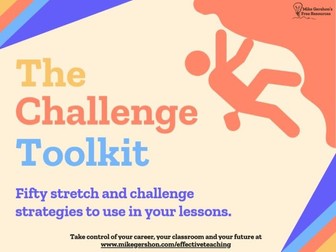
The Challenge Toolkit provides 50 different activities to stretch and challenge learners’ thinking. The activities are generic and can be used across Key Stages and in different subjects. Each activity is explained, often with examples. All can be used as extension tasks within a lesson, or worked up into whole-class activities. The Challenge Toolkit will help you push all learners to think more critically and creatively whatever they are studying. Easily increase the level of challenge for groups, individuals or the whole class. Suitable for primary and secondary. Discover new ways to stretch and challenge your more-able learners. Create your own bank of high-impact challenge strategies that fit with how you teach and plan. Find the sweet spot for high challenge so your learners can experience struggle but also find success. Example Strategies You’ll Find Inside Insoluble Problems Random Words Paradox Defend Your Consequence Analogies Bad Reasoning Lateral Thinking In the mind of … What’s Your Criteria? Rank the Questions Experimenter Devise a way to … Ultimate Reasoning Round Table Make the Metaphor
Essay Writing ToolkitQuick View
mikegershon

Essay Writing Toolkit

(137)
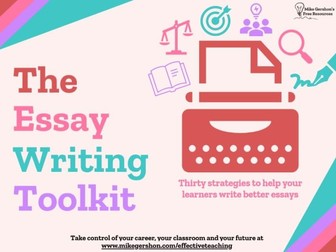
A comprehensive guide to essay writing. Simplify your planning and save time. The Toolkit contains 60+ strategies, activities and techniques you can use to develop effective, enjoyable lessons for every class you teach. All aspects of essay writing are covered and the material is suitable for use across Key Stages 3,4 and 5. Discover techniques and activities you can use to improve your learners’ essay writing skills. Refresh your approach to teaching essay writing and discover new strategies to use with your learners. Bring novelty, variety and renewed interest to your lessons. **Example strategies, activities and techniques include: Alternative Plans Writing Guides Read Aloud Speed Debating Silent Debate Evaluation Tables First Sentences Model Answers Group Essays Viewpoints Cut and Paste Critiquing Arguments Purpose Essay Planner Introductions Different Arguments
The Starter Generator: KS2 - 4(Ages 7-16) Starter ActivitiesQuick View
mikegershon

The Starter Generator: KS2 - 4(Ages 7-16) Starter Activities

(394)
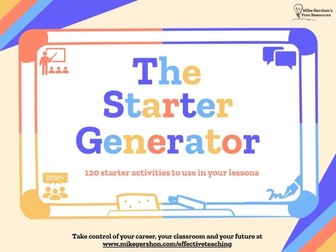
The Starter Generator has enough starters for you to shake a stick at. 120 Starter activities you can use in primary and secondary classrooms. Speed up your planning with activities that are easy to adapt for use across the curriculum. Engage learners from the moment the lesson starts and help them experience success before you increase the level of challenge. Create variety, widen your repertoire and motivate your learners. Develop your own bank of starter activities that work best for you and your class. Nearly all are generic and can be used across subjects and age ranges. Enjoy! Example Starters Waiting For You Inside List-O-Mania Show me the answer! Definition Match Name that tune! Describe and Draw Tell me three things … What do you know? Just a Minute Continuum Pictures in Time Strongest Argument What’s your reply? Silent Instructions Create-a-Title Multi-Tracking
The EthicistQuick View
mikegershon

The Ethicist

(51)
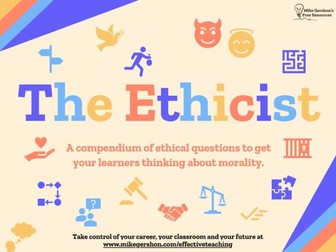
The Ethicist has 168 ethical questions focussing on morality, moral reasoning, and issues of right and wrong. Learners can select questions at random by clicking a button on the contents page. The Ethicist promises hours of ethical thinking around the biggest questions concerning morality! Suitable for secondary (mainly KS4 and KS5). Designed so you can choose questions at random, or search through for ones you like. Easily develop ethical debates in your lessons with little or no planning. Engage learners in some of the biggest, most important debates in the history of ethics and moral philosophy. Example Questions You’ll Find Inside What is a moral question? Are ethical judgements the same as knowledge judgements? Are there more moral states than right and wrong? If people know what is right, will they then do what is good? What does happiness mean? Is there a greatest good? What sort of consequences count as good consequences? How ought we to live? Does morality apply only within a society? Are there any objective values? Are we obliged to reciprocate? What constitutes a harm and what constitutes a benefit? Does sympathy underpin moral behaviour? Is pleasure the absence of suffering? Should we eat animals?
The Feedback CompendiumQuick View
mikegershon

The Feedback Compendium

(90)
The Feedback Compendium is a brilliant resource which will make your life easier! It contains two hundred high quality, ready-to-use targets which are appropriate for all subjects and for Key Stages 2-5. They can be used in formative assessment, report-writing and as oral feedback. The targets are divided into ten categories for ease of use.
The Whole Class Feedback GuideQuick View
mikegershon

The Whole Class Feedback Guide

(81)
Included are 25 different strategies for eliciting feedback from an entire class of students. All the strategies are generic and can be used across the Key Stages and the curriculum.
Assessment For Learning ToolkitQuick View
mikegershon

Assessment For Learning Toolkit

(536)
70 different activities, ideas or tools based around assessment for learning. Each comes with a description and a pretty picture to liven up your day. The toolkit is easy to navigate and the ideas are transferable across key stages and subjects. Become an AfL master with the AfL toolkit! Tried-and-tested strategies for use across the curriculum. Elicit information about where your learners are at, open up success criteria, and give effective formative feedback. Suitable for primary and secondary. Easily weave new and familiar techniques into your planning and teaching. Finesse your lessons so learners target their efforts more effectively, freeing you up to circulate, support and raise achievement. Example Strategies You’ll Find Inside Learners Write Questions ‘Might’ Exemplar Work Making Aims Clear Articulate Then Answer One-Sentence Summary Idea Thoughts Bouncing Incorrect Discussion Invert the Question Conveying Progress KWL Why is it best? Regulating Learning Squares
The What If...? BoxQuick View
mikegershon

The What If...? Box

(43)
The What If? Box fires up your learners’ imaginations and gets them thinking creatively, minimal planning required. There are 168 creative questions to get you and your learners thinking differently. All starting with the words ‘What if …’ It’s Suitable for primary and secondary. You can pick out questions you like, or select at random using the specially designed contents page. Use it to stimulate creative thinking in your classroom and train your learners in how to think outside the box. Develop inventive, imaginative discussions that take you and your learners down paths you were never expecting. The What If? Box is one of my favourite resources. I loved creating it, and I loved using it with my learners. Everything flows from that question stem: What if …? It encourages speculation, hypothesising, and imaginative thinking. All things we want our learners to be able to do. Some of my favourite experiences have been when learners took a question in a direction I would never have anticipated. And that’s the beauty of using ‘What if …?’ questions. The structure invites learners to step outside the box and see where it takes them. I designed The What If? Box so it’s as easy as possible to use. No planning. No effort. Maximum engagement. You’ll find 168 ‘What if …?’ questions inside. Each is on a different slide/page. The contents page contains 168 buttons, each linked to a different question. All you have to do is display the contents page, then either you or one of your learners picks a button and … voila! You have a ‘What if …?’ question to discuss. (And if that question doesn’t quite cut it for you, simply jump back to the contents page and go again.) Example Questions What if humans could fly? What if you could turn invisible for a day? What if there was someone exactly the same as you? What if school didn’t exist? What if society was less equal? What if money was banned? What if humans had not invented writing? What if colours had no names? What if everything was black and white? What if aliens exist? What if other people could read your mind? What if there were no mountains? What if robots demanded rights? What if farming was banned? What if Paris was the capital of England?
Discussion Toolkit: Develop Oracy NowQuick View
mikegershon

Discussion Toolkit: Develop Oracy Now

(95)
**Weave Effective, Structured Discussion Opportunities into Any Lesson ** 20+ key discussion strategies explained in simple, practical language. Suitable for primary and secondary. Create structured oracy interventions in your classroom today. Find the discussion techniques that work for you and best suit your learners. Develop speaking and listening in your lessons that builds confidence, improves writing and sustains engagement. Example Activities Waiting For You Inside the Guide Circle Time P4C Rainbow Groups Snowballing Listening Triads Envoys Jigsawing Value Continuum Hot-Seating Goldfish Bowl Radio Phone-In TV Chat Show
Peer and Self-Assessment GuideQuick View
mikegershon

Peer and Self-Assessment Guide

(47)
A straightforward guide to peer and self-assessment. Includes a step-by-step guide explaining how to embed it in your practice, examples of good practice, slides you can drop into your lessons and bonus features!
Movement BreaksQuick View
mikegershon

Movement Breaks

(29)
A guide to movement breaks. Inside you will find thirty different activities you can use to get your class moving and give them a break (plus a bit of fun). All activities are suitable across the curriculum and the Key Stages. All come with pictures and clear explanations with many also including extension activities. Find fun, engaging ways to break up your lessons and re-energise your learners. Most relevant to primary and Key Stage Three. Stimulate learners’ minds, get them moving and help regulate their behaviour. Create your own bank of favourite movement breaks and use them to reward and motivate your class. Example Movement Breaks You’ll Find Inside Mirror Me Zip Zap Boing The Sun Shines On Image Envoys Shape Your Learning Charades Mime Multi-Tasking Puppet on a String Dance-Oke Can You Help? Emotions This is a Spoon Stand, Crouch, Sit Human Shape Professions
The Political PhilosophiserQuick View
mikegershon

The Political Philosophiser

(3)
168 political philosophy questions which can be chosen at random from a contents page of coloured dots. The questions cover all areas of the subject and include key quotes from a range of thinkers. Great for use as a starter, plenary or discussion activity. Discover a huge collection of political philosophy questions that put the onus on learners to think deeply. Suitable for secondary (mainly KS4 and KS5). Use the contents page to randomly select challenging questions or browse through at your leisure. Facilitate political philosophy debates in your classroom with little or no planning required. Engage learners with some of the biggest debates and most important thinkers in the history of political philosophy. Example Questions What are the limits of government? What is the optimum relationship between the state and individuals? To what extent do social practices influence politics? To whom do rights belong and on what grounds? How ought the state to allocate resources? Is taxation just? Can any government ‘manage’ an economy? Do individuals behave in a rational manner? What methods should the political philosopher use? Does politics work? What is the fairest system of voting? Is freedom of speech a good idea? What is justice? Should anyone be above the law? Can the pursuit of self-interest lead to the general good?