The First World War
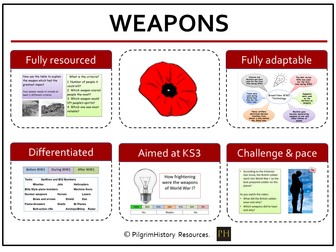
The aim of this lesson is to evaluate just how efficient and effective the new arms and equipment of the Twentieth Century were.
Students have two objectives; to rate the effectiveness and killing power of the weapons used during the First World War and to explain how well equipped the soldiers were in the trenches, particularly the British Tommy.
The lesson begins with discussing the type of weapons used and for students to recognise the continuity and change of many of these pre, post and during World War I.
The historian Dan Snow is quoted as saying the British soldier went into the First World War ‘as the best prepared soldier on the planet.’
The lesson subsequently unfolds to explain and evaluate the new weapons used and the advantages (or not) they gave each side.
The plenary requires students to link the effectiveness of the weapons to images and to explain how and why this is the case.
This lesson is enquiry based with a key question using a lightbulb posed at the start of the lesson and revisited throughout the lesson and this unit of study to show the progress of learning.
The resource includes retrieval practice activities, suggested teaching strategies and differentiated materials, and comes in PowerPoint format if there is a wish to adapt and change.
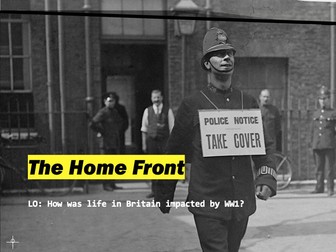
This is a complete, ready-to-teach lesson on life on the homefront during World War One.
Designed for KS3, this lesson explores the social, economic, and emotional impacts of the war on civilians, including rationing, women’s roles, and public morale. It encourages students to understand the wider effects of the conflict beyond the battlefield.
Includes:
PowerPoint presentation – clear, visually engaging slides that guide the full lesson
True or false task – interactive activity to challenge students’ preconceptions and reinforce learning
Quiz task with accompanying information sheet – supports knowledge retention and provides key facts
Starter and plenary activities – to engage students and check understanding
In this lesson, students will fully understand the M.A.I.N. long-term causes of the First World War – Militarism, Alliances, Imperialism and Nationalism. Students will be first introduced to these key terms and then use them to explain the tensions which existed in Europe by 1914.
This is a fully resources lesson which includes a warmup, starter task, engaging background information, various learning activities, challenge tasks and learning reviews.
**
The lesson includes the following:**
Slide 1: Title slide
Slide 2: Outline of the main lesson aims
Slide 3: As you come in warmup activity – what causes war?
Slide 4: As you come in warmup activity 2 – Why do people argue?
Slide 5: Starter Task 1: Why is it important to learn about the causes of the First World War – suggestions then given.
Slide 6: Starter Task 2: Political cartoon analysis with prompt questions provided.
Slide 7: Background information about Europe in 1914
Side 8: Background information explaining the term long-term causes.
Slide 9: An overview of the M.A.I.N. reasons and discussion task.
Slide 10-13: Background information about militarism, alliances, imperialism and nationalism.
Slide 14-15: Activity 1: Student diagram to help make notes and explain the MAIN causes. Printable resource included.
Slide 16-17: Activity 2: Source based activity based on three cartoons of Europe in 1914.
Slide 18: A student fact sheet for the lesson – printable
Slide 19: Follow Up Challenge Tasks
Slide 20: Learning Review 1
Slides 21-23: Learning Review 2 with printable handout
I would be really grateful if you could leave a review for the lesson if you feel the lesson is effective for you. Many thanks if you spend some of your valuable time doing this as feedback is highly valued.
All images used in this lesson are in the public domain and are therefore copyright free at the time of publishing. Images which require attribution have been attributed in the notes section of each slide where the image appears. If you feel any errors have been made, please contact me at raschoolresources@gmail.com in the first instance to resolve any issues. My lessons are completed using PowerPoint and designed on widescreen formatting. Thank you.
In this 26 slide lesson, students will student nine of the main weapons used during the First World War: rifles, artillery, machine guns, grenades, cavalry, flamethrowers, tanks, aircraft and gas. Students will be able to describe the features of each weapon before comparing and evaluating the effectiveness of the weapons.
This is a fully resources lesson which includes a warmup, starter task, engaging background information, various learning activities, challenge tasks and learning reviews.
The lesson includes the following:
Slide 1: Title slide
Slide 2: Outline of the main lesson aims
Slide 3: As you enter activity – ‘Odd One Out’.
Slide 4: Background knowledge about the Wider Historical Context
Slide 5: Starter Task – Weapons True or False
Slide 6: Links to 7 useful clips about the weapons of the First World War.
Slide 7: Starter Task 2: Problem Solving Puzzle linked to the production of the Brodie Helmet.
Side 8: Fact Sheet (printable) about the weapons of the First World War.
Slide 9-18: Image based background knowledge about each weapon featured in the fact sheet.
Slide 19-20: Activity 1 - Instructions about how to complete the table with an A4 printable table included.
Slide 21-22 Activity 2 – Key Term Fill with answers revealed
Slide 23: Printable worksheet
Slide 24: Challenge Questions about the impact of the weapons
Slide 25-26: Learning Review – Match the statistics to the facts with answers revealed.
I would be really grateful if you could leave a review for the lesson if you feel the lesson is effective for you. Many thanks if you spend some of your valuable time doing this and your feedback is highly valued.
All images used in this lesson are in the public domain and are therefore copyright free at the time of publishing. Images which require attribution have been attributed in the notes section of each slide where the image appears. If you feel any errors have been made, please contact me at raschoolresources@gmail.com in the first instance to resolve any issues. My lessons are completed using PowerPoint and designed on widescreen formatting. Thank you.
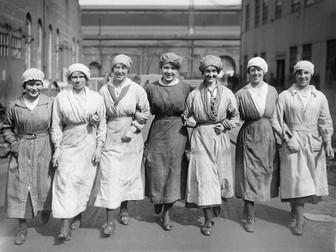
The main focus of the lesson is the role and contributions of women to Britain’s war effort during World War One. Students will examine both the positive and negative experiences of women during the war, be able to describe the various roles that women took on and then carry out their own research into the topic.
This is a fully resources lesson which includes a warmup, starter task, engaging background information, various learning activities, challenge tasks and learning reviews.
**
The lesson includes the following:**
Slide 1: Title slide
Slide 2: Outline of the main lesson aims
Slide 3: As you enter warm up – Discussion about the statement, ‘Most of the History we learn in school is about men’.
Slide 4: Starter Task 1: Women in Propaganda during the First World War.
Slide 5: Starter Task 2: Gender roles in 1914
Slide 6-7: Activity 1: Data analysis (including printable worksheet) about the employment figures of women in work between 1914-1919.
Slide 8-9: Activity 2: The experiences of women in the war – students read statements and mark if they show a positive or negative experience of war.
Side 10-17: Image based background information about the role of women during the First World War.
Slide 18-20: Activity 3 – A guided research task. Links are given to useful websites as well as useful documentary clips. Students are given a number of areas they can research.
Slide 21: Useful websites for the research and further reading
Slide 22: Useful short documentary clips
Slide 13: Challenge Tasks
I would be grateful if you could leave a review for the lesson if you feel the lesson is effective for you. Many thanks if you spend some of your valuable time doing this and your feedback is highly valued.
All images used in this lesson are in the public domain and are therefore copyright free at the time of publishing. Images which require attribution have been attributed in the notes section of each slide where the image appears. If you feel any errors have been made, please contact me at raschoolresources@gmail.com in the first instance to resolve any issues. My lessons are completed using PowerPoint and designed on widescreen formatting. Thank you.
This lesson contains:
A starter to recap trench warfare.
A background of the armistace and what it means and a YouTube video to show how the war ended.
An exercise to study a series of cards, in groups, with information about the reasons why the war was lost by Germany. Students make notes about why each led to a loss in the war.
A task to then complete a graph to decide the most important events and to colour code them by category. Students then put the categories into a pie chart to sort the reasons.
A final task to connect the reasons, showing deeper analysis of the reasons.
A plenary to discuss the ways we commemorate the War and whether we do enough.
Attachments:
1 x Powerpoint Presentation
2 x Publisher Files
This lesson contains:
A starter to consider what the students have heard about the Somme and to look at a picture source.
A background to the battle including the purpose of the Somme attack.
An overview of who Field Marshall Haig was.
An overview of the plan and a discussion activity to determine what might go wrong.
A brief YouTube video from Blackadder to look at a comedic perspective of the plan.
An exercise to study statements about the Somme and determine which show success or failure. A judgement is then written.
An overview of the consequences using an interpretation and finding arguments for and against it Haig being ultimately responsible.
A plenary to consider whether Haig was guilty or not.
Attachments:
1 x Powerpoint Presentation
1 x Publisher File
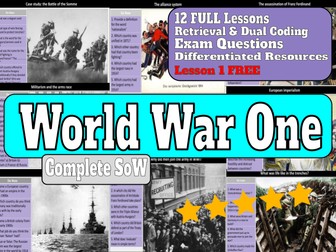
**Topic: World War One - 13 Lessons **
Lesson 1 FREE -https://www.tes.com/teaching-resource/-12727985
KS3 SoW
This SoW is designed in detail and is both differentiated and engaging, and allows you to move pupils through content efficiently. As a result, lessons can take around two periods to deliver and are sequenced to flow through this period of time comprehensively.
Made to the highest standard and constructed using current research, both dual coding and retrieval practices are at the heart of this unit. A colour scheme also runs throughout to ease both your delivery and students comprehension.
An outline of the SoW can be viewed below: World War One
Nationalism
The alliance system
European imperialism
Militarism and the arms race
The assassination of Franz Ferdinand
Causes of WWI - evaluating factors
Essay writing and peer review
Joining up
Fighting in the trenches
Medical Improvements
Somme case study
End of WWI
Assessment
Additional: Knowledge Organiser
Any question please do feel free to get in contact:
teachercentralltd@gmail.com
Best FREE Resources (Teacher Central)
https://www.tes.com/teaching-resource/britain-losing-and-gaining-an-empire-12973075
https://www.tes.com/teaching-resource/financial-literacy-12898983
https://www.tes.com/teaching-resource/romeo-and-juliet-12908635
https://www.tes.com/teaching-resource/shakespeare-12908634
https://www.tes.com/teaching-resource/macbeth-gcse-12863697
https://www.tes.com/teaching-resource/animal-farm-free-sow-12942163 (FREE SoW)
https://www.tes.com/teaching-resource/slavery-sow-12843084 (FREE SoW)
https://www.tes.com/teaching-resource/russia-1917-91-from-lenin-to-yeltsin-12834552
https://www.tes.com/teaching-resources/shop/TeacherCentral?sortBy=lowestPrice&p=5
I hope you find this SoW useful. If you have, I have created a series of resources.
You can check them out here.
https://www.tes.com/teaching-resources/shop/TeacherCentral
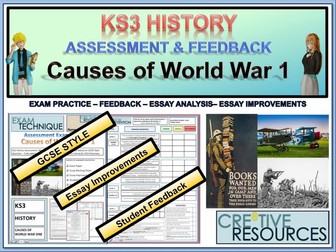
**KS3 History Assessment - Causes of WW1 - Causes of World War one. **
Product Code: HIS/C8/WB/07
All our paid exam resources are fully editable.
This resource is based on a History GCSE Style essay question about the causes of world war one and “how far do you agree with each interpretation”.
This Assessment / exam is out of 35 marks and consists of;
Section A: 15 Knowledge and Understanding short answer questions
Section B: A 16 mark + 4 for SPAG Substantiated judgement essay about interpretations of the causes of world war one.
The new History GCSE Objectives are as follows:
AO1: demonstrate knowledge and understanding of the key features and characteristics of the period studied.
AO2: explain and analyse historical events and periods studied using second-order historical concepts.
AO3: analyse, evaluate and use sources (contemporary to the period) to make substantiated judgements, in the context of historical events studied.
AO4: analyse, evaluate and make substantiated judgements about interpretations (including how and why interpretations may differ) in the context of historical events studied.
This resource contains:
Knowledge Based Exam Paper
1 Essay Question
Essay improvement sheet - Linked to the Action Points on the feedback sheet.
Feedback Sheet - with marking scheme, example answers and grade boundaries to be used by students or teacher
Question mark analysis - Track missing marks to improve exam technique
Product Code: HIS/C8/WB/07
This resource is fully adaptable to fit your own schools assessment criteria and is currently set up to follow the 1-9 GCSE formula and simplifying it for KS3 students.
You may also want to check out our other popular selling History resources:
History Christmas Quiz
History General Knowledge Quiz
AQA GCSE History - Norman England Revision
Causes of the English Civil War
The Tudors - Henry VIII and Edward VI
The Big WW1 Quiz
Geography Quiz
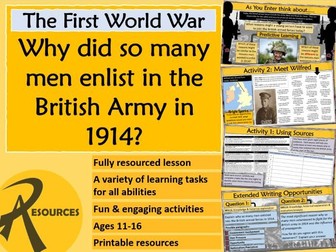
In this lesson, students will be able to understand and explain the many and varies reasons why so many men voluntarily enlisted in into the British army at the start of the First World War. For example, students will learn about aspects such as propaganda, censorship, patriotism, the role of the British government, the formation of Pals Battalions, the White Feather Campaign and more.
This is a fully resources lesson which includes a warmup, starter task, engaging background information, various learning activities, challenge tasks and learning reviews.
The lesson includes the following:
Slide 1: Title slide
Slide 2: Outline of the main lesson aims
Slide 3: As you come in warmup activity – Why might young people today want to join the armed forces?
Slide 4: Previous Learning Recap – order the events
Slide 5: Previous Learning Recap – multiple choice quiz
Slide 6: Starter Task – Activity and discussion based on persuasion techniques.
Slide 7: Background information about the start of the First World War.
Side 8: Background information about the role of the British government, propaganda and censorship.
Slide 9: Background information about the creation of the Pals Battalions.
Slide 10: Useful Clips – three links to video clips covering topics from the lesson.
Slide 11-15: Activity 1: Using first-hand accounts (sources) to understand why men enlisted in 1914. Includes a practice source to do as a class and a printable table for students to record their ideas.
Slide 16-17: Activity 2: ‘Meet Wilf’ – A focus on the life of one recruit and his life in 1914. Why would Wilf want to enlist?
Slide 18: Activity 3: Why did men enlist diagram and instructions.
Slide 19: Follow Up Challenge Questions
Slide 20: Extended writing opportunities
Slide 21: Learning Review Picture Quiz
I would be really grateful if you could leave a review for the lesson if you feel the lesson is effective for you. Many thanks if you spend some of your valuable time doing this and your feedback is highly valued.
All images used in this lesson are in the public domain and are therefore copyright free at the time of publishing. Images which require attribution have been attributed in the notes section of each slide where the image appears. If you feel any errors have been made, please contact me at raschoolresources@gmail.com in the first instance to resolve any issues. My lessons are completed using PowerPoint and designed on widescreen formatting. Thank you.
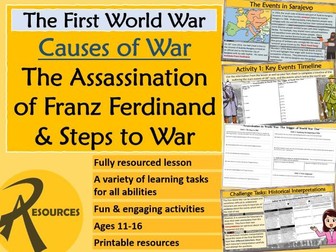
**In this lesson, students will fully understand the events which led to the assassination of Franz Ferdinand and how the assassination then triggered the First World War. **
Students have various learning options such as creating a timeline of the key events, creating a storyboard, analysing historical interpretations and explaining how each country became involved in the First World War.
This is a fully resources lesson which includes a warmup, starter task, engaging background information, various learning activities, challenge tasks and learning reviews.
The lesson includes the following:
Slide 1: Title slide
Slide 2: Outline of the main lesson aims
Slide 3: As you come in warmup activity – Analysis of an illustration of the assassination of Franz Ferdinand.
Slide 4: Discussion about the definition of ‘assassination’.
Slide 5-6: Starter Task 1: A recap knowledge quiz with answers revealed.
Slide 7: Image led background information about the location of the Balkans and key places such as Bosnia, Serbia and Sarajevo.
Slide 8: Background information about the events in Sarajevo.
Side 9: A fact sheet covering all the information needed for the lesson.
Slide 10-11: Activity 1: Students create a timeline of the main events of the assassination and the steps towards war. Print out included.
Slide 12-13: Activity 2: A series of questions and sentence starters which ask students to explain why each country became involved in the war and the Domino Theory. Printable worksheet included.
Slide 14: Activity 3: A printable storyboard for students to complete using the fact sheet.
Slide 15-16: Activity 4: A higher ability challenge task based on the various interpretations about the causes of war. Printable worksheet included.
Slide 17: Follow Up Challenge Task – A cartoon showing the causes of the First World War and Domino Effect – cartoon analysis.
Slide 18: Links to three useful clips/videos covering the events of the assassination of Franz Ferdinand.
Slide 19-20: Learning Review Quiz with answers
I would be really grateful if you could leave a review for the lesson if you feel the lesson is effective for you. Many thanks if you spend some of your valuable time doing this and your feedback is highly valued.
All images used in this lesson are in the public domain and are therefore copyright free at the time of publishing. Images which require attribution have been attributed in the notes section of each slide where the image appears. If you feel any errors have been made, please contact me at raschoolresources@gmail.com in the first instance to resolve any issues. My lessons are completed using PowerPoint and designed on widescreen formatting. Thank you.
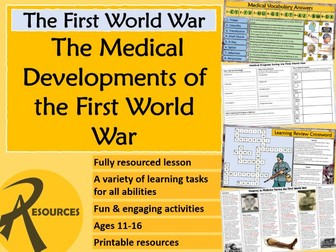
In this 23 slide lesson, students will investigate the many developments made in medicine as a result of the First World War. Foor instance, students will study shell shock, the methods used to treat infection, X-rays, the treatment of broken bones, developments in blood transfusions and plastic surgery.
This is a fully resources lesson which includes a warmup, starter task, engaging background information, various learning activities, challenge tasks and learning reviews.
The lesson includes the following:
Slide 1: Title slide
Slide 2: Outline of the main lesson aims
Slide 3: As you enter warm up discussion tasks.
Slide 4-6: Starter Task – Medical vocabulary task with printable sheets and answers.
Slide 7: Background information & discussion task about the problems of treating soldiers on the Western Front.
Slide 8-9: Activity 1: How does war help progress in medicine? Fill in exercise with answers revealed.
Slide 10: Lesson fact sheet covering all aspects of medical progress and developments.
Side 11-16: Image based background information about each development – ideal to use when reading through the fact sheet.
Slide 17: Activity 2: Printable lesson worksheet
Slide 18: Activity 3: Extended writing task
Slide 19: Useful clips about medicine in the First World War
Slide 20: Challenge Tasks
Slide 21-23: Learning Review Crossword with printable crosswords and answers revealed.
I would be grateful if you could leave a review for the lesson if you feel the lesson is effective for you. Many thanks if you spend some of your valuable time doing this and your feedback is highly valued.
All images used in this lesson are in the public domain and are therefore copyright free at the time of publishing. Images which require attribution have been attributed in the notes section of each slide where the image appears. If you feel any errors have been made, please contact me at raschoolresources@gmail.com in the first instance to resolve any issues. My lessons are completed using PowerPoint and designed on widescreen formatting. Thank you.
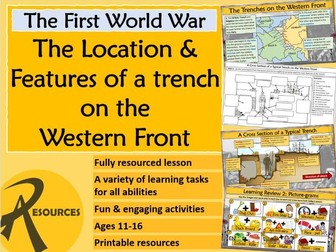
In this lesson, students will learn about the location of the Western Front and be able to identify and explain the various features of a First World War trench.
This is a fully resources lesson which includes a warmup, starter task, engaging background information, various learning activities, challenge tasks and learning reviews.
The lesson includes the following:
Slide 1: Title slide
Slide 2: Outline of the main lesson aims
Slide 3: As you come in warmup activity.
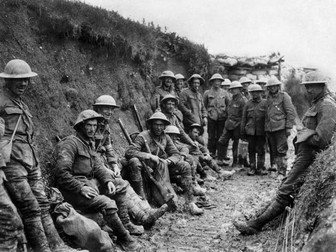
Slide 4: Starter Task 1: What can students infer (learn) about a trench from the photograph?
Slide 5: Starter Task 2: What can students infer (learn) about a trench from the photograph and how is it different from the image in the previous slide?
Slide 6-8: Image led background information about the location of the Western Front.
Slide 9: Image led background information about the trench system from a bird’s eye view.
Side 10: A fully labelled and clear diagram showing the cross section of a typical trench.
Slide 11-12: Activity 1: Creating a diagram on a First World War trench – printable student worksheet included.
Slide 13: Activity 2: The purpose of a trench
Slide 14: Activity 3: Explaining the importance of a trench – writing frame included.
Slide 15: Follow up challenge questions
Slide 16-17: Learning Review 1 with answers revealed
Slide 18-19: Learning Review 2 with answers revealed
Slide 20: Bonus fact sheet covering all the information from the lesson.
I would be grateful if you could leave a review for the lesson if you feel the lesson is effective for you. Many thanks if you spend some of your valuable time doing this as feedback is highly valued.
All images used in this lesson are in the public domain and are therefore copyright free at the time of publishing. Images which require attribution have been attributed in the notes section of each slide where the image appears. If you feel any errors have been made, please contact me at raschoolresources@gmail.com in the first instance to resolve any issues. My lessons are completed using PowerPoint and designed on widescreen formatting. Thank you.
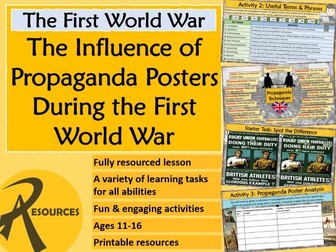
In this lesson, students will be able to analyse the various propaganda techniques which were used in World War One propaganda posters which aimed to enlist more men into the armed forces. Students will be given a selection of posters to analyse and then have an opportunity to design and explain their own, original, propaganda poster.
This is a fully resources lesson which includes a warmup, starter task, engaging background information, various learning activities, challenge tasks and learning reviews.
The lesson includes the following:
Slide 1: Title slide
Slide 2: Outline of the main lesson aims
Slide 3: As you come in warmup activity – Modern day propaganda and advertising methods.
Slide 4: Key Meaning – A discussion and definition of the term ‘propaganda’.
Slide 5-6: Starter Task – Spot the difference activity based on a propaganda poster (answers shown).
Slide 7-8: Activity 1: Whole class analysis of a propaganda poster.
Slide 9-10: Activity 2: Useful terms linked to propaganda techniques – a match up activity.
Side 11-17: Activity 3: Analysis of propaganda posters with a choice of 12 posters.
Slide 18: Activity 4: Instructions on how to create your own propaganda poster.
Slide 19: A diagram showing a wide variety of propaganda techniques – can be used to display while students create their own diagram.
Slide 20: Useful clips linked to propaganda during World War One.
Slide 21: Follow Up Challenge Questions
Slide 22-23: Learning Review Quiz with answers revealed.
I would be really grateful if you could leave a review for the lesson if you feel the lesson is effective for you. Many thanks if you spend some of your valuable time doing this and your feedback is highly valued.
All images used in this lesson are in the public domain and are therefore copyright free at the time of publishing. Images which require attribution have been attributed in the notes section of each slide where the image appears. If you feel any errors have been made, please contact me at raschoolresources@gmail.com in the first instance to resolve any issues. My lessons are completed using PowerPoint and designed on widescreen formatting. Thank you.
A flow chart-style worksheet (aimed at KS3) which charts the overview of the First World War and includes tasks for students to complete as they work their way through the sheet reading the information. There is also a challenge task at the end.
The worksheet was designed as either a short introduction to the war or a revision task which could be completed at the end of a First World War unit.
The worksheet includes short chunks of text, a task per text box, images, a diagram to annotate, and a final challenge task. It covers the start of the war and alliance systems, trench warfare, the end of the war and the legacy of the war.
AQA GCSE history 9-1 Conflict and Tension the First World War 1894-1918 timeline.
Students complete timeline by adding key statistics or summary notes on the key events from the WW1 topic. Can be used as an end of topic summary task or revision activity.
Private Charles Johnson of Hull served with the East Yorkshire Regiment. During 1915 he fought in France in the Ypres salient. This is a transcript of the diary he kept during that year. Charles was killed in action in June 1917.
This resource is part of the Joining up the Humber Project. View the full resource and many other resources about Hull, the East Riding and Lincolnshire in WW1 on the MyLearning website.
This Y8 lesson investigates the long-term causes of WW1. The main activity is sorting the cards into the MAIN causes.
Militarism
Alliances
Imperialism
Nationalism
Originally designed for a higher ability group.
 Quick View

 Quick View
 Quick View
 Quick View
 Quick View
 Quick View
 Quick View
 Quick View
 Quick View
 Quick View
 Quick View
 Quick View
 Quick View
 Quick View
 Quick View
 Quick View