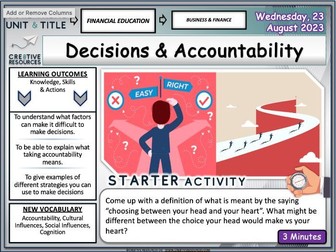
Decisions and Accountability. A fully-resourced lesson (1 hour +) which can be used by teachers to deliver a detailed Careers / Personal Development lesson
Learning objectives
To understand what factors can make it difficult to make decisions.
To be able to explain what taking accountability means.
To give examples of different strategies you can use to make decisions.
Some Key Terms Covered
Accountability, cultural influences, social influences, cognition
Each Lesson Pack Contains:
1 Fully Editable Careers PowerPoint (Learning Outcomes, Confidence Checkers, Assessment of Learning, Variety of Tasks, Video Embedded URL Clips, Engaging Premium Quality Slides, Extra Support Websites, Challenging & Thoughtful Questioning) Assessment Opportunity (Confidence Checker)
The lesson includes a detailed PowerPoint, variety of student facing tasks and comprehension tasks These resources have been designed to be engaging, informative and pick up and teach.
Why not check out some of our latest PSHE super bundles below:
Personal Finance as a young adult
Online Safety + Staying Safe
Y12 Survival Kit - Personal Safety
Y11 Survival Kit - Revision + Exam Stress
British Values Explored Bundle
PSHE - Debating Topical Issues
Society, Body Image + Peer Pressure
Finance Risk + Online Safety
16 HOURS UNIT (more just added!)- Bank Accounts, Tax, Debt, Budgeting, Inflation, Economy - everything! 50x resources in 14 lesson packs. Well differentiated to three challenge levels - all hour long PowerPoints come with clear LOs, starters, plenaries, accompanying clips and worksheets. Created by EC Publishing - who recently made the Bank of England's financial education resources.
1. Income and Expenditure Introduction- credit and debit
2. Budgeting - being financially savvy and keeping to a personal budget
3. Payslips, tax and national insurance.
4. Public money - how it's spent nationally and locally.
5. Saving, investing and pensions - how to plan for a secure financial future.
6. Personal finance and debt- managing your finances sensibly.
7. Financial products- debit cards, loans, credit cards, bank accounts, what are they for and how do we use them.
9. Money Laundering - what is it and why shouldn't we do it.
10. Financial Products, loans, avings and management.
11. Independent living - with a focus on being financially literate and self-sufficient.
12. What are payday loans and why are these so risky?
13. Why do I need to know about pensions?
14. Buying or renting? Cars and houses.
15. The cost of Living Crisis
16. The economy
Variety of different level tasks for MA,LA or Core. Suitable for secondary - all editable.
ALSO - Leave me a review and I'll send you a resource of your choice for free.
Differentiated to 3 levels or 4 levels where possible
Designed to fit Ofsted criteria for' Good' or above
Credit to BBC for clip and links
Powerpoints to accompany the new OCR Personal Finance Year 12 Enrichment courses.
This is taken directly from the published OCR Scheme of Work in Excel on Cambridge Online that I have converted into powerpoints with images and tasks using various tools.
30 hour long Lesson Powerpoints with activities and homeworks that covers the whole of the teaching course…
It took me 2 days to create, so hopefully this saves you a bit of time!
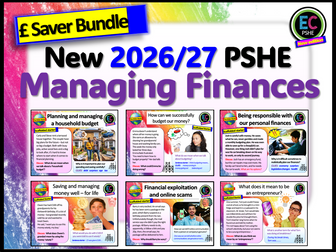
NEW 11 HOURS- A selection of brand new 2026/27 EC Publishing PSHE lessons created for the new 2026 KS3 DfE / PSHE Association guidance for managing money and finances throughout life successfully. Perfect for young people navigating our challenging modern world. There are 11 hours of total content as three of the lessons are doubles, each coming with detailed easy to follow PowerPoint, worksheets, clips, activities and info packs. Made by a wonderful team of consultants and teachers who are, above all, humans, not AI (we write and check every word and fact and are happy to stake our company reputation on what we produce). This is a saver pack - bought separately the lessons would total £19.
CONTENTS:
Budgeting Money Introduction - NEW 2026 - One hour lesson introducing the concept of budgeting with all the templates needed for students to create a working budget plan. Students will first discover what budgeting, sources of income and outgoings are, before investigating why it’s important to budget and studying a sample budgeting plan from an average teenager. Finally they will create their own. Includes lesson plan. This has been created to best suit KS3, but could easily be used with KS4 and is entirely editable. It covers the DfE and PSHE Association guidance for 2026 and will last you one hour.
Budgeting personal finances through life PSHE - NEW 2026 DfE GUIDANCE COMPLIANT (see lesson plan included for details). New lesson with a focus on how we can be responsible with our personal finances and avoid bad debt. Students will recap on key monetary terms (interest, short-term loans, debt, long-term loans, credit score) before investigating different case studies of young people in financial trouble. To arm them for this task, they will first read through a source pack and complete a clip task. Students will then review the advice they gave and then complete the plenary summarizing what they learned today. The lesson includes a detailed, editable PowerPoint, accompanying worksheets, information pack, clip tasks, analysis tasks, creative tasks, signposting and much more. Suitable for KS3 or KS4. Includes detailed lesson plan.
Saving Money - New PSHE lesson, best suited to lower KS3. Students will explore wants and needs, saving and investing, as well as different types of savings accounts and their benefits, before beginning to investigate stocks and bonds at a basic level. They will also cover a basic explanation of interest and how banks work. Includes lesson plan. There are a variety of tasks, from clips, bingo, analysis, role-play, case studies and more. Everything is editable and ready to go and I’ve tried to make a dry-ish subject as fun as possible. This lesson is taken from the new 2026 EC Publishing Complete Primary Package, which can be found with a quick Google on the EC Publishing website.
Introduction to Entrepreneurship - New lesson for 2026 (lesson plan details new guidelines covered) which focuses on what exactly it means to start a business and become an entrepreneur. Students will explore case studies of famous entrepreneurs from diverse backgrounds, analyse a clip of Elon Musk giving advice to wanna-be entrepreneurs and complete interactive tasks following the exploits of Tom, a student who starts a business up whilst at school. The resources are editable, fun, creative and ready to go. Includes lesson plan.
Managing a household budget - DOUBLE LESSON - New for 2026 - a two hour lesson on planning and managing a household budget. Students will examine the household budgets of four UK households - a young couple on average income, a divorcee nurse, a wealthy businessman and a young family with a disabled child. Their task is to stick to the budgets of each household, whilst navigating financial challenges such as pregnancy, a new car, a brother in debt, carer’s allowance, lodgers and much more! This is a fun lesson and culminates in a video bingo game about how different levels of income are managed by UK citizens. Best for KS4/5 but nothing unsuitable for KS3.
Financial Exploitation - 2 HOURS for new 2026 RSHE guidance (see lesson plan included for details) - In this double lesson students will explore online scams, with particular regard to financial exploitation and money laundering. They will investigate how easy it is to fall for a scam, the common techniques used by scammers and how to spot one. Students will then focus on a growing criminal industry which young people often fall victim to; money laundering. They will discover how money laundering works, what happens to the victims, the penalties, and how criminals operate to trick people and avoid detection. The lesson includes a detailed, editable PowerPoint, accompanying worksheets, information pack, clip tasks, analysis tasks, creative tasks and much more. Suitable for KS3 or KS4. Includes detailed lesson plan.
Resilience, Wisdom and Being Tough PSHE (student loans, pensions, rent and mortgages) - Brand new, 2 hour lesson which may be one of the most important lessons we’ve ever produced. The lesson informs students about the realistic levels of challenge they will face as they strive for a successful adulthood in modern, competitive Britain. The topics are all off-line subjects for this lesson, and those covered are; mortgages and the housing market, university and alternatives, pensions and their importance, attitude and entitlement and credit scores. The lesson aims to equip students with essential knowledge they need and the inspiration to be tough, resilient, wise and future-proof.
Best suited to KS5 (or maybe Year 11) Students will complete a wide range of tasks, literacy-based, creative presentation, case studies, analysis and clip tasks. Everything is editable and easy to just pick up and use. All information need is included.
The UK Economy: New edition, all new content. A detailed, differentiated and editable PSHE/Citizenship/Finance lesson which has been updated for 2026 and will last you up to 90 mins. The lesson introduces what the economy is, what is happening with the UK economy currently, what key terms such as recession, growth and austerity mean, why interest rates have risen and what it all means for the everyday Brit’s pockets.
Who are EC Publishing?
EC Resources are the top TES PSHE providers and are a group of teachers who work together to create easy to use, high quality and editable lessons and units of work. We have created lessons for The Children’s Commissioner, The Bank of England, The British Legion, MACS Charity, Tes, LikeToBe Careers, the Criminal Cases Review Commission (UK Gov) and have also completed PSHE and Citizenship commissions for schools across the UK.
We also run the EC Publishing site where you can find everything you need for PSHE, RE and Citizenship at discounted rates. You can contact us at info@ecpublishing.co.uk
Check out our PSHE Packages on Tes here:
Complete KS3 PSHE and RSE
Complete KS4 PSHE and RSE
Complete KS5 PSHE and RSE
One Year of Citizenship and British Values
Complete KS3 RE
Complete Careers and Employability
AQA Citizenship GCSE Mega Pack
Teaching PSHE, RE or Citizenship GCSE next year? Why not join our Citizenship and PSHE teachers Facebook group, with 12,000 other teachers, for guidance, advice and resource sharing.
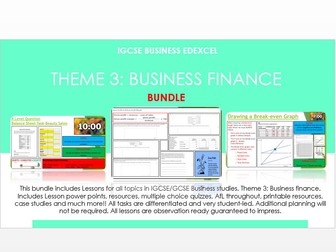
This bundle includes Lessons for all topics in IGCSE/GCSE Business studies. Theme 3; Business finance. Includes Lesson power points, resources, multiple choice quizzes, AfL throughout, printable resources, case studies and much more!! All tasks are differentiated and very student-led. Additional planning will not be required. All lessons are observation ready guaranteed to impress.
3.5 Accounts analysis is not included in this bundle but 3.5 Accounts analysis is available for FREE via TES resource store.
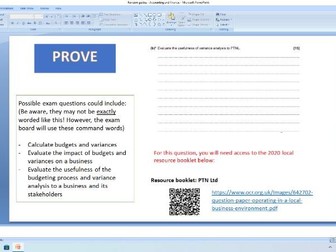
A revision guide for OCR A Level Business - Accounting and finance. This includes:
Retrieval practice
QR codes
Power points
Case studies (With guided answers)
Exam questions with mark scheme
A mix of questions on the following topics
Breakeven
Costings
Mix and Match Cards - Difference between Financial and Management
Accounting
Ratio Analysis - Acid Test, Current Ratio, ROCE, Gross Profit
Have used these questions as class room topics as well as stretch and challenge with students studying the following topics
BTEC Business
A Level Business
AAT Accounting
A Level Accounting
GCSE Business Studies
This PowerPoint, “Finance and Accounting Strategy – Complete Study Guide,” is a comprehensive Year 13 Cambridge A-Level Business resource that teaches how to use financial data for strategic decision-making.
It is structured into eight clear chapters:
Introduction to Accounting Data – Presents the three pillars of financial assessment: current performance, finance availability, and competitive comparison.
The Annual Report – Breaks down its key components (financial statements, chairman’s report, auditors’ report, etc.) with real examples (Apple, Tesco).
Who Uses Annual Reports – Explains how different stakeholders (managers, shareholders, banks, government) use reports for different purposes.
Ratio Analysis – Teaches trend analysis and inter-firm comparison, emphasizing the importance of industry context.
Strategy & Ratios – Shows the cause-and-effect relationship between strategic decisions (debt vs equity, dividends, takeovers, NPD) and financial ratios.
Limitations – Critically evaluates 9 key limitations of ratio analysis (historic data, qualitative factors, window dressing, etc.).
Practical Analysis Skills – Provides a 4-step systematic approach to ratio analysis: calculate, compare, explain, evaluate.
Exam Strategy – Breaks down command words (define, calculate, analyse, evaluate) and offers tips for structuring high-mark answers.
Perfect for A-Level students and teachers looking to build strong analytical skills, understand the strategic use of financial data, and excel in exam questions involving ratio analysis and evaluation.
Lesson presentations for the AS Business Unit 5 of Finance and Accounting
Topics included are Business finance, forecasting and managing cash flow, costs and break-even and accounting fundamentals.
A new series of resources aimed at assisting teachers with the delivery of the Edexcel A Level Business specification. This resource specifically looks at topic 2.1.2. External Finance. This PowerPoint presentation looks at the concept of external sources of finance and considers both sources of finance and the methods of finance applicable to a business. Sources of finance include family and friends, banks, peer-to-peer funding, business angels, crowdfunding and other businesses. Methods of finance include loans, share capital, venture capital, overdrafts, grants, leasing, and trade credit. The slides contain several activities with suggested answers including the Quick Fire Five and a 10 mark practice question. The clear and well-presented nature of the slides are aimed at helping students to understand the topics with each topic analysed to provide a balanced assessment of the theory.
10.4 Finance and Accounting Strategy - (2 Full Lessons)
Leave a review for a FREE single resource
This SoW has been meticulously crafted, offering a differentiated and engaging approach that enables efficient progression through content.
Built to the highest standards and grounded in current research, the unit incorporates dual coding and retrieval practices at its core. A consistent colour scheme is also utilised to enhance both your delivery and students’ comprehension.
10.4 Finance and Accounting Strategy - (2 Full Lessons)
10.4.1 & 10.4.2 Finance and Accounting Strategy
By leaving a review of any of our resources, you can claim a FREE single resource from our ever-expanding library. Just send a message to the email above, which is checked daily.
upsidelearning1@gmail.com
Best FREE Resources (Upside Learning)
FREE - Computer Safety - https://www.tes.com/teaching-resource/-13121810
FREE - Coraline Neil Gaiman (Lesson 1) - https://www.tes.com/teaching-resource/resource-13108829
FREE - Gothic Literature (Lesson 1) - https://www.tes.com/teaching-resource/-13109342
FREE - Physics IGCSE (Lesson 1) - https://www.tes.com/teaching-resource/-13118154
OCR Business new specification (first exams June 2017)
This is a summary test for the Accounting and Finance section of the specification. It is a mixture of medium and short answers.
It also includes an 'OCR style' mark scheme with workings and full explanation.
An excellent indicator and 'check in' test. Ideal for understanding the understanding.
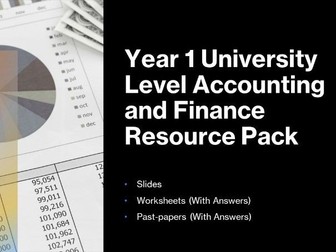
This is the perfect resource pack for any Accounting, Finance or Economics professor who teaches Year 1 University students. I developed these resources when tutoring Year 1 students at City and Loughborough Universities.
This pack includes slides, worksheets, answers to worksheets and exam-style questions for the following topics
Introduction to Accounting and Finance
Statement of Financial Position
Statement of Profit and Loss (Income Statement)
Accounting for Credit Losses and Advance Sales
Non-current assets
Inventory Valuations
Statement of Cash Flows
Appraisal Performace
I hope you enjoy using these resources. My logo is on the top of the documents but they are easily editable.
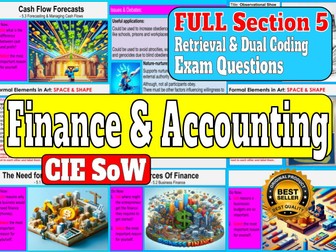
5) Finance & Accounting - (5 Full Lessons)
Leave a review for a FREE single resource
This SoW has been meticulously crafted, offering a differentiated and engaging approach that enables efficient progression through content.
Built to the highest standards and grounded in current research, the unit incorporates dual coding and retrieval practices at its core. A consistent colour scheme is also utilised to enhance both your delivery and students’ comprehension.
5) Finance & Accounting - (5 Full Lessons)
5.1 Business Finance
5.2 Sources Of Finance
5.3 Forecasting & Managing Cash Flows
5.4 Costs
5.5 Budgets
By leaving a review of any of our resources, you can claim a FREE single resource from our ever-expanding library. Just send a message to the email above, which is checked daily.
upsidelearning1@gmail.com
Best FREE Resources (Upside Learning)
FREE - Computer Safety - https://www.tes.com/teaching-resource/-13121810
FREE - Coraline Neil Gaiman (Lesson 1) - https://www.tes.com/teaching-resource/resource-13108829
FREE - Gothic Literature (Lesson 1) - https://www.tes.com/teaching-resource/-13109342
FREE - Physics IGCSE (Lesson 1) - https://www.tes.com/teaching-resource/-13118154
This is one of a set of Powerpoints (and accompanying Notes/Key Terms sheets) that I have created for my own teaching of various sections of the new (linear) OCR AS Business specification (H031/H431). They follow the order of teaching recommended by the exam board and (generally) the OCR-approved textbook (Mottershead/Grant/Kelt, 2015).
Specification reference:
• explain sources of finance
• distinguish between internal and external sources of finance for a business
• distinguish between short-term and long-term sources of finance for a business
• explain how factors such as the following affect the choice of finance for a business: o time
o legal structure
o quantitative factors
o qualitative factors
o external influences
• evaluate sources of finance for a business and its stakeholders.
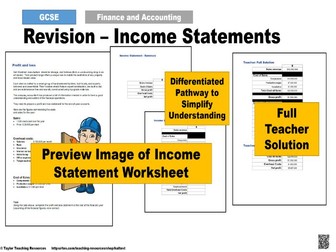
This is a revision resource to revise Income Statements and is one part of a pack / Workbook to revise Accounts and Finance. This resource will be part of a Full Revision Pack to cover:
Breakeven
Cashflow Forecasts
Sources of Finance
Income Statements
Balance Sheets
Ratios
⠀
This worksheet has been designed for GCSE / iGCSE.
⠀
This Worksheet has the following Learning Objectives:
Revise all aspects of Income Statements
Know how to create and income statement based on given data
Extension Task to calculate Gross and Net Profit
⠀
Resources to run the lesson(s) included in this download:
Worksheet based on a Scenario
Full teacher answers
⠀
The aim of all my resources is to provide lessons / activities of good quality that will add value to your lessons / schemes of work.
⠀
All activities and resources have been used in classes and any errors will be fixed and resources updated as soon as I am aware them. I have priced my resources at what I consider to be a reasonable cost based upon the amount of effort and work I have put into them but all comments and suggestions are very welcome and will be used to improve future resources.
⠀
If you have an idea for a topic / resource that you would like to see, feel free to leave a comment.
⠀
The contents of this page and all downloaded materials are copyrighted Taylor Teaching Resources.
⠀
See our other resources for Business Studies, Computer Science and ICT here
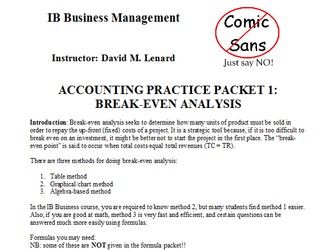
This resource is a work packet for IB Business Management Unit 3 (Accounting and Finance). It provides structured, scaffolded help for students in learning the concepts of break even analysis.
This packet is the first of a series (ultimately 7 packets are intended) and is provided free of charge. If you find this packet useful, please consider purchasing some of the others. The full series is described below:
Packet 1: Break Even Analysis
Packet 2: Profit & Loss Statement/Income Statement
Packet 3: Balance Sheet
Packet 4: Cash Flow Statement
Packet 5: Investment Appraisal
Packet 6: Sales Projection
Packet 7: Production Planning/Inventory Management


 Quick View