Edexcel further maths AS Level decision maths notes. Super simple and concise, contain everything you need to know for the AS decision maths exam. Got me an A in the AS Level exam!
PowerPoints to teach the full A Level Further Maths Decision/Discrete Maths course (Edexcel)
Primarily written for Edexcel but suitable for much of the OCR specifications. The set of 16 PowerPoints contains complete, step-by-step instructions and A Level standard examples. These may be used for both teaching and for student revision.
Decision Maths is a module that lends itself to PowerPoint instruction – networks grow and develop as information is added, and these PowerPoints model this in real time.
Having developed these as a teaching resource, I find the course can be taught in a substantially reduced time, leaving more time for consolidation and practice or for teaching other FM options. My students take no notes in class but, once taught, use the PowerPoints as reminders and revision as they practise. Most PowerPoints contain a handy flowchart for in-class prompts or for private revision. When used under the previous, modular, A Level specification, this module was consistently the highest-scoring module for my students.]
“S”, year 12, says: “I find these PowerPoints really visual – I can see what is happening. It makes the process of learning much quicker and easier to understand, and I like the fact that I can always go back and replay the lessons, which is helpful. I find them very useful for revision.”
The full set of 16 PowerPoints consists of:
Algorithms
Bin-Packing Algorithm
Critical Path Analysis (GANTT)
Dijjkstra’s Shortest Path Algorithm
Floyd’s shortest distance algorithm
Graphs & Networks
Kruskal’s Minimum Spanning Tree
Linear Programming
Planarity Algorithm
Prim’s Minimum Spanning Tree
Route Inspection Algorithm
Simplex Algorithm 1 - Edexcel tableau
Simplex Algorithm 2 (artificial variables) - Edexcel tableau
Simplex Algorithm 3 (Big M method) - Edexcel tableau
Sorting Algorithm: Quick-sort, Bubble-sort (& Shuttle-sort for OCR)
Travelling Salesperson Problem, including Nearest Neighbour Algorithm (+ tour improvement algorithm for OCR)
Updated 2022
This is a set of lessons for Decision Mathematics. The resources include Powerpoints and worksheets.
Powerpoint include:
Learning objectives
Examples animated at each step to support explanations and independent learning
Important information written in red boxes to scaffold learning.
Worksheets include examples on a word document for students to write on.
Topics:
Spanning Trees
Linear Programming
Dijkstra’s Algorithm
Chinese Postman Problem
Travelling Salesman Problem
Matching
Sorting
Algorithms
Graph Theory
I hope you enjoy these lessons, where they can be used in the following ways:
To deliver a course with reduced planning but not reducing quality of the lesson, as this course can be time consuming writing and preparing examples, where this resource can help.
As a basis for an observation lesson to save time preparing resources.
To give to students for out of lesson learning.
To support teachers who are new to this topic, again to reduce planning time.
DECISION ANALYSIS is one PowerPoint covering one topic of Edexcel’s Further Maths Decision Maths 2 course. There are 7 other PowerPoints covering the other topics (detailed below), which can be bought separately. The whole set of 8 PowerPoints is also available to purchase as a bundle.
Each PowerPoint contains complete, step-by-step instructions and A Level standard examples. These may be used for both teaching and for student revision.
Decision Maths is a module that lends itself to PowerPoint instruction – networks grow and develop as information is added, and these PowerPoints model this in real time.
Having developed these as a teaching resource, I find the course can be taught in a substantially reduced time, leaving more time for consolidation and practice or for teaching other FM options. My students take no notes in class but, once taught, use the PowerPoints as reminders and revision as they practise. Most PowerPoints contain a handy flowchart for in-class prompts or for private revision. When used under the previous, modular, A Level specification, this module was consistently the highest-scoring module for my students.
“S”, year 12, says: “I find these PowerPoints really visual – I can see what is happening. It makes the process of learning much quicker and easier to understand, and I like the fact that I can always go back and replay the lessons, which is helpful. I find them very useful for revision.”
This PowerPoint is for:
DECISION ANALYSIS
Other titles in the series are available separately for each of:
Dynamic programming
Flows 1
Flows 2
Game Theory
Hungarian Allocation Algorithm
Recurrence Relations
Transportation Algorithm
Updated 2025
This bundle of 8 PowerPoints teaches the complete Edexcel D2 Decision Maths Further Maths module.
Each PowerPoint gives thorough, step by step instructions on how to do all aspects of the topic, supported by exam-standard worked examples.
The algorithms involved in Decision Maths are ideal for explanation by PowerPoint, where complex diagrams are built up gradually, with each step explained.
Now you’ve learned the basics of Scratch, you can experiment with some of its more advanced features. The more you practice, the better your coding will become.
What You Get:
• Things to try
• Backpack
• Help
• Similarities to Python
• Next Steps
My Scratch Resources:
This resource is part of a numbered set. It can be used separately or in conjunction with my other Scratch resources.
This resource can be bought in a bundle here. Other Resources in this set include the following:
• Scratch: Binary (Advanced #1)
• Scratch: Decisions (Advanced #2)
• Scratch: Sensing and detecting (Advanced #3)
• Scratch: Complex loops (Advanced #4)
• Scratch: Sprite Communication (Advanced #5)
• Scratch: Creating Blocks (Advanced #6)
• Scratch: Monkey vs Bat - Game Programming (Advanced #7)
• Scratch: Things to try (Advanced #8)
• Scratch Bundle: Advanced To Your Third Game (Value Pack)
Full lesson on Dijkstra's algorithm for finding the shortest path in a network. Fully animated powerpoint takes students slowly through the process of labelling the nodes and selecting which nodes will form part of the solution. The lesson resource is fully write-on and will only need printing (answers are included). There is another resource which covers more basic practice questions (with answers given).
This is a PowerPoint presentation which uses animation, simple layouts, graphics and diagrams to clearly explain all topics required for a full understanding of Decision Maths Year 1, Linear programming. This is completely in-line with the Edexcel A-level Further Maths specification.
teachingisgood is happy to declare that this presentation also includes loads of practice questions, which build up a key understanding and build exam skills, as well as exam-style questions which push problem solving skills with questions aimed at the highest achieving students.
This presentation is part of a series of presentations for A-level Further Maths, some of which also include interactive quizzes, videos and fun ways to test students and develop knowledge.
The topics covered in this presentation is as follows.
Linear programming problems
Graphical methods
Locating the optimal point
Solutions with integer values
This is a PowerPoint presentation which uses animation, simple layouts, graphics and diagrams to clearly explain all topics required for a full understanding of Decision Maths Year 1, The simplex algorithm. This is completely in-line with the Edexcel A-level Further Maths specification.
teachingisgood is happy to declare that this presentation also includes loads of practice questions, which build up a key understanding and build exam skills, as well as exam-style questions which push problem solving skills with questions aimed at the highest achieving students.
This presentation is part of a series of presentations for A-level Further Maths, some of which also include interactive quizzes, videos and fun ways to test students and develop knowledge.
The topics covered in this presentation is as follows.
Formulating linear programming problems
The simplex method
Problems requiring integer solutions
Two-stage simplex method
The big-M method
A complete set of PowerPoint resources specifically aimed at the (Edexcel) Mathematics IAL (2018) course but also suitable for the IB Diploma.
The files contain fully editable teaching / revision notes, examples, animations and hyperlinks to facilitate navigation.
Try the free sample before you buy: https://www.tes.com/teaching-resource/resource-11976115
Topics covered are algorithms, algorithms on graphs, critical path analysis, algorithms on graphs II, linear programming.
Files are updated on a regular basis and feedback is welcome.
Follow me on Twitter and Pinterest @hatchtag73.
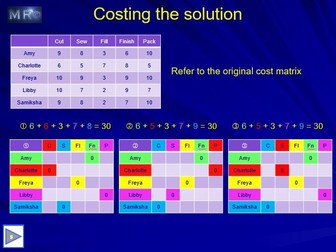
PowerPoints written so that a teacher can learn from the PowerPoints and teach from them. Students can use the PowerPoints to learn independently too. Many colleagues have used my lessons on Decision 1 without a strong understanding of Decision themselves. Includes an easy to mark chapter test with answers.
 Quick View

 Quick View
 Quick View
 Quick View
 Quick View
 Quick View
 Quick View
 Quick View