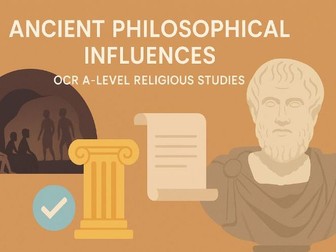
Ancient Philosophical Influence planned for OCR Philosophy - H573. This resource consists of nine PowerPoint presentations with an accompanying workbook planned to be taught in twelve hours. One of the presentations is an introduction to the course and how to argue in Philosophy. Attached you will also find a key assessment quiz with answers.
This comprehensive resource pack includes everything you need to teach the Ancient Philosophical Influences topic with confidence and clarity. Designed specifically for the OCR A-Level Religious Studies specification, this pack contains a full sequence of high-quality, fully embedded lessons and supporting materials.
What’s Included:
Engaging, ready-to-teach lessons covering:
An introduction to Plato and Aristotle
An overview of Socrates and the pre-Socratics
Plato’s Theory of the Forms and the Hierarchy of Forms
Plato’s Cave and other key analogies
Aristotle’s Four Causes and Prime Mover
A comparative study of Plato’s Form of the Good and Aristotle’s Prime Mover
Dedicated essay planning and evaluation support
What You’ll Get
Each lesson includes:
Fully resourced PowerPoints with all key content for the OCR specification
Retrieval and recap activities to strengthen understanding
Worksheets and discussion tasks
Evaluation and essay-planning templates to develop AO2 skills
Exam-style practice and model responses
Proven Impact
These resources have been tried, tested, and refined to support outstanding student outcomes — contributing to ALPS scores of 1 and 2 in A-Level Religious Studies.
Whether you’re an experienced teacher looking to save time or new to the course and seeking clear, structured guidance, this pack provides everything needed for success in the Philosophy of Religion unit.
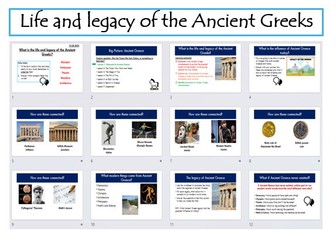
This KS3 lesson explores the lasting impact of Ancient Greece on the modern world. Students evaluate which Greek achievements, such as democracy, philosophy, art, sport, and warfare, have been most influential, providing reasons for their choices. The lesson encourages critical thinking while introducing key examples of Greek contributions to modern society. Ideal as an introduction to Classics or Ancient History. All resources are included!
Learning Outcomes:
Explain key achievements of Ancient Greece in politics, sport, art, philosophy, and warfare.
Evaluate which Greek achievements have had the greatest impact on the modern world.
Identify examples of Ancient Greek innovations and cultural contributions.
Thanks for looking at my resource! If you find it helpful, please leave a review. You can also check out my other lessons on Ancient Greece and Classics.
These lessons are part of a History of Philosophy in Fifty Questions scheme of work, which takes students from Thales and the origins of philosophy, right up to the 21st Century.
Each lesson is based around an inquiry question, which links to the work of a key philosopher:
Thales: What is Philosophy?
Plato: What is reality?
Plato: Should art be censored?
Aristotle: What is the best type of government?
Aristotle: What is Friendship?
Each lesson is a contained in single resource which includes:
Vocabulary recap “settle down” starter/bell task
Discussion based starter linking to the inquiry question for the lesson
Glossary of key terms introduced in the lesson
A key reading which supports the inquiry question
Knowledge check questions to clarify student understanding of the reading
Discussion and extended writing tasks
A teacher page, giving suggested answers for starter tasks
These resources are great if you want to spend your time on teaching rather than editing somebody else’s PowerPoint. They also work well for cover lessons and distance learning or home education.
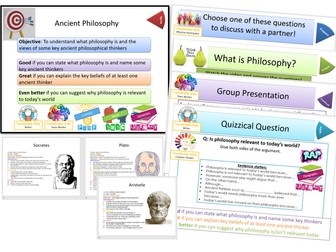
Lesson intended as a double lesson (roughly 1.5 hours) as part of a unit of work called ‘Ancient Beliefs’ for KS3. Lesson includes:
Homework
Starter
3D learning objectives and differentiated outcomes
What is philosophy? video task
Q and A
Video Activity
Group research
Presentations
Quizzical question
Plenary
Differentiation (where necessary)
Please give feedback! I am always happy to respond to comments - whether positive or constructive - this will help to improve the quality of my resources in the future and, more importantly, the quality of pupils’ RE/RS education in general - which is what we’re all here for!
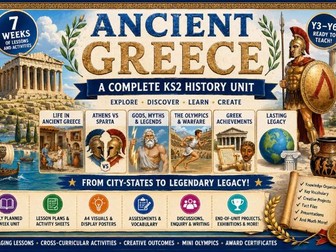
Ancient Greece KS2 Complete Topic Pack | 7 Weeks | Lessons, Activities, Visuals & Assessments
Bring Ancient Greece to life with this engaging and fully planned 7-week KS2 history unit, packed with colourful A4 visual resources, activity sheets, assessments and end-of-unit outcomes.
Designed to develop historical knowledge, enquiry skills and cross-curricular learning, this topic explores the people, achievements and lasting legacy of one of the world’s most influential civilisations.
Perfect for Years 3–6, this resource provides a complete sequence of lessons that guide pupils from locating Greece on a map through to understanding how Ancient Greek ideas still influence modern life.
Included Topics
Week 1: Introduction to Ancient Greece
Where is Greece?
When was Ancient Greece?
What was Ancient Greece?
Athens and Sparta
Ancient Greece and Today
Week 2: Life in Ancient Greece
Homes and Daily Life
Food, Clothing and Trade
Children and Education
Rich and Poor Citizens
Men, Women and Slaves
Week 3: Athens vs Sparta
Democracy in Athens
Military Life in Sparta
Similarities and Differences
Which City-State Offered the Better Life?
Week 4: Greek Gods and Myths
Greek Beliefs
Mount Olympus
Gods and Goddesses
Myths, Heroes and Monsters
Creating Original Greek Myths
Week 5: The Olympics and Warfare
Origins of the Olympic Games
Ancient Greek Athletes
Hoplite Soldiers and Warfare
The Battle of Marathon
Classroom Mini Olympics
Week 6: Greek Achievements
Philosophy and Famous Thinkers
Mathematics and Science
Theatre and Storytelling
Architecture and the Parthenon
Greek Achievement Exhibition
Week 7: Lasting Legacy
Democracy and Government
The Olympics Then and Now
Greek Influences in Everyday Life
Architecture, Storytelling and Culture
Presentation or Digital Project
Resource Features
✔ Full 7-week topic structure
✔ A4 portrait teaching posters
✔ A4 portrait activity sheets
✔ End-of-week assessment pages
✔ Key vocabulary for every lesson
✔ Knowledge-rich teaching points
✔ Discussion and enquiry activities
✔ Writing opportunities throughout
✔ Creative projects and presentations
✔ Mini Olympics event resources
✔ Award certificates and recording sheets
✔ Exhibition and presentation outcomes
Final Outcomes
Pupils will create:
Fact files
Diary entries
Persuasive writing
Myth retelling books
Sports reports
Achievement exhibitions
Presentations and digital projects
Curriculum Links
History
Geography
English
Art and Design
Design Technology
Speaking and Listening
PSHE
Physical Education
This comprehensive topic pack provides everything needed to deliver an engaging, knowledge-rich Ancient Greece unit while encouraging curiosity, critical thinking and creativity. Perfect for classroom teaching, intervention groups, topic weeks or home learning.
12 hours of fully resourced Philosophy lessons and an assessment offering an introduction to Philosophy for KS3/4. All lessons include a 1 or 2 hour PowerPoint, clips, worksheets and are differentiated fully to three or four levels.
All our RE, PSHE, Citizenship and RE resources have been designed to be engaging, detailed and easy to follow. All our resources are editable (so easy to adapt for your classes) and are designed to last one hour each.
Or you can check out some of our most popular PSHE, Citizenship and RE resources below:
Mental Health PSHE Bundle
1 Whole Year of PSHE Resources
British Values Citizenship Bundle
Careers, Employment and Enterprise Bundle
Islam Bundle
Sex and Relationships Education
These are Snipnotes. A resources which is designed to break down difficult philosophy into sizeable chunks. This specific Snipnote is on Ancient Greek Philosophy designed for the OCR course.
This comprehensive worksheet focusing on Ancient Greek Philosophy – Reading Comprehension is expertly crafted to elevate critical thinking and analytical skills. It delivers a wide array of stimulating exercises tailored to enhance word meaning, inference, summarizing, analysis and evaluation, content evaluation, structure comprehension, retrieval skills, prediction, explanation, exploration, comparison, and synthesis capabilities.
Key Features:
Word Meaning: Broaden your vocabulary through comprehensive exploration of word meanings.
Inferences: Hone your ability to draw logical conclusions from provided information.
Summaries: Cultivate the skill to distil intricate texts into concise, meaningful summaries.
Analysis and Evaluation: Enhance your capacity to analyse and critically evaluate information.
Content, Structure, and Quality: Assess the content, structure, and quality of diverse texts.
Retrieval: Refine your aptitude to locate and extract specific information from texts.
Predicting: Anticipate outcomes or future developments based on available information.
Explaining and Exploring: Expand your knowledge by explaining and exploring various topics.
Comparison and Synthesis: Merge information from multiple sources to deepen insights.
Ideal Usage:
Cover Lesson: Perfect for stepping in when the lead educator is absent.
Homework Task: Assign as homework to reinforce learning beyond the classroom.
Revision: An exceptional resource for reviewing and solidifying key skills and knowledge.
Don’t overlook this invaluable resource that promises to accelerate your academic growth, fostering proficient critical thinking skills. Download the PDF and embark on a journey towards enhanced learning and mastery. Please note PDF is not editable.
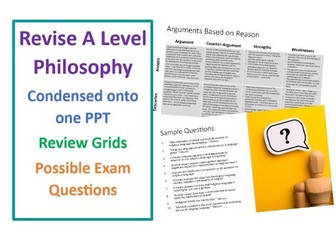
This extensive revision PPT revises the whole of OCR A Level Philosophy, helpfully summarising each topic into one revision grid. After each unit, ten sample questions (based on the language of the spec) are there to focus revision and prepare for possible exam questions on the topic.
Topics include:
Ancient Philosophical Influences
Soul, Mind and Body
Arguments from Observation
Arguments from Reason
Religious experience
Problem of Evil
Nature of God
Religious Language
20th Century Perspectives
Created with the OCR RS AS/A Level in mind, though can be applied across specifications and qualifications.
Please give feedback! I am always happy to respond to comments - whether positive or constructive - this will help to improve the quality of my resources in the future and, more importantly, the quality of pupils’ RE/RS education in general - which is what we’re all here for!
Complete unit of work for the teaching of Ancient Greek Influences, focusing on Plato and Aristotle. This was created for the A-Level Religious Studies OCR.
The resource includes PowerPoint slides for a series of lessons covering the whole unit, plus a student booklet made alongside the PowerPoint to encourage student-led learning. The booklet includes a wide range of activities to test and demonstrate knowledge and understanding.
The resource covers all key points on the spec, including Plato’s theory of the forms and analogy of the cave, Aristotle’s four causes and the Prime Mover, concluding in evaluation of both theories and comparison of the two.
Also included in this resource package is an A3 revision sheet for comparison of the theories plus an A3 revision map breaking the unit down into clear sections; a knowledge test, with answers included; an example essay with clear structuring and example points to support students.
If you find this resource helpful or have any further comments, please let me know.
Happy teaching!
Formative Essays for Ancient Greek influences on religious philosophy.
Each essay is broken down into either AO1 or AO2 for the OCR Philosophy of Religion - G571 - specification.
Each breakdown makes clear what a student needs to do to achieve either A, C or E.
Overview, self and teacher assessment, self-reflection document. I designed it to help me to keep a tight reign on the programme of study (I have a tendency to spend too long on this topic!) and to encourage my students to take more of an active role in their progress and learning. I'm hoping it will also help to encourage an open learning environment by encouraging the sharing of misconceptions etc.
A workbook for OCR AS Religious Studies unit on Ancient Greek influences on Philosophy of Religion. Contains thought points for discussion, activities and review questions. Stretch and challenge activities are marked **


 Quick View