Absolutely everything you need to teach Trigonometry. The whole units worth of lessons.
- SOHCAHTOA
- Sine and cosine rules
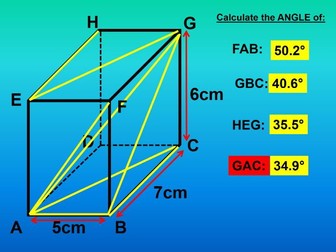
- Trig in 3D
- Trig with bearings
- Trigonometric graphs
A complete lesson on finding an angle in a right-angled triangle using trig ratios. Designed to come after pupils have been introduced to the ratios sin, cos and tan, and have investigated how the ratios vary. Please see my other resources for complete lessons on these topics.
Activities included:
Starter:
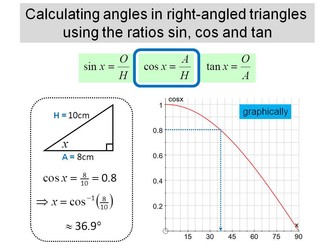
Provided with the graph of y=sinx, pupils estimate sinx for different values of x and vice-versa.
Main:
Slides to introduce use of scientific calculators to find accurate values for angles or ratios.
Examples of the basic method of finding an angle given two sides. Includes graphs to reinforce what is happening.
Quick questions for pupils to try and provided feedback.
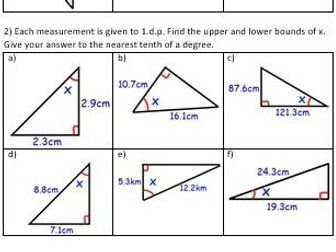
A worksheet of questions with a progression in difficulty. Starts with standard questions, then moves on to more challenging ones (eg finding the smallest angle in a non-right-angled, isosceles triangle).
Plenary:
A final question to check pupils’ understanding, but also with a combinations/logic element.
Printable worksheets and answers included.
Please review if you buy as any feedback is appreciated!
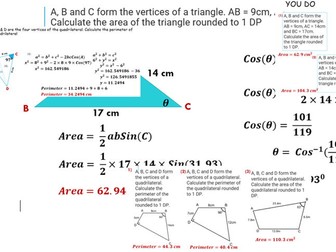
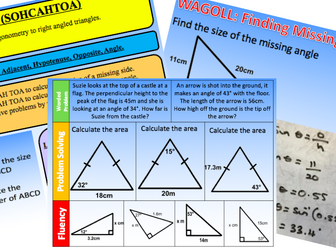
This is the last lesson in the series of lessons on all non-right angled traingle trigonometry. Students are presented with problems where they have to apply multiple trig rules they’ve learned over the last few lessons (area rule, sine rule, cosine rule) in order to solve multistep problems. All answers are provided on the slides
This is designed for a year 9 class. The idea is to have a break down list of what to do with trigonometry questions and then practise each step as it comes. Worked examples/your turn to build confidence.
This interactive PowerPoint is designed to be used over 2 to 3 lessons for teaching and contains worksheets/activities for learners.
This resource comes with two PowerPoints (Teacher and student). The teacher PowerPoint has interactive functions and has answers to all questions; also every slide has an invisible protective sheet preventing you from accidentally clicking to another slide making this PowerPoint ideal for teaching a lesson. The student PowerPoint does not have answers so it’s great for printing out slides and worksheets for learners.
Every question has its own answer button allowing you to select the answers you want to display. This provides immediate feedback and can be used to differentiate work.
Furthermore, all boxes with a brown background contain a function, click on them to activate the function.
Level of work: GCSE level 4-5
Duration: 2-3 lessons
Learning objectives: Solve simple equations containing trigonometry operations. Use the three trigonometric ratios to calculate angles and lengths of right angle triangles. Use trigonometry to solve worded problems and exam questions.
PowerPoint contains 15 slides:
slide 1: Content page with information and links to all slides in the PowerPoint
slide 2: Learning objectives
slide 3: Crossword activity to learn key words
slides 4-6: Three worked examples
slides 7-12: Worksheets with progressive questions and interactive answers.
slides 13: Questions for class/group discussion. (excellent for paired/group work)
slides 14-15: Exam style questions with interactive answers
Similar resources can be purchased from my shop in TES resources.
A memory-jogger for students who have recently covered basic trigonometry. How to determine whether to use Pythagoras, and how to use SOHCAHTOA. The sine and cosine rule are not included at this stage.
A collection of seven questions that use the basic trigonometric principles, but in a worded problem context.
Students will need to draw out the problem, work step-by-step to solve these questions.
nb: One of the questions involves an Arc calculation.
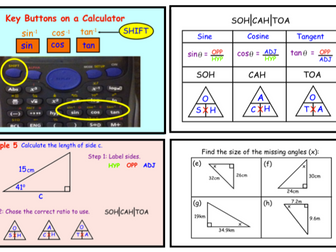
3 lessons, taking students through a step by step process of what is a trig ratio, to how to what buttons to use on a calculator, to problem solving.
Includes; keywords, why we use trig, correct labeling of sides, using SOH/CAH/TOA and related formulae.
Plus worked examples, practice questions, exam style questions, and a separate lesson on Angles of Elevation and Depression.
Objectives:
To be able to use a calculator to find trigonometric ratios. (grade 5)
To be able to recognise which trigonometric ratios to use. (grade 5)
To be able to use trigonometric ratios to solve problems. (grade 5/6)
A complete lesson on using and applying Trigonometry to right angled triangles which is suitable for the new curriculum.
Pupils are given the chance to master the fluency of this topic aswell as work on reasoning and problem solving tasks.
All tasks are differentiated to 3 levels all with solutions and offer lots of consolidation as well as alot of challenge. Can be used with KS3/KS4.
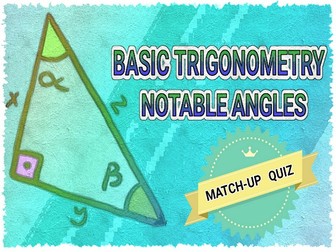
A set of 20 worksheets containing match-up quizzes about the most common trigonometric functions of the “notable angles”. For example: Cos(90°), Tan(60°)…Sin(π)…
Each worksheet has 10 pairs to match, there is also a subset of “tricky” quizzes where one item is an “intruder” and must be identified.
Why ? Because trigonometry is a building block for physics and geometry. Also, advanced math courses like calculus require trigonometry proficiency.
Summary:
File format: Printable PDFs
Worksheets: 20
Topic : trigonometry (the notable angles with radians and degrees)
Difficulty: easy
Don’t hesitate to contact me for further details, thanks.
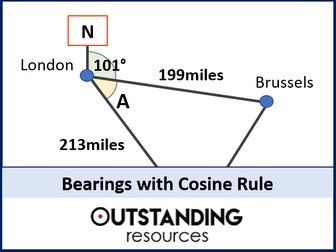
This is an excellent whole lesson on Bearings with the Cosine Rule with resources to teach a subject that is often done poorly in exams. The lesson involves using understanding bearings but also how often it is incorporated with trigonometry and therefore a good existing level of trigonometry is required. It comes after a lesson on Bearings with SOHCAHTOA, this is the next more advanced level. This lesson is ready to go, with no prep required. It is also great for home learning and flip learning. 18-slide presentation + supplementary resources.
The lesson includes:
Starter (linked to angle rules)
Learning objectives (differentiated)
Keywords
Key Rules and Notation
Fantastic Teaching Slides (with lots of custom animation)
Great Examples to follow
Worksheet (with answer key)
Plenary
Bonus Poster (for classroom display)
All LESSONS on Geometry in one MEGA BIG Bundle :
Geometry - All Lessons
For any issues, please email outstandingresourceshelp@gmail.com
and we will aim to respond within 48 hours.
Lessons are flat-packed (with limited editing) to maintain copyright protection.
We would greatly appreciate it if you could leave a rating and feedback.
Thank you for your support, your purchase, and for taking the time to provide feedback!
#mathslessons #maths #secondarymaths #mathscentres #teachingideas #algebra #teacherslife #teachingkids #teachingmaths #mathsactivities #homeschooling #tesresources #teaching #mathsisfun #teachershare #teachertips #teachers #KS3 #KS4 #KS5 #igcse #learning #gcsemaths
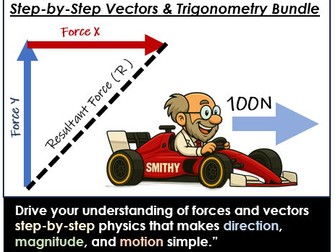
Build student confidence in vectors, forces, and trigonometry with this clear, structured bundle of step-by-step GCSE Physics resources.
Each PowerPoint breaks complex vector and trig problems into simple, guided stages — ideal for teaching, revision, or independent learning.
Includes:
Resultant Vectors & Pythagoras’ Theorem – Combine forces using scale diagrams and right-angle triangles.
Step-by-Step Guide: Resultant Force Vectors – Calculate magnitude and direction with clear worked examples.
Trigonometry Step-by-Step Guide – Apply sine, cosine, and tangent to resolve components and forces.
Vector Diagrams Step-by-Step – Draw, label, and analyse vector triangles accurately for real-world contexts.
Perfect for:
GCSE Physics and Combined Science (AQA, Edexcel, OCR).
Classroom teaching, revision sessions, and homework.
Strengthening mathematical reasoning and graphical skills.
Save over 35% with this complete vectors and trigonometry toolkit — clear explanations, consistent formatting, and printable student examples.
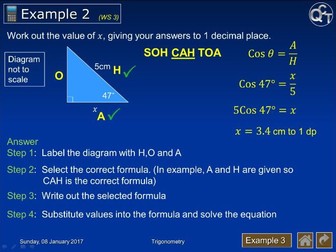
This resource demonstrates, step-by-step, how to use ‘SOH CAH TOA’, with a question covering each (three slides in total).
During another year of tutoring, I have constantly been reminded of how so many students struggle with the basics. These basics obviously provide the foundation to move onto more complex topics and knowledge of them is absolutely essential in building confidence and belief in a student’s ability in the subject. Educational establishments must begin to realise this and ensure that the foundations are absolutely secure and solidly embedded before moving on.
This resource demonstrates, step-by-step, how to use ‘SOH CAH TOA’, with a question covering each (three slides in total).
During another year of tutoring, I have constantly been reminded of how so many students struggle with the basics. These basics obviously provide the foundation to move onto more complex topics and knowledge of them is absolutely essential in building confidence and belief in a student’s ability in the subject. Educational establishments must begin to realise this and ensure that the foundations are absolutely secure and solidly embedded before moving on.
“In the small town of Raven’s Hollow, a mysterious mansion stands abandoned on the outskirts. The locals speak of a dark history surrounding the mansion, with tales of a gruesome murder that took place within its walls. Curiosity draws a group of friends to enter the mansion, where they find themselves trapped in a series of interconnected rooms, each holding clues to unravel the secrets of the past.”
The story runs alongside tasks to test students’ knowledge and understanding of trigonometry.
The escape room is interactive. Students can move objects and click on them to reveal clues. No handouts are required but scrap paper is useful as some clues need to be written down and rearranged.
There are gentle hints at the top of each page but students should click around the whole room to move or reveal clues.
It is important clues are solved as they are required to pass to the next page.
The escape room is a great end-of-topic task to check student´s understanding in a novel way.
You will receive a PDF document on purchase containing the website, password and answers.
No email addresses are needed to play.
No google account needed.
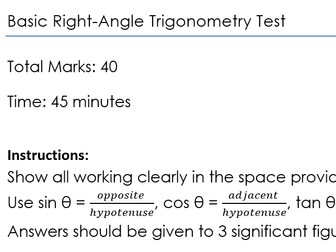
Right-Angle Trigonometry Test – Year 10 Cambridge Curriculum
This comprehensive 40-mark test is designed for Year 10 students following the Cambridge Curriculum. It covers key concepts in right-angled trigonometry, focusing on sine, cosine, and tangent ratios, as well as practical applications such as calculating distances, angles of elevation, and angles of depression.
The test is divided into three sections:
Basic Applications (10 marks): Evaluates understanding of fundamental trigonometric ratios.
Problem Solving (20 marks): Involves real-world scenarios, encouraging students to apply their knowledge.
Mixed Concepts (10 marks): Challenges students with more complex, multi-step problems involving trigonometric calculations.
An accompanying mark scheme, provided in table format, ensures quick and accurate grading. With clear instructions and print-friendly formatting, this resource is ideal for class assessments, homework, or revision practice. Downloadable in Word format, it is easily editable to suit different teaching needs.
This test is perfect for assessing student progress and reinforcing essential trigonometry skills.
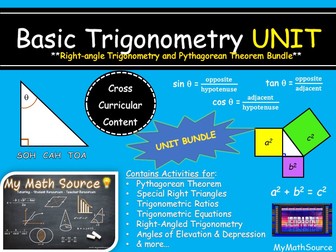
This resource is a WHOLE UNIT PLAN covering the following topics:
Pythagorean Theorem
Special Right Triangles
Trigonometry: Trigonometric Ratios
Trigonometry: Solving Trigonometric Equations
Trigonometry: Finding missing sides and angles of right triangles
Trigonometry: Applications of Trigonometry - Angles of Elevation and Depression
This Unit contains Vocabulary Activites, Skill and Drill Worksheets, Problem Solving, Critical Thinking and Error Analysis Activites, all with their respective Answer Keys.
There are also Student Study Guides and a PowerPoint Revision Template that can be edited for any topic, chapter, unit or even subject.
The activities are based off of the IGCSE 0580 standard which states:
E6.2 – Apply Pythagoras’ theorem and the sine, cosine and tangent ratios for acute angles to the calculation of a side or of an angle of a right-angled triangle.
 Quick View

 Quick View
 Quick View
 Quick View
 Quick View
 Quick View
 Quick View
 Quick View
 Quick View
 Quick View
 Quick View
 Quick View
 Quick View
 Quick View