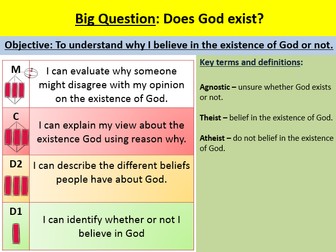
A lesson on atheism, theist and agnostics views on the existence of God. Used as an introduction to Religious studies. Can be use at Key Stage 3, but can be adapted for all levels. Lesson contains engaging activities and opportunities for in-depth discussion about related issues. There are opportunities for extended writing. Lesson is differentiated via SOLO Taxonomy. Please visit my online shop for lots more similar resources at https://www.tes.com/teaching-resources/shop/JamesPearson
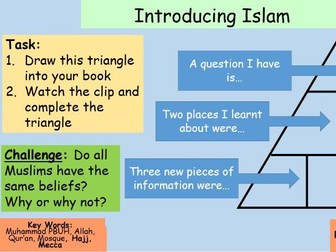
Introductory lesson- Muslim beliefs about God.
Full lesson with 1 resource
Suitable for Y7/Y8
This lesson focuses on
Origins of Islam- where and when it was founded
Includes introductory information around Muhammad
Key beliefs about Allah
Guided reading task
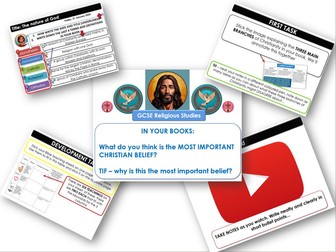
GCSE lesson with all accompanying resources based on the AQA Religious Studies A course, Christian Beliefs unit. Lesson one. This lesson introduces students to the three main branches of the church, to three key qualities of the Christian God (Omnipotence, Omnibenevolence, Justice) and to 2 types of AQA exam question. Updated August 2025 in line with new AQA guidance, which places greater emphasis on identifying and applying sources of authority / religious teachings. Included in this resource:
Lesson powerpoint with originally designed images
Written resources on the three branches of the church, three qualities of God and some key Bible teachings
Interactive activities to help students retain key information
2 exam style questions with model answers for peer / self assessment
Video clip
Extra resource for students needing more support to master the ‘qualities of God’ learning
This tried and tested lesson will get your students off to a great start with the Christian Beliefs module…
Need more along these lines? Check out these resources:
Trinity – https://www.tes.com/teaching-resource/christian-beliefs-2-trinity-13192396
Creation – https://www.tes.com/teaching-resource/christian-beliefs-3-creation-13192844
Incarnation - https://www.tes.com/teaching-resource/christian-beliefs-4-the-incarnation-13302387
Crucifixion - https://www.tes.com/teaching-resource/christian-beliefs-5-the-crucifixion-13302451
Resurrection double lesson - https://www.tes.com/teaching-resource/christian-beliefs-6-resurrection-and-ascension-double-lesson-13303592
Ascension short lesson - https://www.tes.com/teaching-resource/christian-beliefs-7-the-ascension-13304006
Judgement and afterlife - https://www.tes.com/teaching-resource/christian-beliefs-8-judgement-and-afterlife-13304113
Christ and salvation - https://www.tes.com/teaching-resource/christian-beliefs-9-christ-and-salvation-13304800
Nicene Creed - https://www.tes.com/teaching-resource/christian-beliefs-extra-nicene-creed-13310293
CHRISTIAN BELIEFS FULL UNIT - https://www.tes.com/teaching-resource/christian-beliefs-full-unit-13310337
CHRISTIAN PRACTICES FULL UNIT - https://www.tes.com/teaching-resource/christian-practices-full-unit-13310344
REVISION MASTERY PACK - https://www.tes.com/teaching-resource/christianity-mastery-pack-13108079
ISLAM BELIEFS FULL UNIT - https://www.tes.com/teaching-resource/islam-beliefs-full-unit-13311171
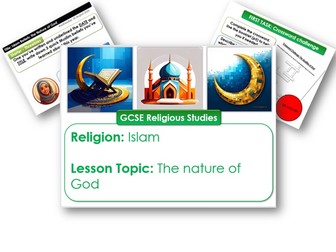
GCSE package with all accompanying resources based on the AQA Religious Studies A course, Islam Beliefs unit.
Everything you need for excellent, comprehensive, learning. Save 32% - buy the whole package for £25 (£37 if bought separately)
All resources have been updated in August 2025 in line with new AQA guidelines (6 mark questions, new question wordings etc.) Included in this resource:
10 lessons covering all the topics in the textbook
All accompanying resources are editable and feature originally designed images
Lessons feature ‘do it now’ tasks that require no printing
A full set of model answers, updated to new exam styles and wordings
Links to video clips and a range of other resources to help students understand the significance of key themes for contemporary Muslims
Guidance and scaffolding to help students consider and construct their responses
Need more along these lines? Check out the first 3 lessons in this series in my online shop:
Nature of God – https://www.tes.com/teaching-resource/christian-beliefs-1-nature-of-god-13192358
Trinity – https://www.tes.com/teaching-resource/christian-beliefs-2-trinity-13192396
Creation – https://www.tes.com/teaching-resource/christian-beliefs-3-creation-13192844
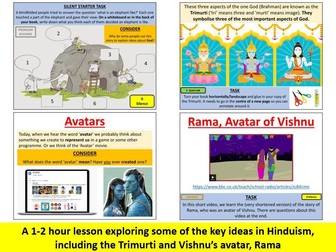
This PowerPoint-based lesson looks at the concept of monotheism and polytheism in Hinduism, as well as focusing on the Trimurti (Brahma, Vishnu and Shiva) and the story of Rama, an avatar of Vishnu. It contains two links to some great short videos about these ideas as well as a range of activities for students to complete. There is also a sheet with printable images of the Trimurti.
Overall, the (fully editable) PowerPoint is 24 slides in length and likely to take 1 lesson (or 2 lessons depending on discussion, etc.) to complete.
A NOTE ABOUT MY POWERPOINTS:
All slides have information for delivery provided in the ‘Notes’ section.
Gold boxes contain information that can be read to the class; it’s also a good opportunity to select a student to read for literacy.
Blue ‘TASK’ boxes are always tasks to be completed (these may link to an extra resource that has been provided, such as a worksheet). There will also be a ‘sound level icon’ suggested for these (there is also a slide at the end full of sound levels icons that you can use to edit). Some tasks also have key careers/employability skills indicated.
Orange ‘CONSIDER’ boxes are questions that can be discussed as a class or in groups.
Green ‘EXTENSION’ boxes are extra work/challenge for those who complete the main blue box tasks or are otherwise ready for something more difficult.
Red boxes generally have some information hidden behind them and will reveal as you click through the PowerPoint.
Whole lesson resource looking at the differing beliefs that people hold about God.
Excellent introduction includes all tasks and also a video link.
Suitable for KS2 & 3
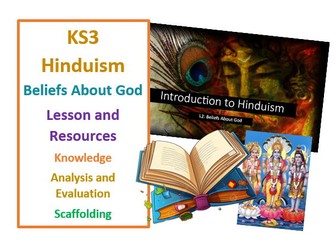
Lesson: What do Hindus believe about God?
This resource is Lesson 2 on a new Hinduism unit aimed at KS3. The lesson and PowerPoints include a range of engaging, high-quality activities covering Hindu beliefs about Brahman, the Trimurti and deities, including an exploration into the symbolism used in Hindu imagery.
Lesson includes:
Homework slide
Review of prior learning
Title, objective and date
Key Words
AO1 - Knowledge and understanding
AO2 - Analysis and evaluation task
Plenary
Scaffolding is included in the Powerpoint itself and also in the resources to ensure maximum engagement and comprehension. Challenges (extension tasks) also exist throughout the lessons to further enhance skills and understanding.
There are a variety of knowledge, understanding and evaluation tasks throughout the lesson, including video and debate activities that the students always love - year-on-year.
Please give feedback! I am always happy to respond to comments - whether positive or constructive - this will help to improve the quality of my resources in the future and, more importantly, the quality of pupils’ RE/RS education in general - which is what we’re all here for!
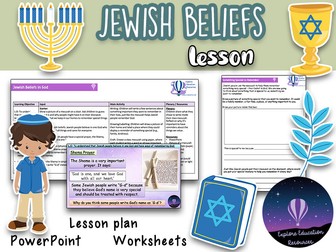
Jewish Beliefs About God | KS1 RE Lesson on Judaism
Fully Resourced for Interactive Learning and Reflection | Perfect for 30–60 Minute Lessons
Help young learners explore Jewish beliefs about God with this comprehensive lesson designed for KS1 students. This resource includes a detailed lesson plan, three engaging worksheets, and a 12-slide PowerPoint presentation to guide your teaching. Students will discover that Jewish people believe in one God and learn how Jewish families remember God through the mezuzah and the Shema prayer.
What’s included:
★ A structured and detailed lesson plan to guide your teaching
★ A 12-slide PowerPoint presentation to introduce key concepts
★ Differentiated worksheets to encourage independent reflection and creative activities
Key learning objectives:
★ Understanding that Jewish people believe in one God
★ Discovering the importance of remembering God through the mezuzah and Shema prayer
★ Exploring personal connections to the concept of special reminders
Why this lesson stands out:
★ Engages students in creative activities, including writing, drawing, and a class craft
★ Promotes discussion and reflection on the importance of remembering special things in life
★ Encourages students to connect religious teachings to their own experiences and values
★ Fully resourced for easy implementation with minimal prep
Perfect for:
★ KS1 RE lessons
★ Introducing Jewish beliefs to young learners
★ Whole-class teaching and assemblies
★ Engaging students in meaningful religious discussions
Search terms:
Jewish beliefs about God | KS1 RE lesson | Judaism mezuzah | Shema prayer lesson | primary religious education | Year 1 RE | Year 2 RE | lesson plan on God | differentiated activities RE | religious education KS1
This lesson has been designed as one of five lessons on Christianity, all of which are for sale on TES. These Christianity lessons make up part of a Six Major World Faiths Scheme of Work. Lessons are also available on Buddhism, Hinduism, Sikhism, Judaism and Islam. Bundles are available at discounted rates.
All lessons have been designed for a capable KS3 class (I use them for year 7), are fully differentiated with additional challenges, and include a range of activities. Although part of a series of lessons, each lesson has also been designed to work perfectly as a stand-alone.
Lessons follow the following order:
Holy Text/Teachings
Place of Worship
Beliefs about God/Key Religious Figures
Major Religious Festival
Life as a Religious Believer
Please leave a review of this lesson.
A KS3 lesson where pupils learn the Christian beliefs about God. There is a main focus on the Omni words. The lesson includes a variety of activities that are engaging. One activity involves student learning the key beliefs through actions, this can also be adapted in to a written task to promote literacy. Another activity focuses on personal beliefs about God, exploring reasons for these beliefs. This lesson is a fast paced lesson, but can also be stretched in to two lessons to for mixed ability/lower ability groups or to include more exploration of the differing beliefs. A homework task is included to continue to learning from the lesson.
This lesson has been designed as one of five lessons on Hinduism, all of which are for sale on TES. These Hinduism lessons make up part of a Six Major World Faiths Scheme of Work. Lessons are also available on Buddhism, Sikhism, Judaism, Christianity and Islam. Bundles are available at discounted rates.
All lessons have been designed for a capable KS3 class (I use them for year 7), are fully differentiated with additional challenges, and include a range of activities. Although part of a series of lessons, each lesson has also been designed to work perfectly as a stand-alone.
Lessons follow the following order:
Holy Text/Teachings
Place of Worship
Beliefs about God/Key Religious Figures
Major Religious Festival
Life as a Religious Believer
Please leave a review of this lesson.
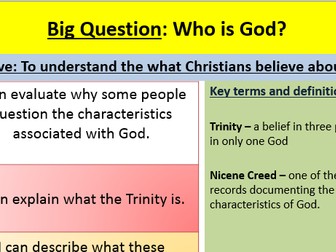
A lesson aimed for key stage 3 RE on the theme of introducing Christianity. Lesson contain is based around the Christian belief in God covering areas such as The Trinity and the Nicene Creed. Lesson is challenge and stretched throughout via evaluation questions. Lesson contains image discussions, engaging lesson tasks, tasks are scaffolded and differentiated and an opportunity to prepare students to GCSE style questioning through a three mark exam question. Lesson differentiated via SOLO Taxonomy.
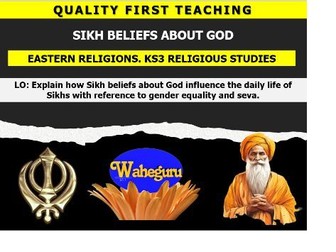
SIKH BELIEFS ABOUT GOD will spark students’ curiosity and critical thinking. It’s engaging, scaffolded for accessibility and challenging for academic rigour. It is easy to deliver for specialists and non-specialists alike and requires minimal printing and preparation.
YOUR STUDENTS WILL BE ABLE TO:
Explain how Sikh beliefs about God influence the daily life of Sikhs with reference to gender equality and seva.
CONTAINS ALL THE FEATURES OF AN EXCELLENT LESSON:
Do Now retrieval of critical content for this lesson
Tasks broken down to prevent cognitive overload
Checks whole class understanding using miniboards or cold call
Extra challenges throughout
SEN/LA support sheet to promote independence.
Independent practice task:
• Past exam question `
• Clear success criteria
• Writing frames
• Relevant sacred writing
• Key Vocabulary
I hope you enjoy delivering this lesson. Feedback is welcome.
Find more Religious Studies resources and bundles for ALL KEY STAGES at my shop: https://www.tes.com/teaching-resources/shop/Examined_Life
This lesson has been designed as one of five lessons on Sikhism, all of which are for sale on TES. These Sikhism lessons make up part of a Six Major World Faiths Scheme of Work. Lessons are also available on Buddhism, Hinduism, Judaism, Christianity and Islam. Bundles are available at discounted rates.
All lessons have been designed for a capable KS3 class (I use them for year 7), are fully differentiated with additional challenges, and include a range of activities. Although part of a series of lessons, each lesson has also been designed to work perfectly as a stand-alone.
Lessons follow the following order:
Holy Text/Teachings
Place of Worship
Beliefs about God/Key Religious Figures
Major Religious Festival
Life as a Religious Believer
Please leave a review of this lesson.
Lesson 2 in my Hinduism Unit of Work aimed at year 8. Each lessons is one hour long with differentiation and challenge.
Aimed at my school which use tablet but all PPTs are editable
Task cards which can spark debate, be used as pointers for essay planning or can be used for match up activities. Used as part of a lesson entitled 'Why do people believe in God?' They are either scientific or religious reasons.
Many more inexpensive and free resources at my shop:
Emjcot's Shop
Leave me a review and pick any other resource for free :)


 Quick View