AQA GCSE Bengali 8638 – Me, My Family and Friends | Vocabulary, Grammar & Exam SkillsQuick View
zakden

AQA GCSE Bengali 8638 – Me, My Family and Friends | Vocabulary, Grammar & Exam Skills

(0)
AQA GCSE Bengali 8638 – Me, My Family and Friends | Vocabulary, Grammar & Exam Skills A comprehensive AQA GCSE Bengali 8638 workbook and teacher-answer pack for Theme 1: Identity and Culture – Me, My Family and Friends. Designed for Foundation and Higher Tier, this resource develops the vocabulary, grammar and exam skills students need to discuss family, relatives, friendships, personality, relationships, disagreements, trust, respect, marriage and partnerships. The complete pack contains a 13-page Student Workbook plus a separate 14-page Answers & Teacher Guide — 27 pages in total. Student Workbook includes: 58 key Bengali words and phrases Bengali–English family and relationship vocabulary personality adjectives and descriptive language marriage and partnership vocabulary shuffled matching activities vocabulary retrieval and categorisation gap-fill and odd-one-out activities Bengali → English practice English → Bengali translation Grammar Masterclass personal pronouns and possessives familiar and polite register তুমি / আপনি সে / তিনি extended Bengali reading comprehension present, past and future time frames GCSE-style translation in both directions speaking and general-conversation questions dedicated role-play checkpoint Foundation 40-word writing task 90-word Foundation/Higher writing task Higher 150-word extended-writing challenge writing checklists for opinions, reasons, tense, adjectives, contrast and complex language generous writing and answering space Answers & Teacher Guide includes: complete answers to closed activities acceptable alternative answers reading-comprehension answers model translations guidance on Bengali register indicative speaking responses role-play models 40-word model response 90-word model response 150-word Higher model response explanations of why model answers work classroom writing-assessment grids Foundation and Higher marking guidance speaking-assessment support The workbook follows a clear progression from vocabulary acquisition → grammar → reading → translation → speaking → extended writing, helping students move beyond memorisation and produce accurate, developed Bengali. The resource has been designed with large, readable text, generous answer space and a full-colour illustrated Bengali-themed cover. Suitable for: AQA GCSE Bengali 8638 | KS4 | Years 9–11 | Foundation | Higher | Homework | Revision | Intervention | Independent Learning | Speaking Practice | Writing Practice | Exam Preparation Files included: Student Workbook – 13 pages Answers & Teacher Guide – 14 pages 27 pages total
AQA GCSE Bengali 8638 – Home, Town, Neighbourhood & Region | Vocabulary, Grammar & Exam SkillsQuick View
zakden

AQA GCSE Bengali 8638 – Home, Town, Neighbourhood & Region | Vocabulary, Grammar & Exam Skills

(0)
This keeps the standalone Bengali topic series consistent. Current TES listings for your Me, My Family and Friends, Technology in Everyday Life, Free-time Activities, and Customs & Festivals resources are all £5.00. The larger Themes 1–3 Bengali bundle is £9.00, so £5.00 is also a clear standalone-vs-bundle structure. TES Description A complete AQA GCSE Bengali 8638 workbook and answer pack for Home, Town, Neighbourhood and Region. Designed for Foundation and Higher Tier, this resource develops the Bengali vocabulary, grammar and GCSE exam skills students need to describe their home, rooms and facilities, neighbourhood, town, local services, transport, advantages and disadvantages of an area, urban and rural life, environmental issues and improvements to the local area. Student Workbook includes 60 key Bengali words and phrases houses and different types of accommodation rooms and household facilities furniture and home descriptions gardens and outdoor spaces town and neighbourhood vocabulary shops and local services schools, hospitals and libraries parks and recreational facilities public transport traffic and commuting advantages and disadvantages urban and rural comparisons environmental vocabulary green spaces and cycle paths present, past and future time frames vocabulary matching phrase completion Bengali → English retrieval categorisation gap-fill practice odd-one-out challenges sentence-building comparison practice extended Bengali reading comprehension English → Bengali translation Bengali → English translation GCSE-style speaking questions role-play checkpoint Foundation and Higher speaking development 40-word Foundation writing 90-word extended writing 150-word Higher writing additional Higher writing continuation writing checklists generous writing space Answers & Teacher Guide includes complete vocabulary answers practice answers grammar solutions reading-comprehension answers translation models speaking models role-play model 40-word model response 90-word model response Higher 150-word model response writing assessment guidance exam-language upgrade structures teacher quality-control checklist Exam progression Vocabulary → Grammar → Reading → Translation → Speaking → Role-play → Extended Writing Students build the topic vocabulary first, manipulate it through grammar and retrieval tasks, then apply it through reading, translation, speaking and extended writing. Suitable for AQA GCSE Bengali 8638 KS4 / Years 9–11 Foundation & Higher Home, Town, Neighbourhood and Region GCSE Bengali revision Vocabulary practice Grammar practice Reading Translation Speaking Writing Homework Intervention Independent revision
Learning Bengali Is Fun! - BundleQuick View
peterfogarty

Learning Bengali Is Fun! - Bundle

3 Resources
Are you learning Bengali? Are you looking for a fun way to learn Bengali? I have developed a way to learn different languages based on my experience as an ESL teacher. This pack has 57 different settings for students to talk about in Bengali. The worksheets themselves are in English and the students do need to translate the places and objects they see into Bengali. At the end of the session, the students can play a fun game of word bingo to show they have mastered that day's vocabulary. Try it, it is a lot of fun for everyone!
114 Bengali Bingo pack cardsQuick View
peterfogarty

114 Bengali Bingo pack cards

(0)
Welcome to the Bengali Bingo pack. This is a simple starter game for students. There are 114 different pictures to choose from. Select a single picture and project the image on the wall or share it with the class as a handout. Talk about the picture and then ask your students to select and write down 5 items from the picture. Then look at the picture and pick out all the key vocabulary you want them to talk about. The first student to have all their items read out is the winner. With 57 different settings and 1 1 4 different game cards, there are plenty chances for great vocabulary. ***** Please note - these resources provide visual prompts and support to the students, not direct language instruction **************
Village Community - based on a Bengali villageQuick View
durgamata

Village Community - based on a Bengali village

(2)
The slide show is in the process of development - to support a family member who is studying Early Years Childcare in Kolkata, Having been to Bengali villages I googled things that I remember seeing there and this is a complete jumble of images. I suggest you edit it, arrange the images you wish to use and add text as required. I googled India Village and found some very interesting bits of contemporary news which may be useful in citizenship and international studies. The Stories may be good for drama and to give insight into village life and characters past and present.
Bengali Writing Stories Worksheets To Translate English to Bengali + 31 Fun Teaching Ideas For ClassQuick View
peterfogarty

Bengali Writing Stories Worksheets To Translate English to Bengali + 31 Fun Teaching Ideas For Class

(0)
These pages could also be used to write different stories, using the pictures as a stimulus. I have included 31 different teaching ideas to try in your class. They are easy to set up, lots of fun and will improve both your students' vocabulary and memory skills. ***** Please note - these resources provide visual prompts and support to the students, not direct language instruction ************** Welcome to the 'Lets Write in Bengali!' pack. There are lots of ways of using this teaching pack. It could be used as writing assessment for students learning Bengali. The students could write about a topic in Bengali before starting a unit, and then write again about the topic, using the second worksheet at the end of the topic to see how much they have progressed. It could also be used as an introduction to guided writing. Students can write sentences as a class and share the sentences together and they can then write them on their own. Alternatively, students could work in pairs - one student dictates to the other what to write down about what they see in the picture. These pages could also be used to write different stories, using the pictures as a stimulus. ***** Please note - these resources provide visual prompts and support to the students, not direct language instruction **************
Bengali-English EAL Alphabet Letter CardsQuick View
EverythingELL

Bengali-English EAL Alphabet Letter Cards

(0)
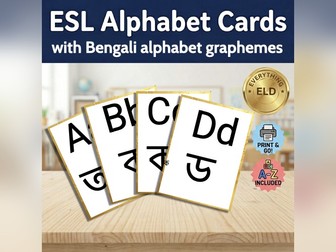
Bengali-English alphabet letter cards for EAL pupils. Print double-sided for each English letter on the front and the closest matching Bengali sound on the back. Ideal for new-to-English Bengali pupils. These cards support pupils who are new to English and just beginning to read, by giving them a phonetic reference in their home language. What’s included (9 pages) A–Z English letter cards backed with the matching Bengali letters Bonus digraph cards (pages 7–8): Ch, Sh, Th /θ/, Th /ð/, Ph, Wh, Ng and Ck A Basic Guide to Bengali Sounds infographic for your classroom wall. Displaying it (or enlarging it to poster size) values pupils’ home-language literacy and gets the whole class curious about a new script. Printing: the alphabets look reversed on screen so that they line up front-to-back when printed double-sided. If yours don’t, set your printer to “flip on long edge”. Letters without an exact match A uses আ (aa), the closest Bengali sound to English a. D uses ড and T uses ট, the letters Bengali uses for English d and t, as in ডাক্তার (doctor) and টেবিল (table). F uses ফ and V uses ভ, the letters used for f and v in borrowed words. C and K both use ক. Q uses খ (kh). W uses ওয়, the spelling used for w in borrowed words. X uses ক্স (k + s), as in বক্স (box). Bengali has no z sound. J and Z both use জ, as in জিরো (zero). Digraph cards The two Th cards are marked in the upper right corner with their IPA spelling: /θ/ as in think and /ð/ as in this. Bengali has no “th” sounds, so Th /θ/ uses থ and Th /ð/ uses দ, the letters Bengali uses to spell English “th”. Ph, Wh and Ck use the same letters as F, W and K. The Bengali alphabet is also used for Assamese (which writes r as ৰ and w as ৱ), Kurmali and Sylheti, so these cards also suit many Sylheti-speaking families. What to expect from Bengali speakers A different script: Bengali letters hang from a line across the top, and vowels can be written before, after, above or below a consonant. Pupils need to learn that English letters are always written in order, left to right. One word for he and she: সে (se) means both, so pupils often mix them up. No “is/am/are” in many sentences: Bengali often leaves out “to be” in the present tense, so expect “I happy”. Three levels of “you”: formal আপনি, familiar তুমি and very close তুই. English “you” for everyone can feel too plain with a teacher. No articles: expect “I have book”. Plurals: Bengali doesn’t mark plurals after numbers, so expect “three book”. Verb at the end: Bengali word order is subject–object–verb (“I rice eat”), so English word order needs practice. Sounds to watch: expect “j” for “z” (“jero”), “ph” for “f”, “bh” for “v”, and “t/d” for “th”. Also in my shop: Bengali-English sight word flashcards, plus alphabet letter cards for Urdu, Arabic, Russian, Korean and Greek.
57 Bengali Setting Cards For Conversation PracticeQuick View
peterfogarty

57 Bengali Setting Cards For Conversation Practice

(0)
Welcome to the 'Lets Talk in Bengali! This set of cards looks at 57 different settings. The teacher describes something in the top card. The students then use this to model a sentence using the bottom set of pictures. There are lots of things to see and describe in every picture. When the students have completed this task, they can repeat it by working in pairs to discuss each picture. There are lots of different ways you could use this pack. You could laminate them into two cards and get each student to talk about what they had seen in their picture. ***** Please note - these resources provide visual prompts and support to the students, not direct language instruction **************
Should the statues of Churchill be changed? Churchill and the Bengali FamineQuick View
blackadderfiend

Should the statues of Churchill be changed? Churchill and the Bengali Famine

(0)
A fully resourced lesson looking at Churchill’s role in the Bengali famine and the other factors involved. Includes a homework. Has been linked to the recent Black Lives Matter protests and asks pupils to re-examine the role of statues and how to redesign them to provide a more rounded history. Could be linked to Heroes and Villains in History, World War Two, Empire.
Bilingual Sight Words, Bengali (Bangla) and English Flash CardsQuick View
EverythingELL

Bilingual Sight Words, Bengali (Bangla) and English Flash Cards

(0)
When printed double sided, these flashcards of dolch sight words have English on one side, and the Bengali translation on the back. It is helpful if you are trying to give meaning to sight words to students who are learning to read English while simultaneously beginning to learn English.
Bangla(Bengali) Flash Cards, 3,000 Words (Audio, PDF) for childrenQuick View
HochingJung

Bangla(Bengali) Flash Cards, 3,000 Words (Audio, PDF) for children

(0)
Bangla(Bengali) Flash Cards, 3,000 Words (Audio, PDF) for children Vocabulary - Learn with images and simple sentences for Grade 1 beginners. Includes MP3 audio and bonus PDFs. Learn Bangla (Bengali) with Images — 3,000 Words & Sentences Make Bangla learning simple, natural, and enjoyable with a visual learning method designed around Grade 1–level vocabulary. Each word is paired with a clear flash card image to help learners understand meaning instantly, remember faster, and study with confidence. Perfect for beginners, children, and anyone starting Bangla (Bengali) for the first time. The PDF file contains the download address for the MP3 files and additional PDF materials.
Bengali Read, Write And Play Cards + 31 Fun Teaching Activities For These CardsQuick View
peterfogarty

Bengali Read, Write And Play Cards + 31 Fun Teaching Activities For These Cards

(0)
Are you learning Bengali? Are you looking for a fun way to learn Bengali? I have developed a way to learn different languages based on my experience as an ESL teacher. This pack has 57 different settings for students to talk about in Bengali. The worksheets themselves are in English and the students do need to translate the places and objects they see into Bengali. At the end of the session, the students can play a fun game of word bingo to show they have mastered that day's vocabulary. Try it, it is a lot of fun for everyone! This pack contains a 31 Teaching Activity Teacher Guide using these photo flash cards. These activities are quick and fun to do and will improve both your students' memory and vocabulary skills. * Please note - these resources provide visual prompts, not specific language instruction. Speak, Write and Play In Bengali Bengali Bingo pack: This is a simple starter game for students. There are 114 different pictures to choose from. Select a single picture and project the image on the wall or share it with the class as a hand-out. Let's Talk in Bengali!: This set of cards looks at 57 different settings. The teacher describes something in the top card. The students then use this to model a sentence using the bottom set of pictures. There are lots of things to see and describe in every picture. When the students have completed this task, they can repeat it by working in pairs to discuss each picture. Let's Write in Bengali pack: There are lots of ways of using this teaching pack. It could be used as writing assessment for students learning Bengali. The students could write about a topic in Bengali before and then after a topic, using the second worksheet at the end of the topic. * Please note - these resources provide visual prompts, not specific language instruction.
AQA GCSE Bengali 8638 – Customs & Festivals | Vocabulary, Grammar & Exam SkillsQuick View
zakden

AQA GCSE Bengali 8638 – Customs & Festivals | Vocabulary, Grammar & Exam Skills

(0)
T A complete AQA GCSE Bengali 8638 workbook and answer pack for Theme 1: Identity and Culture – Customs and Festivals. Designed for Foundation and Higher Tier, this resource develops the Bengali vocabulary, grammar and GCSE exam skills students need to discuss festivals, customs, traditions, cultural celebrations, family events, traditional food, clothing, music, religious and cultural occasions, changing traditions and cultural identity. Student Workbook includes: 58 key Bengali words and phrases customs and traditions vocabulary festivals and celebrations Bengali cultural occasions family celebrations traditional food and clothing music, dance and entertainment guests, invitations and gifts preparation and decoration religious and cultural vocabulary opinions about traditions present, past and future time frames shuffled vocabulary matching phrase-completion activities categorisation gap-fill practice odd-one-out activities grammar practice sentence-building extended Bengali reading comprehension Bengali → English translation English → Bengali translation GCSE-style speaking questions role-play checkpoint Foundation speaking development Higher speaking development 40-word Foundation writing 90-word extended writing 150-word Higher writing additional Higher writing space writing checklists generous answer space Answers & Teacher Guide includes: complete answers to closed activities vocabulary answers grammar answers reading-comprehension answers translation models indicative speaking responses role-play model responses 40-word model answer 90-word model answer Higher 150-word model answer writing assessment guidance speaking assessment guidance exam-language extension structures teacher quality-control checklist The resource follows: Vocabulary → Grammar → Reading → Translation → Speaking → Role-play → Extended Writing Students first build the language, then retrieve and manipulate it before progressing to GCSE-style communication and extended writing. Suitable for AQA GCSE Bengali 8638 KS4 / Years 9–11 Foundation & Higher Theme 1: Identity and Culture GCSE Bengali revision Vocabulary practice Grammar practice Reading Translation Speaking Writing Homework Intervention Independent revision Why this resource? This is designed as a complete topic workbook rather than a single vocabulary worksheet. Students repeatedly encounter the same language through retrieval, grammar, reading, translation, speaking and extended writing. The separate answer/teacher guide also makes it practical for classroom teaching, homework and independent revision.
EAL Welcome Books - Bengali, French, Lithuanian, Polish, Romanian, UrduQuick View
primaryclass

EAL Welcome Books - Bengali, French, Lithuanian, Polish, Romanian, Urdu

(18)
EAL Welcome Books - Bengali, French, Lithuanian, Polish, Romanian, Urdu Resources to help new learners of English settle in to their class. The language is mainly translated using electronic translators. Whilst each translation runs through at least 2 electronic translators to ensure accuracy, some inaccuracies may still persist.
BSL Greetings, Family, Feeling & Questions Signs with URDU, GUJARATI & BENGALI TranslationsQuick View
deafbooks

BSL Greetings, Family, Feeling & Questions Signs with URDU, GUJARATI & BENGALI Translations

(0)
This publication has been produced in response to frequent requests for translated British Sign Language (BSL) materials for speakers of URDU, GUJARATI and BENGALI. The translation work was carried out initially in 2004 with the help of the National Deaf Children’s Society and the original publications were printed and in poster/mat format. Contains 40 signs in four topic pages translated into the three languages with fingerspelling alphabet borders. GREETINGS HELLO, WELCOME, GOOD, MORNING, AFTERNOON, EVENING/NIGHT, ALL RIGHT?, NAME, WHAT?, PLEASE/THANK YOU. FAMILY FAMILY, MOTHER, FATHER, SISTER, BROTHER, GRANDMOTHER, GRANDFATHER, HUSBAND/WIFE, FRIEND, NEIGHBOUR. FEELINGS FEEL, SAD, HAPPY, SCARED, ANGRY, FED UP, DON’T LIKE, HURT, UPSET, LOVE. QUESTIONS QUESTION, WHY? WHAT? WHEN? WHO? HOW? HOW OLD?, HOW MANY?, WHERE? WHICH? The English meanings have been added below each sign and written descriptions for the sign movements have been added at the back of the publication to assist teachers and carers working in this field. Supported by the Let’s Sign BSL collection of books, dictionaries, posters, flashcards, reward stickers and ebook/kindles.