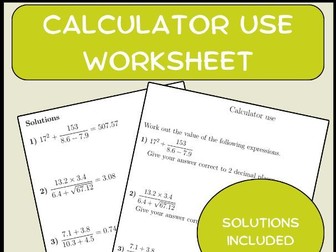
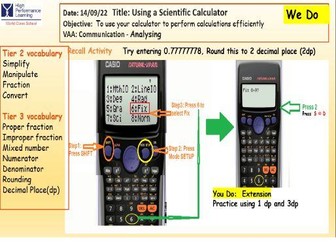
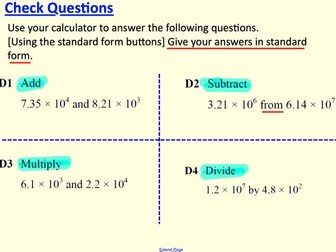
A resource answering questions on standard form using a calculator. Notes explain method mainly using a CASIO calculator
The lesson is structured using Rosenshine’s principles of instruction.
Worksheets and Answers are included.
A PowerPoint conversion from my SMART file is included too if you do not have access to the SMART NOTEBOOK
If you enjoy this lesson and the resources, if it saves you time, lightens your huge workload or engages your students, please leave me a REVIEW as your feedback is valuable to me as it helps me improve and create more resources that meet your needs.
A simple PowerPoint, showing a step by step guide to using a calculator. It includes a series of questions, with answers, and finishes with a shootout between pupils, to see who has become the 'fastest draw', when using a calculator.
Worksheet consisting of 15 questions where students need to calculate the energy using specific heat capacity formula.
Answers are included, so can be used as revision or as a final assessment task
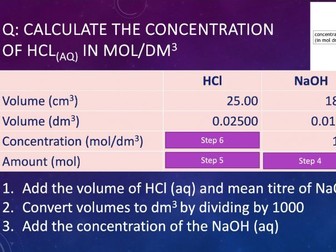
A detailed 20 slide powerpoint resource designed for use in a 1 hour KS4 chemistry lesson introducing titrations and how to complete titration calculations (follow up lesson would be required practical). ** Includes: - An introduction to titrations including an RSC video / teacher demo and intro to the equipment used - A methodical step by step explanation for how to complete titration calculations to determine the concentration of an acid / alkali -* Lots of worked examples*** to go through with students or get them to complete independently in books as they get more confident - Past exam questions to consolidate their learning with mark scheme answers to self-assess
10 questions using half-life calculations. A variety of questions where pupils have to calculate half-lives, final activity and initial activity. Mark scheme included. (Note: the worksheet is repeated for printing 2 copies per A4 sheet).
High quality full PowerPoint lesson and associated exam questions handout, with all answers included where possible but some questions involve live measurement of images by teacher or pupil and therefore will be dependent on the printing and photocopying scale.
Covering:
Recap of conversion of units and calculating magnification, image size and actual size recap
Extended practise with application of magnification calculations
Maths skills development
Further practise questions also supplied could be used to extend the lesson, further modelling or as homework.
NEW AND IMPROVED
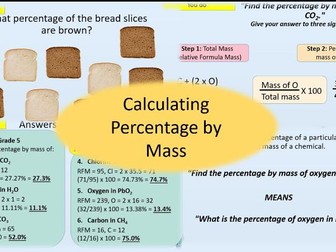
A fully resourced lesson for GCSE AQA chemistry on calculating percentage by mass.
Suitable and applicable for GCSE Chemistry Trilogy, and Combined Science Higher and Foundation.
Lesson Objectives
Recall how to calculate relative formula mass using a periodic table
Find the total mass of an element in a compound
Calculate the percentage by mass of an element in a substance using relative formula mass and atomic mass
Give answers to a specified number of significant figures
Lesson features
Introduction slides to assess students prior knowledge and understanding of percentages
Worked scaffolded examples (I do, we do, you do) for percentage by mass calculations and increasing difficulty
Assessment for learning opportunities throughout
Student-led practice calculation tasks (aimed both at Grade 5 and Grade 7+ candidates)
Full answers integrated into powerpoint slides for all activities
Stretch and Challenge Tasks throughout
Past exam questions for separate science and combined science papers with full mark schemes and examiners reports (where available)
Lesson includes:
Lesson powerpoint (.pptx)
Separate science past exam questions with mark scheme and examiners reports
Combined science past exam questions with mark scheme and examiners reports
New for the AQA GCSE 1-9 Combined Trilogy module ‘C4 Chemical Calculations (Quantitative Chemistry)’
Full lessons ready to use straight ‘out of the box’.
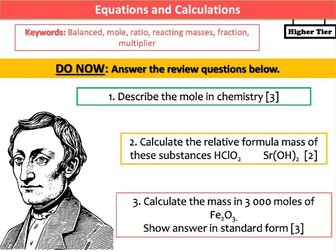
DOUBLE LESSON on Relative masses and the higher tier moles calculations.
Lessons meet the full criteria for this unit
Similar structure to my other power points following the input - activity - review phasing
Plenary sections for progress checking
Clear learning objectives and outcomes
Modern and engaging layout
Little adaptation needed
Practice exam questions for each lesson with mark schemes
Each lesson covers at least an hour of lesson time
29 ppt slides
Please leave constructive feedback :D
A student workbook with A Level examination questions along with an accompanying teacher PowerPoint which explains how to solve the questions.
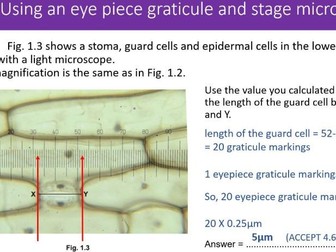
The resource goes through several calculations and question types involving a stage micrometer and eyepiece graticule. The PowerPoint and student workbook both have a step by step example of how to calibrate an eyepiece graticule and then how to use the same eyepiece graticule to measure cells and cellular components. The size of cells and organelles are measured using the micrometre (μm) scale. One question also asks student’s to calculate magnification (M) when both the size of the image (I), and the actual size of the specimen (A), is known. A starter activity where students label the parts of a light microscope is also included in both the PowerPoint and student workbook
The A Level OCR examination questions give students practice in calibrating an eyepiece graticule and use images from microscopes. The student booklet contains 6 questions and a range of different question types (calculation, written response and multi-choice) where students use their calculations of the eyepiece graticule to calculate the actual size of some real example images. Useful for exam practice and to build understanding of a tricky topic. Answers included in the animated PowerPoint so that the teacher can explain each step in the calculation. There is also a teacher version of the student workbook with a full mark scheme and examiner’s feedback.
Resources included here were used as part of an observed lesson which was graded as outstanding. These resources have been used successfully with SEN and Entry Level students but would also work well with primary age students.
A PowerPoint presentation that guides students through the necessary input for adding monetary amounts successfully; includes tutor notes where appropriate. Supported with differentiated worksheets that students can complete individually or in pairs. Answers have also been included.
Two notebook activities have also been included for those who may have access to a SmartBoard.
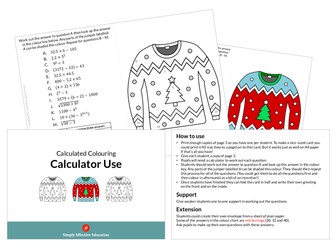
A calculated colouring activity in which students create their own Christmas card featuring a jazzy Christmas jumper! Students have to answer the questions in order to reveal the colours to shade the jumper. The questions feature all four operations, powers, brackets and roots so they will offer good practice on using a calculator properly. Once complete and coloured in they can add their own greeting to the front and the inside of the card.
This makes a great task for the end of term and gives the students a nice card to take home, with all the maths on the back of the card for them to show off!
The resource includes full instructions, a clear solution and ideas for how to extend students who finish. It can easily be made into a full lesson by combining it with other resources from our Christmas bundle.
Get this resource as part of our great value Christmas Maths Bundle
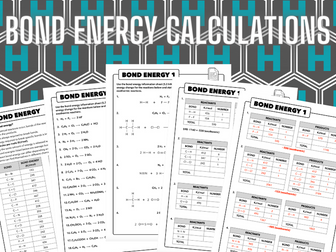
This superb resource on bond energy calculations can be used for all abilities. It includes a more demanding version in which students need to determine the bonds in the reactants and products, and also a support sheet to help those who find it more challenging. The bond energy calculations resource includes the answers and a useful bond energy reference sheet. I use this resource with my Y10 students and they really enjoy it!
The calculation worksheet (with answers and slides) is available separately here
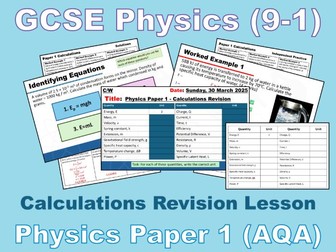
Prepare your students for AQA Physics Paper 1 calculation questions with revision lesson focusing on selecting and utilising the relevant equations.
The lesson begins with identifying the quantities that appear on paper 1 and their relevant units. Then students practice identifying the correct equation to use in different situations with an opportunity for AfL. The lesson is designed assuming the students will have access to the AQA equation sheet, which can be downloaded from the AQA website.
The bulk of the lesson is Independent practice, where through 12 worded calculation questions, including 3 worked examples, students identify and use the correct equations from the Energy, Electricity and Particle Model topics. Competence in substitution, unit conversions and rearrangements are supported through use of the FIFA method in worked examples and answers.
Slides for two options of plenaries are also included - Spot the mistake and writing their own question - to consolidate the lessons content.
Perfect for Exam Preparation: This worksheet is an excellent tool for preparing students to tackle calculation questions typically found on AQA Physics Paper 1, and it’s equally valuable for other exam boards.
Included:
Full powerpoint slide deck (.ppt) with animated answers using our clean Resistance Physics layout.
Ready-to-print (.pdf) and editable (.doc) versions (.doc) of calculation worksheets and their solutions
Ready-to-print table of quantities and units (.doc)
Similar resources:
P1 Energy Multi-Step Calculations Worksheet
P2 Electricity Equation Worksheet Bundle
P5 Forces Equation Worksheet Bundle
GCSE Physics Paper 2 Calculations - Revision Lesson
This lesson is covering the topic of mass and formula. It will make the pupil understand what is meant by the idea of a confirmed equation, how to use RAM in the calculation of an equation and how to confirm an equation mathematically.
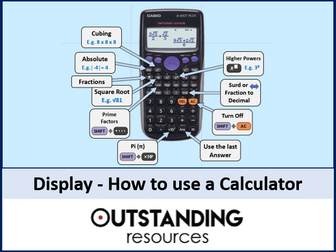
This is a classroom display on How to use a Calculator. This will make an excellent addition to any classroom display and obviously has massive benefits for students. It comes with lots of additional arrows and information on buttons that aren’t in the exemplar.
There is a strong link between the visual environment and visual props and retaining key facts or information.
For any issues, please email outstandingresourceshelp@gmail.com
and we will aim to respond within 48 hours.
Lessons are flat-packed (with limited editing) to maintain copyright protection.
We would greatly appreciate it if you could leave a rating and feedback.
Thank you for your support, your purchase, and for taking the time to provide feedback!
#mathslessons #maths #secondarymaths #mathscentres #teachingideas #algebra #teacherslife #teachingkids #teachingmaths #mathsactivities #homeschooling #tesresources #teaching #mathsisfun #teachershare #teachertips #teachers #KS3 #KS4 #KS5 #igcse #learning #gcsemaths
This is a set of 9 questions using the v2 = u2 + 2as formula, suitable for use with GCSE/IGCSE classes. The questions involve some re-arrangement of the formula and a small amount of unit conversion, so are suitable for more mathematically able students.
The questions are worth a total of 30 marks and are appropriate as a homework or revision exercise.


 Quick View