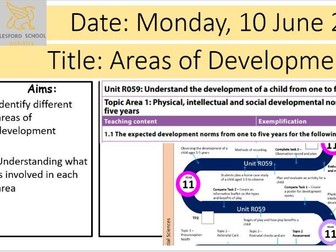
These lessons will help to teach the content required to deliver the R059 coursework unit called ‘Understanding the development of a child from one to five years.’
for OCR J809 Child Development
Each lesson powerpoint contains interactive activities linked to the endorsed Hodder Education Textbook with linked page numbers etc.
It contains 10 lesson powerpoints, with starter activities, answers for starters, accompanying worksheets, tasks throughout, homeworks where applicable and sharp start retrieval practice and plenary activities included videos links from youtube etc.
Estimated 6 weeks worth of lesson before commencing the writing of the coursework.
Step by step coursework resources available seperately
*** UPDATED ***
BTEC Edexcel Pearson Child Development Component 3 Revision Guide.
Each page has full information from Edexcel Child Development Student Book, as well as questions to complete for practice.
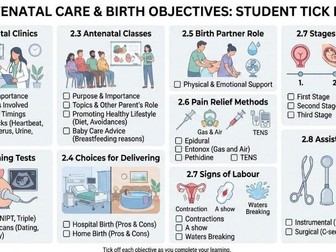
These high-quality revision cards are specifically designed for the OCR Cambridge National (CNAT) Level 1/2 in Child Development. They provide comprehensive coverage for Unit R057: Health and well-being for child development, specifically focusing on Topic Area 2: Antenatal Care and Birth
Product Overview
This resource consists of a set of visually engaging, color-coded revision cards that break down complex biological and lifestyle factors into digestible “bites” for students. They are mapped directly to the OCR specification, ensuring learners have exactly what they need for their final exam.
How to Use These Cards in the Classroom
Retrieval Practice & Starters
Use the cards as “flashcards” for quick-fire retrieval at the start of a lesson. Project a card with sections covered up and ask students to identify the missing parts of the reproductive system or the advantages/disadvantages of a specific contraceptive method.
Scaffolding for NEA (R058 & R059)
While these cards target the R057 exam, they provide the essential biological foundation needed for the NEA assignments. Students can refer to the “Growth & Development” cards when explaining the background of the child they are observing in Unit R059.
Differentiated Revision Stations
Set up “Topic Stations” around the room. Give students a blank “Knowledge Organiser” and have them rotate through the stations, using these cards to find the facts needed to complete their notes.
Active Learning Games
Mix and Match: Print the cards and separate the “Advantages” and “Disadvantages” from the contraceptive methods. Challenge students to match them back up correctly.
Peer-to-Peer Quiz: Students work in pairs to quiz each other using the “Common Symptoms” or “Lifestyle Factors” cards to prepare for the exam’s short-answer questions.
Why Choose This Resource?
Exam Focused: Directly aligned with the OCR J809 specification.
Visual Learning: Uses professional icons and diagrams to support EAL learners and students with SEND.
Teacher-Ready: High-resolution images ready for printing (A4 or A5) or digital display.
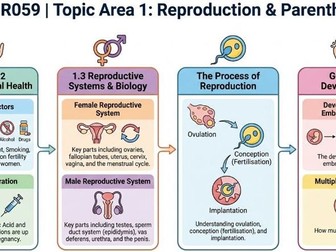
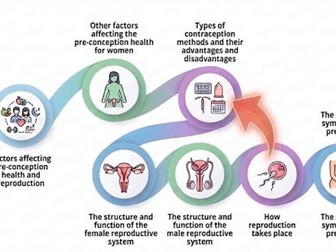
These high-quality revision cards are specifically designed for the OCR Cambridge National (CNAT) Level 1/2 in Child Development. They provide comprehensive coverage for Unit R057: Health and well-being for child development, specifically focusing on Topic Area 1: Pre-conception health and reproduction.
Product Overview
This resource consists of a set of visually engaging, color-coded revision cards that break down complex biological and lifestyle factors into digestible “bites” for students. They are mapped directly to the OCR specification, ensuring learners have exactly what they need for their final exam.
Key Topics Covered:
1.1 & 1.2 Pre-conceptual Health: Impact of age, weight (BMI), smoking, alcohol, and recreational drugs on fertility.
1.3 Reproductive Systems: Detailed diagrams and functions of both the male and female reproductive systems.
1.4 & 1.5 Methods of Contraception: Barrier (condoms, diaphragms), Hormonal (pills, injections), and Long-Acting Reversible Contraception (LARC) like implants and IUDs.
The Process of Reproduction: Clear stages from ovulation and conception to implantation.
Growth & Development: The journey from zygote to embryo and foetus, including key supporting structures like the placenta and umbilical cord.
1.5 Early Signs of Pregnancy: Common symptoms such as missed periods, nausea, and tiredness.
Multiple Pregnancies: Explanations of how identical and non-identical twins occur.
How to Use These Cards in the Classroom
Retrieval Practice & Starters
Use the cards as “flashcards” for quick-fire retrieval at the start of a lesson. Project a card with sections covered up and ask students to identify the missing parts of the reproductive system or the advantages/disadvantages of a specific contraceptive method.
Scaffolding for NEA (R058 & R059)
While these cards target the R057 exam, they provide the essential biological foundation needed for the NEA assignments. Students can refer to the “Growth & Development” cards when explaining the background of the child they are observing in Unit R059.
Differentiated Revision Stations
Set up “Topic Stations” around the room. Give students a blank “Knowledge Organiser” and have them rotate through the stations, using these cards to find the facts needed to complete their notes.
Active Learning Games
Mix and Match: Print the cards and separate the “Advantages” and “Disadvantages” from the contraceptive methods. Challenge students to match them back up correctly.
Peer-to-Peer Quiz: Students work in pairs to quiz each other using the “Common Symptoms” or “Lifestyle Factors” cards to prepare for the exam’s short-answer questions.
Why Choose This Resource?
Exam Focused: Directly aligned with the OCR J809 specification.
Visual Learning: Uses professional icons and diagrams to support EAL learners and students with SEND.
Teacher-Ready: High-resolution images ready for printing (A4 or A5) or digital display.
A* essay responses to the AQA 2017 and 2018 English Language A Level exams (Paper 1 Section B Children’s language development - Q4 learning to talk task).
These essays meet the criteria for high level 5 for both AO1 and AO2 so are ideal as ready made modelling examples for any of the knowledge and skills required for this section of the A Level exams. They have proved hugely beneficial for previous and current students in the classroom and one-to-one tutoring for essay content, structure and the mark scheme skills listed below.
AO1:
linguistic methods and terminology applied with patterns and complexities identified
different levels of language analysis applied in an integrated way with connections explored
levels of language analysis applied with no errors
reader is guided through the essay
AO2:
a synthesised and conceptualised and individual overview of issues demonstrated
approaches, views and interpretations of linguistic issues evaluated and challenged
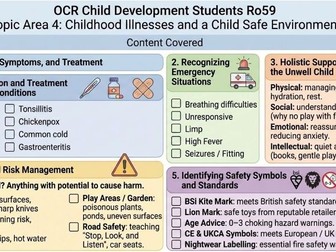
Full topic of of R059 content including the breakdown of coursework tasks with instructions and timers throughout.
A second document “work set out” included. This is a sheet that be given to the students. It breaks down each task and paragraph for the 2026 assignment. Easy for the students to follow along.
Component 3 revision guides
Including 3A,3B and 3C.
Some activities included within revision guide but also revision style notes for each lesson in the components.
I print the booklets for the students and also provide them electronically on our interactive platform. Prepare students for the exam component of the course.
An incredibly detailed PowerPoint (46 slides) containing all key information for topic area 3, aligned with the specification and created alongside the child development Hodder education (second edition J809) book. It includes essential information needed for the exam, pictures to support the content and tasks to test and promote pupil learning.
Includes: Full booklet scheme of child language development- spoken language acquisition.
PowerPoint to support.
8 lessons that take me a half term to complete with time for application and essay practise.
Inside the scheme is a complete breakdown of how children learn to speak from womb to 5+ years old. Homework, model essays and application questions included.
I’ve developed this with AQA English Language A Level in mind, but could be easily adapted.
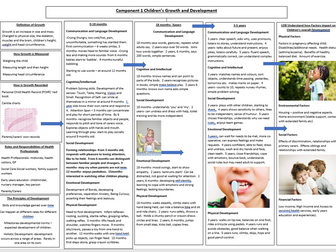
These knowledge organisers are for the 2022 BTEC Tech in child development. They include all areas from component 1,2 and 3. Perfect for printing to aid students in their revision.
This book helps learners revise child development questions. It contains word banks with definitions, exam question ideas, graphics to explain concepts and allows the learners to try questions for themselves.
These high-quality revision cards are specifically designed for the OCR Cambridge National (CNAT) Level 1/2 in Child Development. They provide comprehensive coverage for Unit R057: Health and well-being for child development, specifically focusing on Topic Area 2: Antenatal Care and Birth
Product Overview
This resource consists of a set of visually engaging, color-coded revision cards that break down complex biological and lifestyle factors into digestible “bites” for students. They are mapped directly to the OCR specification, ensuring learners have exactly what they need for their final exam.
How to Use These Cards in the Classroom
Retrieval Practice & Starters
Use the cards as “flashcards” for quick-fire retrieval at the start of a lesson. Project a card with sections covered up and ask students to identify the missing parts of the reproductive system or the advantages/disadvantages of a specific contraceptive method.
Scaffolding for NEA (R058 & R059)
While these cards target the R057 exam, they provide the essential biological foundation needed for the NEA assignments. Students can refer to the “Growth & Development” cards when explaining the background of the child they are observing in Unit R059.
Differentiated Revision Stations
Set up “Topic Stations” around the room. Give students a blank “Knowledge Organiser” and have them rotate through the stations, using these cards to find the facts needed to complete their notes.
Active Learning Games
Mix and Match: Print the cards and separate the “Advantages” and “Disadvantages” from the contraceptive methods. Challenge students to match them back up correctly.
Peer-to-Peer Quiz: Students work in pairs to quiz each other using the “Common Symptoms” or “Lifestyle Factors” cards to prepare for the exam’s short-answer questions.
Why Choose This Resource?
Exam Focused: Directly aligned with the OCR J809 specification.
Visual Learning: Uses professional icons and diagrams to support EAL learners and students with SEND.
Teacher-Ready: High-resolution images ready for printing (A4 or A5) or digital display.
Prepare with precision for the R057: Health and Well-being for Child Development exam. This comprehensive resource is specifically engineered for high-impact revision, focusing on the critical content from the R057 specification that has yet to be featured in previous exam series. It bridges the gap between standard revision and exam-day readiness by targeting “unseen” technical details and higher-mark questions.
What’s Included:
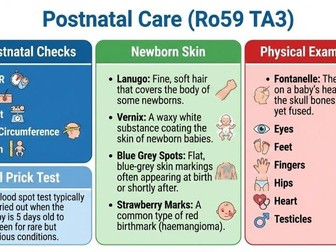
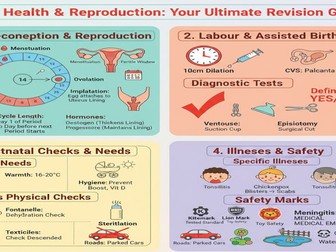
Detailed Revision Guide: A technical breakdown of high-priority topics, including the 28-day menstrual cycle, diagnostic testing (Amniocentesis vs. CVS), stages of labour, and neonatal physical checks.
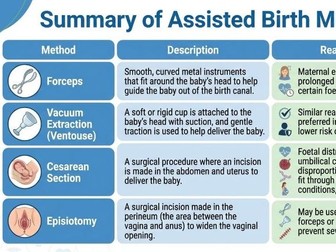
Visual Knowledge Organisers: Multi-ability infographics and “A-Level style” detailed diagrams designed to help students master complex processes like hormonal feedback loops and the mechanics of assisted birth (Ventouse and Episiotomy).
Exam-Style Practice Suite: A collection of short, medium, and extended-response questions (1–8 marks) with full model answers. Includes specific practice for the journey of the egg, Stage 2 of labour, and postnatal developmental needs.
Full Mock Examination: A 70-mark, 1 hour 15-minute practice paper modeled on the OCR exam structure, featuring scenario-based questions in Section A and direct knowledge testing in Section B.
Interactive Revision Tools: A series of “True or False” technical challenges and flashcard prompts to drill essential vocabulary such as “non-blanching rash,” “thermoregulation,” and “environmental stimulation”.
Safety & Hazard Masterclass: Clear guidance on identifying current safety marks (BSI Kitemark, Lion Mark, and the updated UKCA symbol) and risk-assessing roads and gardens.
Target Audience: Ideal for Year 10 and 11 students aiming for Level 2 Merit, Distinction, and Distinction* grades. This pack provides the “extra mile” detail required for high-ability learners to succeed on the most challenging parts of the specification.
Perfect for: GCSE Child Development • Health & Social Care • PSHE • TA Training • SEN Support
Bring complex pregnancy and childbirth concepts to life with this beautifully designed set of clear, student‑friendly flash cards. Created with consistent styling, accessible language, and colourful visuals, these cards support learners who benefit from visual prompts, simplified explanations, and step‑by‑step understanding.
What’s Included
A full set of over 200 professionally designed flash cards, each with:
✔ A bold key term
✔ A simple, student‑friendly definition
✔ An engaging image to aid recall
✔ Consistent colour-coding and layout for easy navigation
Topics include:
Antenatal Health Conditions
Why Teachers Love This Resource
✔ Clear visuals: Supports SEND, EAL, and lower‑ability learners
✔ Accurate terminology: Aligned with UK exam boards
✔ Versatile use: Revision, starters, plenaries, independent work, display
✔ Editable PowerPoint format: Personalise or differentiate with ease
✔ Consistent, high‑contrast design for easy readability
Ideal For
Child Development (NCFE, OCR)
Health & Social Care
PSHE units on pregnancy & reproduction
Teaching Assistants (L1–L3)
Apprenticeships or vocational pathways
This is a powerpoint with over 300 slides and has been designed to give 17 days of revision (over the Christmas Holidays 2025 for Early entry but dates can be edited). Each day has:
a slide to write what they already know (brain dump)
a summary of information on that topic
a page number for the Cambridge Go online textbook (but can be deleted if you use a different resource)
a range of 1 mark - 8 mark questions on that topic
model answers for each topic
Also in this bundle are 2 papers created by me (having looked at the past papers: Januray and June 2024 and 2025) and I have tried to identify missing content. These also contain 1 slide with a question and the next slide with a model answer.
A resource for Health and Social Care AS/level 3. This unit examines child development - physical, intellectual, social and emotional. For more materials relating to this resource, please visit the NGfL site, linked below.
A PowerPoint presentation with links to video clips showing children of different ages communicating. The challenge for the pupils is to correctly link the age of the child with the correct clip. It also encourages pupils to think about other aspects of development in order to identify the age.