Lesson Workbook
This resource is a ten page lesson booklet on the subject of elements, compounds and mixtures. Included within this workbook:
Key Definitions
Diagrams
Element Factfile Task
Simple Reaction Equations
Atoms and Elements in Compounds
Mixture Separation Techniques
Examples of Each
Word search
This lesson workbook is ideal for grades five to eight depending on ability - please view the preview included. This workbook generally takes an hour for a class to complete and I have found it very useful as a summary tool.
Please note that some of my resources may have American spellings. Thank you very much.
Designed to be delivered to Year 9 class but can be adapted for different year groups / abilities.
Recaps on atomic structure.
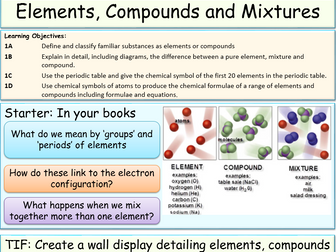
Defines elements, compounds and mixtures with examples.
Worksheet included to test the students understanding.
Rules for naming compounds given. Activity for students to complete word equations and name compounds.
Exam style questions for plenary. Higher ability level attached.
This PowerPoint includes definitions and examples of elements, compounds and mixtures with clear imagery to support. There are several slides to be used to quiz pupils and a worksheet for pupils to apply their knowledge. This can be used to assess pupils on their understanding of key terminology.
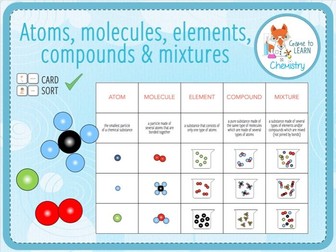
Card Sort on definitions and examples of atoms, molecules, elements, compounds & mixtures.
Great as starter, plenary or revision activity.
Card Sort: 25 cards per set
Including shuffled version
Science Escape Room on Mixtures and Compounds Knowledge Escape Room Quiz - End of term fun for the whole class. No printing required! Just project the Powerpoint and off you go. Built in timers, video clips and answer reveals after every slide. This is an educational fun immersive 'themed Escape Room’ experience.
Have the students compete individually, in teams or as a whole class the choice is yours! This resource is a great team-building activity to keep your students engaged during the last few days (or week) leading up to the end of term.
There are seven different challenging puzzles and you have the choice of setting the timer at easy, medium or high difficult level for each escape. Students will complete a variety of tasks using different skills including: problem-solving, critical thinking, reading comprehension, literacy challenges and some clever deduction.
The puzzles, bonus questions and challenges are a fun way to assess a topic or subject area. This resource covers a variety of different elements including: vocabulary, key terms. key themes, general subject knowledge, literacy and much more…
** Science Escape Room Quiz Experience** Saving the Mascot Escape Room Contents
☞ Interactive 26 slide Powerpoint Escape Room Challenge
☞ Optional Escape Certificates
☞ Optional Team Sheet (Print it or use scrap paper instead)
Common FAQ’s
★Group sizes: 1-30 students per team - (Participants up to 180)
★Time: Approximately 50-60 minutes (Provide hints along the way if time is a factor!)
★Materials: Aside from Powerpoint - all students need is a pen / pencil.
How to run this science escape challenge
This escape room can be done without any printing we have however still included a team sheet (Slide 2) should you wish to use it, if not plain paper will more than suffice.
The escape room is story driven by a YouTube video which is split into 9 sections.
Introduction - Puzzle 1 – Puzzle 2 - Puzzle 3 – Puzzle 4 – Puzzle 5 – Puzzle 6 – Puzzle 7 - Success
At various points you will be instructed to pause the video at these points you can go to the next slide in the presentation.
Each video section (excluding Introduction and Success) will be followed by a puzzle.
Every puzzle has three built in timers in the lower right hand corner to put the teams on a time limit of your choice if you so wish.
Once the timer has expired or everyone has completed the puzzle teams can check their answers on the next slide using the CLICK TO REVEAL boxes.
Once all answers for the current puzzle have been revealed move on to the next video section and subsequent puzzle until all 7 puzzles have been completed and everyone has escaped successfully
(Optional) Give out winning certificates to the highest scorers.
A KS3 lesson looking at the difference between atoms, elements, compounds and mixtures, how to represent elements as symbols and interpreting the numbers of atoms and elements in a chemical compound. The lesson features:
-An engaging starter task using a video to ascertain students prior ideas around what elements are (Daniel Radcliffe singing 'the elements song')
-Key term and definition match
- Quick multiple choice questions to assess student understanding
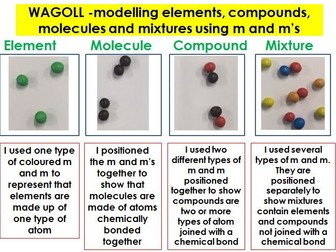
- A task using sweets to model atoms, elements, compounds and mixtures including an opportunity for students to explain their arrangements
- A worksheet requiring students to recognise atoms, elements, compounds and mixtures
-An activity to help students recognise element symbols on the periodic table
An activity to practice recognising numbers of atoms and elements in chemical formulae
Variation style task designed to allow students to practice a variety of different styles of questions.
Used for a KS3 class but could be adapted & used at KS4.
Answers are included.
Created on PPT so can be displayed easily on a screen.
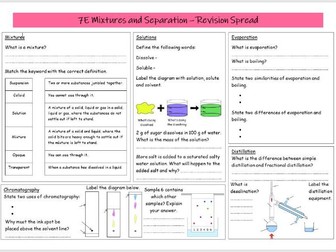
KS3 Science Edexcel Yr7 Revision Spread and Answer Sheet - Chemistry: Topic 7E Mixtures and Separation.
This A4 revision spread condenses the Edexcel topic 7E onto one A4 sheet which can be printed off and filled in to aid revision and help summarize the topic.
A full answer sheet is provided which can be used to mark the filled in revision spread and can also be used as a revision poster.
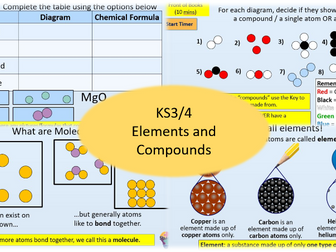
A PowerPoint and Activity sheet on the topic of atoms, elements, compounds and mixtures. The main activity is using separation techniques to extract salt from a mixture…
It is aimed at KS3/KS4 students and includes information, some questions and an experiment.
Please note: the preview for the activity sheet looks like the boxes are overlapping, but they’re not once you download it!
Updated with new chemistry resources: elements and compounds worksheets, formulae activities, etc, etc.
Numeracy task (“all matters”) to help students to figure out the composition of gases in the air - independent and student-led (with extension task). Easy to differentiate further.
Summary task of “atoms, elements and compounds” with answers.
Word cloud for students to annotate, draw diagrams for, summarise their learning… use for spelling tests, make questions using the words, play Taboo, word splat, mind map, etc…
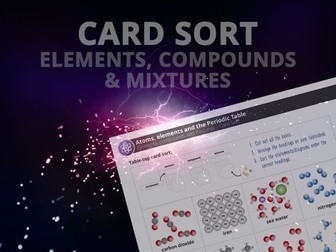
Table top card sort!
Straight forward activity for students to consolidate knowledge of elements, compounds and mixtures.
15 substances require sorting and matching to definitions.
Answer sheet included!
The Elements, Compounds and Mixtures science doodles is a great way for students to organise information and review concepts in a visual and engaging way. A great way for students to identify and define these three types of substances.
Comes with a bonus activity puzzle sheet!
Students can complete either of the two differentiated versions.
Version 1: Students research the elements, compounds and mixtures to complete the science doodles.
Version 2: Students write the key words into the gap fill spaces to complete the science doodles.
Includes a PowerPoint word bank of key words for the gap fill version as well as a model example which can be used as an answer key.
Great accompaniment to this resource:
Atoms Cut and Paste Activity and Word Search
Clipart by:
Clipartino
This resource contains 4 worksheets that can be used in class or as homework to enable your students to practice what they have learnt in the classroom.
This pack includes:
Filtration & Crystallisation
Simple Distillation
Fractional Distillation
Chromatography
We have worksheets for the following topics in Chemistry Paper 1:
Atomic Structure and The Periodic Table
Atoms, Elements and Compounds
Mixtures and Separation Techniques
Relative Atomic Mass and Electronic Structure
The Periodic Table and Metals
Groups 0 & 1
Group 7
Bonding, Structure, and The Properties of Matter
Ionic Bonding
Covalent and Metallic Bonding
Structure and Bonding of Carbon
Quantitative Chemistry
Balancing Equations
% Mass
Relative Atomic and Formula Mass
Amount of Substances in Equations
The Mole
Using Moles to Balance Equations
Limiting Reactants
Concentration of Solutions
Chemical Changes
Metal Oxides and Reactivity Series
Displacement Reactions
Extraction of Metals and Reduction
Ionic Equations
Reactions of Metals with Acids
Neutralisation of Acids
pH Scale, Neuralisation, and Strong & Weak Acids
Electrolysis
Energy Changes
Energy Transfers and Reaction Profiles
Energy Changes of Reactions
More worksheets will be added in the future.
Please rate and review this resource. Thank you!
New for the AQA GCSE 1-9 Combined Trilogy Unit ‘C1 Atomic Structure’.
Full lessons ready to use straight ‘out of the box’.
Lesson meets the full criteria for this unit
Similar structure to my other power points following the input - activity - review phasing
Plenary sections for progress checking
Clear learning objectives and outcomes
Modern and engaging layout
Little adaptation needed
Each lesson covers at least an hour of lesson time
28 ppt slides
Please leave constructive feedback :D
This lesson is about Compounds and Mixtures. Explain the differences between compounds and mixtures with examples. Discuss physical change vs. chemical change. Review the different types of mixtures (solution, colloid, suspension) and classify them to homogeneous and heterogeneous mixtures.
A part of a science course for grade 8 (Chemistry).
The set includes Power-Point presentation and iBook, which is an Interactive Book, where the students fill the blanks that goes in accordance with the PPT slides.
In addition there are all the answers to the iBook for the teacher.
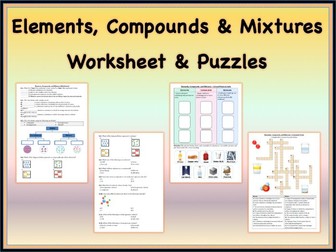
A lesson looking at elements, compounds and mixtures by using different diagrams to illustrate them. Comes with an accompanying worksheet for printing / projecting for students to identify which are elements, which are mixtures - of elements, compounds or both, and which are compounds.