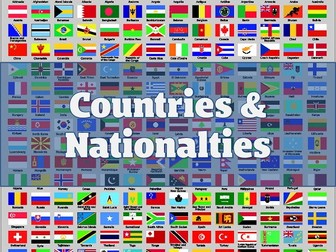
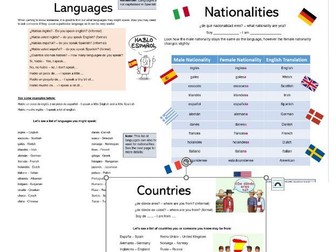
Vocabulary for Nationalities able to be used for languages as they are the same
This PowerPoint provides a full lesson.
Introduces Countries
Mini Italian messaging reading comprehension
True/False activity
Introduction to the verb essere and speaking opportunity with new vocabulary
Nationalities Vocabulary
Grammar summary for adjective endings
Mini writing activity - complete phrases
Writing task -Write a letter plenary activity / Homework
Printable vocabulary slides
Vistas licensed under cc
Great resource for practising nationalities between masculine and feminine, the languages and the countries they are from. A page for each section to help students practise the words and adjective agreement
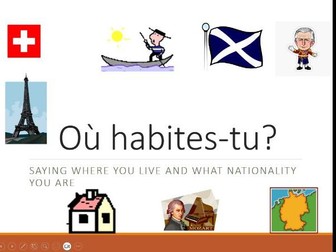
A 38 slide Power Point on countries and nationalities. French vocab, flags, nationalities ( masculine and feminine) Includes use of s'appeller, habiter and etre. Difference between place you live and place of origin. Speaking, Reading and writing tasks. Suitable for KS2 and KS3.
A 3-page Spanish worksheet to aid students in consolidating their knowledge on the topics of ‘countries’ and ‘nationalities’. This resource involves vocabulary recall, a fun crossword based on nationalities and a small, basic writing activity towards the end.
Level: Beginners
Tenses used: Present Tense
Skills developed: Writing
A worksheet I set as a cover lesson on where you live. It covers town, country and nationality and is fairly self explanatory so should be able to be used with a non specialist if necessary. It covers when to use a, en and au and gets students thinking about when to use capitals and how to make gender agreements.. A variety of written activites, each progressivley more difficult, ending with a differentiated homework task.
An animated powerpoint that introduces countries and nationalities with lots of repetition, match up exercises, a listening activity and a grammar exercise. It’s fairly old school style but I have been using it for years and it never fails to engage youngers students. It would take up 2-3 lessons.
Worksheet for use after introduction of countries, nationalities. Pupils should have been taught the adjective endings (français, française) and use of à plus town, en/au plus countries (and why). Uses first and third person singular. You will need to add faces.
A 3-page French worksheet to aid students in consolidating their knowledge on the topics of ‘countries’ and ‘nationalities’. This resource involves vocabulary recall, a fun crossword based on nationalities and a small, basic writing activity towards the end.
Level: Beginners
Tenses used: Present Tense
Skills developed: Writing
A cultural project on a French-speaking country (list included). Students will have to look up information on food, sports, music, wildlife, travel or fashion. By the end, they will have a small booklet with lots of information on the country.
Students will have to complete some files on the different cultural aspects. They look like questionnaires that they have to fill in.
Fact file: basic information on the country (capital, population, size, currency, etc.)
Food file - information on a recipe (utensils, ingredients, method) and some culture facts related (when do you eat it, variations of the dish, etc.)
Sport file - information on the national sport, notable athletes and the Olympics
Travel file - scavenger hunt around a city of your choice
Wildlife file - information on the country’s basic geography, animals and plants
Music file - information on a song & artist
Fashion file - information on the native clothing and some culture facts related (when do you wear it, variations of the outfit, etc.)
Mini-dictionary: section with important phrases related to the topic. Things they would need if they went to the country and had to talk/ask about the topic.
Spanish version available here: https://www.tes.com/teaching-resource/spanish-speaking-country-a-culture-project-12329242
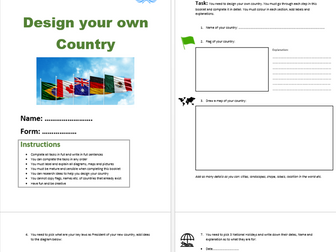
This is a new resource for KS3 that can be adapted, expanded or used as it. It is a 6 page resource that can take 2-3 lessons or even as a homework task.
It includes questions about the governance, laws, location, flag, national holidays etc. It is a great way to engage students to think about how they perceive geography and politics.
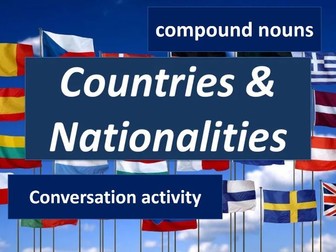
In this 2 pages worksheet, students will do the following activities:
Write the nationality corresponding to the countries.
Complete sentences with the correct nationalities.
Determine the meaning of compound nouns and use them in sentences.
Complete a dialogue with the words in the box.
Fill out the ID cards with name, age, country and nationality.
Follow the conversation guide to present a dialogue in class.
In this worksheet students will identify capital city, country and nationality then they will use this inforamation in a guided speaking activity. There is also an additional exercise for compound nouns.
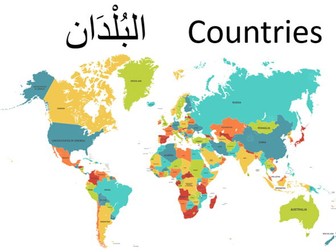
How to say and ask for information about some one’s country and nationality with a rich source of vocabulary, phrases, grammar and conversational Arabic.
Learn around 30 countries of the world.
Learn the names of the 7 continents.
Learn the Arabic countries, capitals and flags.
Be able to use grammar related to nationality: such as pronouns, Nisba, plurals and duals.
Compass directions and location of cities in a country.
Conversation drills
Spelling Tests
This pack includes 2 Power Points presentations introducing a selection of countries and nationalities.
Includes activities for all skills - including EPI method activities such as Fireball, Find the intruder, Sylla-bee, Break the flow.
The pack also include a reading activity and an extension worksheet.
Worksheet to consolidate some basic nationalities in French.
Includes:
- names of countries in French
- image of a boy or girl to revise masculine/feminine
- space for pupils to fill in correct nationality in French
- flags to colour in using correct colours
Ideal for use early in nationalities topic.
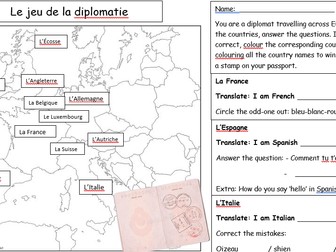
Students have to colour the names of the countries once they complete the short tasks for each country. They can work in autonomy. This resource helps with numeracy skills, geography and activate prior knowledge (greetings, numbers, colours, months…) in French.