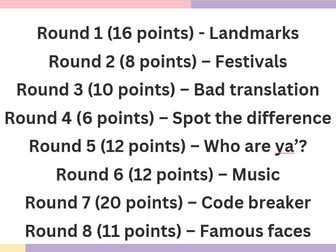
The Big Languages Christmas Quiz - A brand-new, high-quality Christmas quiz packed with five festive, curriculum-rich rounds designed to engage every class. All questions and answers are written in English. Includes a round on the meaning of Christmas words, global festive traditions, international Christmas food, seasonal idioms, and unique world-language features. Fully editable, and perfect for end-of-term lessons, cover, or whole-school activities. Fun, challenging and engaging! A great way to build cultural capital. No printing needed. Ideal for Key Stage 3 to Key Stage 5.
Spanish Cultural Quiz
Suitable for KS3 & KS4 Spanish students.
This interactive PPT quiz (65 slides) is a fun way for students to learn and revise different aspects of the Spanish culture.
It includes many opportunities for learners to talk, share opinions, and even sing and dance.
Easy to adapt as you like.
There are 7 rounds:
Festivales en España: scavenger hunt (2 options), match up vocabulary, videos and worksheets
Música: guess the song/artist
Comida española: food matching game
Países hispánicos: guess the country and flag
Famosos hispánicos: guess the celebrity
La Ruleta: spin the wheel and answer the question
Cine y Televisión: work out the English name of different films/TV shows
Culture quiz with 40 questions total divided up in four rounds (Spanish Geography, Spanish landmarks, Food, People and Culture). Useful as an end of year activity, a house competition or for taster Spanish days/ activities. Questions will suit year 7 and year 8.
Best way to play it is in teams, groups answer on paper and the answers are marked by another team. It can easily take an hour to finish it at a slow pace, about 45 minutes if going fast.
Answers are provided round by round.
(If you have purchase resources for the previous GCSE French specification, and are interested in upgrading your resources, please get in touch)
In this BUNDLE:
You will find everything you need to teach the second Theme of the new GCSE course (with AQA): Popular culture.
It includes resources for all 3 topics:
Topic 4: Free-time activities
Topic 5: Customs, Festivals and Celebrations
Topic 6: Celebrity Culture
For each topic:
The Presentation (approx. 145 slides including answer slides) covers the whole topic and is composed of 4 parts. There are also 4 folders (A, B, C and D) containing the relevant files for that part.
It includes:
• a range of Listening, Speaking, Reading, Writing and Translation activities
• grammar points
• elements of phonics
• retrieval activities, cultural aspects and homework tasks
• QR codes/ links for independent study
• vocab lists+ links to online course
• comments under the slides for notes and worksheet location
• answers
• audio files and transcripts
• .pdf and editable versions of the worksheets (except for the writing mat in topic 6, the dots and boxes game in topic 5, and the Connect4 game in topic 4- which is only available as .pdf)
Activities are differentiated and exam style.
After downloading, save the .zip file in your computer (in “documents” for example), then right-click and select “extract all” to access all the resources.
For previews, please see the description for individual topics.
If you have any questions, please don’t hesitate to get in touch (either via email or through Facebook)
In this digital product:
You will find everything you need to teach Topic 6: Celebrity Culture (third topic of Theme 2 of the new GCSE course (with AQA): Popular Culture)
The Presentation (approx. 145 slides including answer slides) covers the whole topic and is composed of 4 parts:
A: My favourite celebrities
B: Becoming famous
C: Life as a celebrity
D: Celebrities’ actions and influences
There are 4 folders (A, B, C and D) containing the relevant files for that part.
It includes:
a range of Listening, Speaking, Reading, Writing and Translation activities
grammar points including: Revision of relative pronouns, Demonstrative adjectives, Imperative and imperfect tense
elements of phonics: qu, ch, the letter -a, gn
retrieval activities, cultural aspects and homework tasks
QR codes/ links for independent study
vocab lists (full topic list or 4 lists for the 4 parts) + link to online course
comments under the slides for notes and worksheet location
answers
audio files and transcripts
.pdf and editable versions of the worksheets (except the writing support mat, which is only available as a .pdf)
Activities are differentiated and exam style.
The first 15 files are a preview of what is included in the .zip folder: Topic6.zip.
After downloading, save the .zip file in your computer (in “documents” for example), then right-click and select “extract all” to access all the resources.
For the full overview, you can check the free SOW available for download here.
If you have any questions or if you are interested in more resources like this one, you can check this Facebook page: @Frenchresources, where links to resources and freebies are posted regularly.
Complete No-Prep lesson with exam style questions, tasks and answers on Culturing Microorganisms / Bacteria and RP2 for AQA GCSE (9-1) Biology.
This lesson is for GCSE Biology only and covers all of AQA GCSE Biology exam spec point 4.1.1.6 and Required Practical 2.
As a Secondary Science teacher, Deputy Headteacher, writer and examiner for many years I make high quality no-prep lessons so busy teachers can teach outstanding lessons without spending hours planning. This high quality lesson includes explanations, different types of in-lesson assessment (all with answers) and unique exam-style questions.
My lessons are designed to take learners on a journey that builds up their understanding step by step, while still going into a lot of depth. The preview video shows a representative sample of slides from the resource so that you get a good idea of what it includes before you buy.
What’s Included:
• Teaching notes
• Starter / Do Now Activity
• Explanation slides in “chunked” sections with animated diagrams.
• Worked examples of calculations / questions.
• Multiple questions in different question styles and difficulties - no need for worksheets. Each “chunked” explanation section typically includes a set of “learning check / quick questions” followed by a set of in-depth questions on the learning from that “chunk” of the lesson. All questions have answers.
• Exam-style questions on the whole lesson at the end of the lesson- these are unique, based on real exam questions but not just copied from exam boards.
• Answers for all questions
• All easily editable to adapt to your teaching or to use in existing lessons.
• Slightly humorous, at points, if you like that sort of thing.
The lesson was written for AQA GCSE Science / Biology but is very likely to be applicable to other exam specifications.
Please leave a rating / review and all other feedback gratefully received!
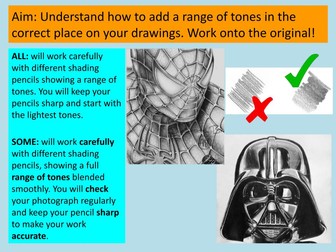
This GCSE Art Project aims to develop and enhance the range of skills that students have been taught at KS3, enabling them to master and improve in a way that was engaging yet simple to achieve. There are some ‘essential’ art skills taught in this project, including: grid drawing, pencil drawing, pen drawing, acrylic painting, watercolor painting, poly printing and different types of research / art analysis / presentation skills.
The theme is Pop Culture, allowing students a wide range of references to work from.
The presentation includes lesson entry tasks / plenaries and exit tasks, examples of student work, homework tasks throughout.
There are printable resources on slides 1-12 with the Pop Culture images I used in lessons. There is an artist research information slide that can also be printed (slide 43)
There are 124 slides in total.
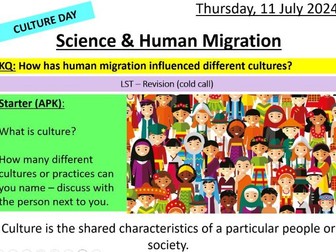
SCIENCE AND HUMAN MIGRATION
This lesson is a key stage 3 or 4 lesson (Year 7 to Year 10) that is 60 minutes long. This was developed as part of a culture day lesson linking science with culture.
Included:
Starter – what is culture
6 x A3 printout information hunt detailing Pakistani, Bengali, British, Eastern European (with Poland), Nigerian and Indian cultures. This links culture to astronomy, traditional medicine, blood types and Japanese personality types and human migration.
Content & Presentation – Astronomy, human migration, blood types
Independent Practice: Questions include:
Timeline of human migration from East Africa
Keyword table from different cultures
How astronomy links to agriculture
Tickbox exercise for blood types
what traditional medicines are used to treat illness.
Markscheme included
Opportunities for Self/Peer Assessment
Worksheet printed double sided in landscape - unblurred when bought
This presentation contains over thirty five super useful slides to kick off the school year with confidence, whether it is your very first lesson or within the opening weeks. The best part? It is editable so you can adapt it to your own style and classroom needs.
It includes:
Icebreakers to help the group get to know each other
A name-learning game
Rules and expectations
Seating plan template
Materials list
Notebook and class rules
General culture quiz
Key Spanish for the classroom
Timetable
Calendar for important dates
Ideas for getting involved in the class and department
Activity on Spanish-speaking countries/territories
Reflections and goal-setting for the new school year
Tips for building a good study routine
Perfect for language teachers who want a structured yet flexible way to start the year, while creating a positive and motivating classroom atmosphere.
This bundle contains the lessons of Unit 6 (Celebrity Culture ) of Theme 2 (Popular Culture) from the NEW AQA spec.
The lessons contain sentence builders of key vocab, tasks that target key skills needed in the GCSE exam and fun activities students can enjoy whilst also learning.
They’ve all been meticulously created to aid students in their success at the GCSE exam. These lessons DON’t contain the activities from the new AQA book. They are different from what you will find in the book but I did follow a similar structure in terms of content.
The activities in the book are also well-planned and if you have access to them, I recommend using them in your lessons along with the activities created by me.
Please bear in mind that any listening activity found in the lessons is meant to be done by the teacher by reading out loud sentences/texts. NO AUDIO is provided.
Each lesson can also be purchased individually if you wish to do so. I have also started working on Unit 7. Units 1, 2, 3, 4 and 5 are already available in my shop.
All lessons will be available in my shop: https://www.tes.com/teaching-resources/shop/SenoritaDi
For any queries please email me at: spanish_learning@yahoo.com
A detailed framework for the 70-mark Cultural Context comparative essay question, featuring a comprehensive breakdown using contemporary texts.
Key Features:
Complete essay scaffold
Step-by-step planning guide
Sample answer with commentary
Marking scheme breakdown
Texts Covered:
“Small Things Like These” (Keegan)
“Sive” (Keane)
“The Shawshank Redemption” (Darabont)
Perfect For:
Exam preparation
Classroom instruction
Student revision
Assessment planning
This comprehensive guide helps teachers lead students through complex comparative analysis while maintaining focus on examination requirements and marking criteria.
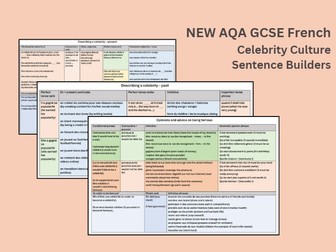
3 x Sentence Builders for the new AQA GCSE French topic CELEBRITY CULTURE
Recommended for Higher Tier due to the range of language, but could easily be adapted for Foundation Tier (editable word documents included)
What’s included:
Learning outcomes covered:
o Describing a celebrity - present
o Describing a celebrity - past
o Opinions and advice on being famous
Vocabulary based on the official AQA lists + high frequency, useful verb phrases, complex structures as chunks and other universals
Integration of complex structures and idiomatic expressions to help students learn high-level language as chunks
High-frequency vocabulary and complex structures are recycled across several of the sentence builders
How to use them:
Modelling & scaffolding: I use sentence builders as a Knowledge Organiser, a modelling tool when introducing a new topic, and a scaffold for writing and speaking.
Teaching ideas: I have a free document in my TES called “Teaching ideas for sentence builders” that I recommend downloading if you’d like more ideas on how to get started with sentence builders.
EPI methodology: Although I do not work in an EPI school or follow every part of MARS EARS from Gianfranco Conti, these sentence builders could be used for EPI - they are in both PDF and word format so can be edited and adapted.
If you have any questions about this resource, please do not hesitate to contact me via my MFL Instagram @eclaireMFL
Students work book and PowerPoint for the whole unit.
Both include the following topics:
22 Engagement patterns of different social groups and the factors affecting participation.
23 Commercialisation, sponsorship, and the media.
24 Positive and negative impacts of sponsorship and the media.
25 Positive and negative impacts of technology.
26 Conduct of performers and introduction to drugs.
27 Sporting examples of drug taking.
28 Advantages/disadvantages to the performer/the sport of taking PED’s.
29 Spectator behaviour and hooliganism, including strategies to combat hooliganism.
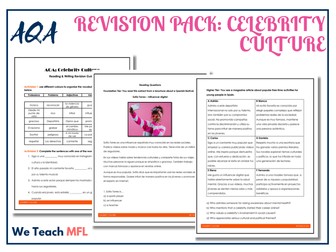
This comprehensive revision pack is designed to support students preparing for the new AQA GCSE Spanish (2026 specification).
Focusing on Unit 6: Celebrity Culture, this resource provides a wide range of exam-style activities to help students develop confidence in Reading, Writing, Translation and Grammar.
The pack includes differentiated tasks suitable for Foundation, Crossover and Higher students, making it ideal for mixed-ability classes.
What’s included:
Vocabulary categorisation activities
Grammar gap-fill exercises
Tense identification practice
Foundation and Higher reading texts in AQA style
Multiple-choice and matching comprehension questions
Spanish to English translations (Foundation and Higher)
English to Spanish translations (Foundation and Higher)
90-word and 150-word writing tasks
Higher-tier model answers
Full teacher answer key
All activities reflect the style, structure and language expectations of the new specification. The tasks provide structured practice with key topic vocabulary, mixed tenses and opinion phrases, helping students prepare effectively for exams.
This resource is suitable for Year 10 and Year 11 students and works well for revision lessons, homework, cover work, intervention sessions or independent study.
Designed to save planning time while ensuring exam-aligned practice throughout.
A worksheet to introduce/reinforce the festival of Las Fallas. It includes a task with key vocabulary, a reading task GCSE style and two writing tasks. One of them is a description of a topic related picture that includes support (vocab bank and sentence starters). Key in the new speaking GCSE exam. Answers are provided which makes it perfect for self-correction both for cover lessons or revision homework.
TRADITIONAL FOOD AND SCIENCE
This lesson is a key stage 3 or 4 lesson that is 60 minutes long. This was developed as part of a culture day lesson linking science with culture.
Included:
Starter – what are some traditional foods in your culture.
Career link - Food Anthropologist
7 x A3 printout information hunt detailing traditional food, origins and science link of the following:
British - stilton cheese
African - Plantain
Italian - Prosciutto
German - Sauerkraut
Polish - Kielbasa
Chinese - Century Egg
Japanese - Natto
Content & Presentation slides:
What is traditional food
Chemistry - atoms making up molecules inside of food
Molecules in food
Food chemistry - chemical reactions rearranging atoms
pH - acidity and alkaline FOOD LINK
Enzymes as workers of cells FOOD LINK
Osmosis definition and FOOD LINK
Fermentation definition and FOOD LINK
Anaerobic respiration definition and FOOD LINK
Worksheet on slide 2 and 3 - student exploration
Scientific keyword definitions
Tick box table of food in different cultures
When did these traditional foods originate in history
Table completion of the scientific process (e.g. fermentation, osmosis etc) and space to write down what it does.
Answers included - Opportunity for Self/Peer Assessment
**PRINT SLIDE 2 TO 3 FOR WORKSHEET
**
Bonjour!
Here’s a free quiz about France with 33 colourful slides. It can be used at the beginning of the year or at the end. I usually have students to work in teams on it. The first 17 slides contain the questions and possible answers to choose from. The other slides contain the answers! This quiz was based on the bigger quiz with 107 slides which can be found here
Enjoy. It’s a great tool to recap about music, monuments, food, brands, culture, geography, history, sports etc.
In this lesson, students think about the meaning of diversity and how this connects to contemporary society. In addition, they explore the positives associated with diversity and the ways in which to celebrate it.
Boost your GCSE German students’ listening skills with this complete Celebrity Culture (Promikultur) resources, tailored for the AQA 2026 German specification.
Perfect for teachers and students alike, this high-quality resource includes:
5-Minute Native Speaker Video on celebrity culture, engaging students with authentic listening practice. (Linked within the worksheet).
Differentiated PDF Worksheet with pre-listening, whilst-listening, and post-listening activities to suit both Foundation and Higher Tier learners.
THE TRANSCRIPT WILL BE AVAILABLE AS A SEPARATE RESOURCE.
What’s covered in this GCSE German Celebrity Culture Listening Practice resource?:
Essential vocabulary and phrases related to Promis (celebrities)
Sectors in which we find celebrities
Examples of celebrities from German speaking countries
Key reasons why German celebrities aren’t as globally famous
Interactive tasks to master listening for exams
This celebrity culture resource is designed to increase student engagement, improve comprehension, and prepare them for the AQA GCSE German exams from 2026. Get your students exam-ready with this dynamic and effective resource!
Download now for your GCSE German lessons today!