The Development of the Periodic TableQuick View
OuttheBoxScience

The Development of the Periodic Table

(0)
New for the AQA GCSE 1-9 Combined Trilogy Unit ‘C2 Periodic Table’. Full lessons ready to use straight ‘out of the box’. Lesson meets the full criteria for this unit Similar structure to my other power points following the input - activity - review phasing Plenary sections for progress checking Clear learning objectives and outcomes Modern and engaging layout Little adaptation needed Each lesson covers at least an hour of lesson time 26 ppt slides Please leave constructive feedback :D
The Development Gap: MigrationQuick View
markthegeographer

The Development Gap: Migration

(0)
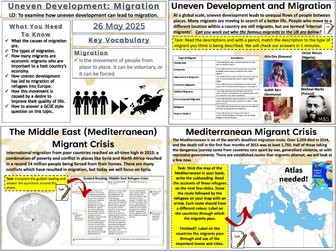
AQA GCSE Geography lesson for the new specification unit 2B. In this lesson we look at how uneven development causes international migration. there is a retrieval practice starter based on development indicators. We start the lesson with a match-up activity where the students match the type of migration to the descriptions. The students then create a diagram that looks at the positives and negatives of international migration for the country and origin and the host country. We then complete a cloze exercise looking at economic migration to the UK. We then introduce the Middle East (Mediterranean) migrant crisis. The students complete a guided reading task then use an atlas to plot the routes of migrants in three example stories on a map of Europe. We then tackle a 4-mark GCSE-style question and the pupils use a writing frame and some points suggestions to help answer the question if needed. hope this saves you valuable planning time. https://www.tes.com/teaching-resources/shop/markthegeographer
The Development Gap: Measuring DevelopmentQuick View
markthegeographer

The Development Gap: Measuring Development

(0)
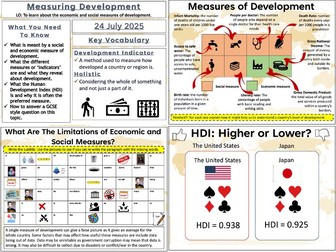
AQA GCSE Geography lesson for the new specification unit 2B. In this lesson we look at how development can be measured. There is a short multiple choice retrieval practice starter. We begin by looking at the difference between standard of living and quality of life. After this the students complete an activity matching the descriptions of the development indicators up with the pictures and colour coding them into social and economic indicators. The students then create a paragraph detailing why some indicators may not be reliable, but use the pictures to work out what the missing words might be. We then look at HDI and what is is made up of. The students complete a quick activity on matching the pictures to the benefits of using HDI as a development indicator. A short game of HDI higher or lower follows which is a fun way to spark debate and consolidate learning. We then tackle a 4-mark GCSE-style question with some suggested points to use on the next slide so the students can correct/feedback on their answer. hope this saves you valuable planning time. https://www.tes.com/teaching-resources/shop/markthegeographer
Sustainable Development Goals LessonQuick View
MyGeographyDepartment

Sustainable Development Goals Lesson

(3)
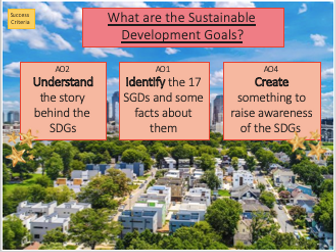
Complete lesson with differentiated activities on introducing the sustainable development goals. Start with definition of sustainable development, then differentiated comprehension task on understanding why they were created and the difference between them and the millennium development goals. Main task focuses on students learning about all 17 SDGs. Creative homework task for students to promote the goals.
AQA GCSE Geography: The Development GapQuick View
markthegeographer

AQA GCSE Geography: The Development Gap

11 Resources
Complete sequence of lessons for Unit 2, Section B (The Development Gap) of the AQA GCSE. Jamaica is the case study for tourism. The lessons included are detailed below. What is the Development Gap? Measuring Development The Demographic Transition Model Changing Population Structures Wealth and Health Migration Foreign Investment and Industrial Development Aid and Intermediate Technology Fair Trade Debt Relief and Microfinance Tourism in Jamaica Hope this saves you some valuable planning time. https://www.tes.com/teaching-resources/shop/markthegeographer
The Development Gap: Wealth and HealthQuick View
markthegeographer

The Development Gap: Wealth and Health

(0)
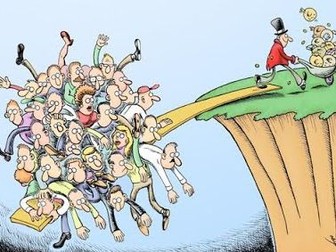
AQA GCSE Geography lesson for the new specification unit 2B. In this lesson we look at why there are disparities in wealth and health both within and between countires. There is a rivers themed retrieval practice starter. We then look at the global state of wealth inequality and where the world’s wealth is and isn’t. We then look at how economic development has created inequalities in the USA. The students watch a video and note down the different types of inequality. The students complete a match-up activity identifying some of the main factors that lead to inequalities in wealth. We then look at health, the students complete a diagram using hexagons that shows how development might be linked to health. We then look at what malaria is and the students complete a colouring by numbers exercise to show the global distribution of malaria. They then watch the Disney information film ‘The Winged Scourge’ and answer questions. We then complete a mind map to show how some less developed countries are more at risk from malaria and categorise these into social, economic and environmental reasons. We then tackle a 6-mark GCSE-style question and the pupils use a writing frame and some points suggestions to help answer the question if needed. hope this saves you valuable planning time. https://www.tes.com/teaching-resources/shop/markthegeographer
The Development Gap: FairtradeQuick View
markthegeographer

The Development Gap: Fairtrade

(0)
AQA GCSE Geography lesson for the new specification Unit 2B: In this lesson we look at how trade and in particular Fairtrade can help reduce the development gap. The lesson has a retrieval practice starter based around Ordnance Survey symbols. We firstly introduce what tariffs and quotas are and the pupils fill in a table where they decide if the statement applies to a tariff or a quota. The pupils complete a cloze exercise on what free trade is and we then look at the benefits of being in a trading group or trade bloc. We introduce Fairtrade and there is a video clip, we then look at Uganda and coffee farmers in the country who participate in a Fairtrade scheme and community project. The pupils complete a guided reading exercise and there is also a video for this. We finish with a GCSE-style practice question with some guidance and structure provided for the students. Hope this saves you some valuable planning time. https://www.tes.com/teaching-resources/shop/markthegeographer
The Development Gap: The Demographic Transition ModelQuick View
markthegeographer

The Development Gap: The Demographic Transition Model

(0)
AQA GCSE Geography lesson for the new specification unit 2B. In this lesson we look at the Demographic Transition Model. There is a multiple choice retrieval practice starter before we look at what the term ‘demographic transition’ means. The students have some sentence fragments to put in order. We then look at some key terminology that is needed for the lesson and the students match the description up to the term. We then look at the model itself an the students have a large A3 sheet to draw the model onto the template. The model is explained in stages and students make notes as they go along, drawing the three lines on too. There is a living graph activity to do when they have finished, by reading the statements in the boxes, they then have to work out which stage it applies to. We then look at examples of countries in the various stages of transition and the students create a diagram titled ‘The Road to Development’. We then tackle a 6-mark GCSE-style question. There is a writing frame for structure and guidance on points to use. hope this saves you valuable planning time. https://www.tes.com/teaching-resources/shop/markthegeographer
The Development Gap: Changing Population StructuresQuick View
markthegeographer

The Development Gap: Changing Population Structures

(0)
AQA GCSE Geography lesson for the new specification unit 2B. In this lesson we look at how population pyramids can reveal changing population structures and levels of development. There is a literacy starter based on the content learned so far in the unit. We begin with an introductory video on population pyramids and the students have a question sheet to answer whilst they watch the video. Using the information they have gleaned from the video they then annotate two contrasting population pyramids to consolidate how the graphs can reveal a great deal about a country’s level of development. We briefly look at dependency rations and the students have a go at calculating a simple example ratio. We then construct a population pyramid for Nigeria using a worksheet and the students can then consider what it reveals about the country. The students then examine an ageing population but looking at Japan’s changing population structure and the students complete a task looking at the factors that have contributed top this. We then tackle a 6-mark GCSE-style question using the population pyramids they annotated earlier. There is a writing frame for structure and guidance on points to use. . hope this saves you valuable planning time. https://www.tes.com/teaching-resources/shop/markthegeographer
Personal DevelopmentQuick View
EC_Resources

Personal Development

(19)
Personal Development/Self-Discipline: 1x hour PowerPoint, worksheets, clips, well differentiated, KS3/4 all editable and ready to go. Perfect as an introduction to Personal Development. These resources have been designed to be engaging, detailed and easy to follow. All our resources are editable (so easy to adapt for your classes) and are designed to last one hour each. You can find many more inexpensive and free PSHE, Citizenship and RE resources at my shop: EC_Resources Leave me a review and pick any other resource for free :)check out some of our most popular PSHE, Citizenship and RE resources below: Mental Health PSHE Bundle 1 Whole Year of PSHE Resources British Values Citizenship Bundle Careers, Employment and Enterprise Bundle Islam Bundle Sex and Relationships Education
The Development Gap: What is the 'Development Gap'?Quick View
markthegeographer

The Development Gap: What is the 'Development Gap'?

(0)
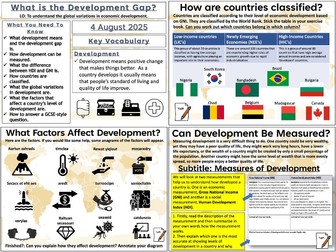
AQA GCSE Geography lesson for the new specification unit 2B. In this lesson we look at what development means and what the development gap is. We also look at the patterns of development globally and the reasons for uneven development. There is an Ordnance Survey-themed retrieval practice starter included. We begin by looking at how development can be measured and comapre HDI with GNI using a table and the students summarise the information and determine which they think is the better measurement. We look at the global patterns of HDI and the students have a map with a variety of questions around the outside for them to answer. Then we examine how countries are classified into LIC’s, NEE’s and HIC’s, the students subsequently try to determine which countries belong in which categories. After completing the definition of the development gap, the students then complete an activity where they consider the factors that affect the level of development of a country. The students categorise these factors into social (historical), environmental, political and economic categories. The next slide has some picture clues and anagrams for the students to work out what the factors are. We then tackle a 6-mark GCSE-style question. There is a writing frame for structure and guidance on points to use. hope this saves you valuable planning time. https://www.tes.com/teaching-resources/shop/markthegeographer
'Essential 8' - Development of the Symphony Revision GuideQuick View
kittgarnerteachingresources

'Essential 8' - Development of the Symphony Revision Guide

(0)
Eduqas A-Level Music ‘Essential 8’ : Development of the Symphony Revision Guide Contents: 1: Development of Melody & Theme 2: Development of Harmony & Tonality 3: Development of Narrative & Programme 4: Patronage & Commission 5: Structural Developments 6: Development of 1st Movements (& Sonata Form) 7: Development of 2nd / Slow Movements 8: Development of 3rd / Minuet / Scherzo Movements 9: Development of 4th / Finale Movements 10: Development of Orchestration 11:Dance, Folk & National Styles
Unit 2: Developing a Marketing Campaign - Revision GuideQuick View
zainabbassyed512

Unit 2: Developing a Marketing Campaign - Revision Guide

(0)
Resource Description: Elevate your Business Studies teaching with the “Unit 2 Marketing Campaign Comprehensive Guide”! Designed specifically for BTEC Level 3 National Extended Diploma, this guide provides all the essentials to master marketing campaigns. Maximize your teaching impact with the “Unit 2 Marketing Campaign Comprehensive Guide,” tailored for educators and students involved in BTEC Level 3 National Extended Diploma in Business. This resource offers a structured approach to learning, applying, and mastering the complexities of developing marketing campaigns. What’s Included: Key Knowledge Section: Begins with detailed theoretical explanations of vital marketing concepts such as the marketing mix (7 Ps), SWOT analysis, PESTLE analysis, and more. Each topic is covered thoroughly to ensure students have a solid grounding in the subject matter. Application Questions: Following the theoretical overview, this section includes practical scenarios and application-based questions. These are designed to challenge students to think critically and apply their knowledge in real-world settings, enhancing their analytical skills. Practice Questions Section: Contains a variety of practice questions that recap and reinforce the knowledge and application sections. This part of the resource is perfect for exam preparation, offering multiple-choice questions, long-answer questions, and scenario-based queries. Separate Model Answers/Mark Scheme Document: Accompanying the guide is a detailed answer key for all sections, providing comprehensive model answers and a marking scheme. This document allows teachers to accurately assess student progress and understanding, offering insights into areas where students may need further guidance or revision. Specifications: The guide is aligned with the BTEC Level 3 National Extended Diploma in Business syllabus, ensuring that it meets educational standards and requirements. Usage: Classroom Instruction: Use the guide to structure lessons or as a reference during lectures. Student Revision: Ideal for student self-study sessions as it includes comprehensive review sections and practice materials. Exam Preparation: Equip students with the tools they need for exam success with targeted practice questions and revision exercises. This resource is an indispensable tool for any business studies teacher aiming to enhance their students’ learning experience and success in marketing-related modules. Ensure your students are well-prepared for their exams with materials that are not only informative but also engaging and applicable to real-world business scenarios.
The Development Gap: Foreign Investment and Industrial DevelopmentQuick View
markthegeographer

The Development Gap: Foreign Investment and Industrial Development

(0)
AQA GCSE Geography lesson for the new specification unit 2B. In this lesson we look at how foreign investment (FDI) and industrial development can help to close the development gap. We start with a short task where students look into the different types of investments that can be made by foreign entities and TNC’s. Students use images to help complete a short paragraph. We then look at the reasons why TNC’s might choose to locate in an NEE or LIC and the students create a mind map. The students then create a diagram of the multiplier effect, annotating it by filling in the blanks on the slide. We then briefly look at the positive and drawbacks of TNC’s investing in countries, using Shell Oil as an example. We then use a map of investments in Africa, the students use an atlas to plot where the investments have been made. We then look at Chinese investment in Africa and the students complete a pictogram worksheet highlighting their reaction to the statements and recording why they reacted the way they did. We then look at Malaysia and industrial development. The students look at some development indicators, plot the economic sectors on a pie chart and then we briefly look at the drawbacks of the growth of the palm oil industry there . We then tackle a 9-mark GCSE-style question and the pupils use a writing frame and some point and evidence suggestions to help answer the question if needed. hope this saves you valuable planning time. https://www.tes.com/teaching-resources/shop/markthegeographer
Development of the Periodic tableQuick View
CMGsSciencelessons

Development of the Periodic table

(1)
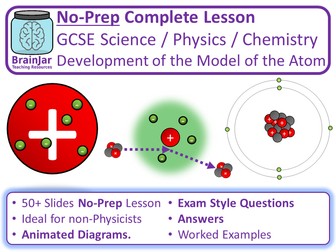
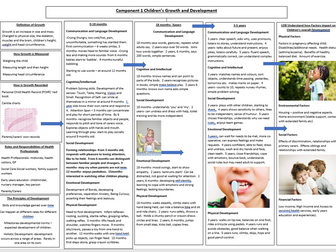
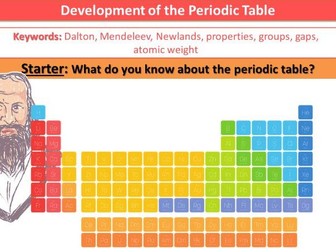
During this lesson (C2-1 Development of the Periodic table) GCSE students work through a variety of tasks to develop their understanding of how the periodic table has developed over time. Based on the 1st from the AQA 9-1 GCSE Chemistry (OUP scheme) C2: The Periodic table chapter. Also available as a digital worksheet, which is ideal for distance learning, independent study or catch-up of missed work through absence. Presentation contains (25 slides)- Bell work activity Lesson objective and success criteria Information slides Challenge activities (group work) Practical activity (where appropriate) Demonstrate understanding tasks (with answers) Lesson resources (additional to scheme) Aimed at a mixed ability class covering content 1-8. Please note: Kerboodle worksheets from scheme are not included due to license.
Unit 2: Developing a Marketing Campaign: Knowledge OrganizerQuick View
zainabbassyed512

Unit 2: Developing a Marketing Campaign: Knowledge Organizer

(0)
The Ultimate BTEC Level 3 Business Revision Resource! Are you preparing for your BTEC Level 3 Business exam? Dive into our comprehensive Knowledge Organizer tailored specifically for Unit 2: Developing a Marketing Campaign. This meticulously crafted resource is designed to boost your understanding and elevate your exam performance through targeted revision. What’s Inside? Detailed Explanations: Understand complex marketing principles with clear, concise explanations. Structured Content: From market research methods to the intricacies of marketing mixes, our resource covers all key areas of the syllabus. Practical Examples: Apply theoretical knowledge with real-world marketing scenarios tailored for a sleeping bag manufacturer. Visual Aids: Engage with well-organized tables and insightful diagrams that simplify learning and revision. Exam Preparation: Master the art of exam strategy with guided advice on tackling typical exam questions. Perfect For: Students preparing for the BTEC Level 3 Business exam. Teachers seeking a comprehensive classroom resource. Tutors needing structured content for effective sessions. Benefits of Our Knowledge Organizer: Boost Exam Confidence: Build your knowledge foundation and approach your exam with confidence. Save Time: Efficiently revise with all your necessary resources in one place. Enhance Understanding: Grasp complex topics easily with our student-friendly formats. Special Features: Up-to-Date Information: Stay current with the latest in marketing practices and case studies. Accessible Format: Available in PDF format for easy access and portability.
scamper design development promptsQuick View
rcteacherdt

scamper design development prompts

(1)
Design development prompts based on the SCAMPER concept. Useful to laminate and use within lessons. Helpful for yr7 right through to A-Level within development work in design.
Developing Medicines / drugs AQAQuick View
eleanorvickers

Developing Medicines / drugs AQA

(8)
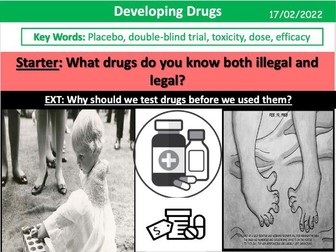
A powerpoint presentation containing activities on developing new medicines. Aimed at the new (2018) AQA GCSE. Some slides adapted from previous TES contributors, thank you to them.
IGCSE Geography - Introduction to DevelopmentQuick View
pwack

IGCSE Geography - Introduction to Development

(2)
What is development? Theme 3.1 IGCSE Cambridge Geography (can be used for any specification) An introduction to development including definitions, card sort development indicators, research using GapMinder and skills questions. Some ideas have been adpated from elsewhere
Fine Motor and Handwriting Development ActivitiesQuick View
trogfoot

Fine Motor and Handwriting Development Activities

(149)
This resource provides a range of activities to develop fine motor skills, designed with learners with severe learning difficulties in mind. It is by no means exhaustive, but covers a range of activities to develop discrimination of left and right, hand-eye coordination, crossing the mid-line, in-hand strength, finger and in-hand manipulations, finger isolation skills, grasps, releases, pencil control skills, early drawing skills and early letter formation skills.