The Development Gap: Measuring DevelopmentQuick View
markthegeographer

The Development Gap: Measuring Development

(0)
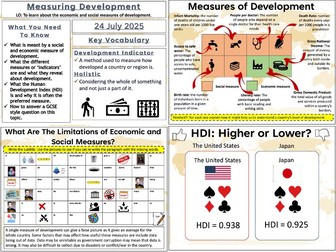
AQA GCSE Geography lesson for the new specification unit 2B. In this lesson we look at how development can be measured. There is a short multiple choice retrieval practice starter. We begin by looking at the difference between standard of living and quality of life. After this the students complete an activity matching the descriptions of the development indicators up with the pictures and colour coding them into social and economic indicators. The students then create a paragraph detailing why some indicators may not be reliable, but use the pictures to work out what the missing words might be. We then look at HDI and what is is made up of. The students complete a quick activity on matching the pictures to the benefits of using HDI as a development indicator. A short game of HDI higher or lower follows which is a fun way to spark debate and consolidate learning. We then tackle a 4-mark GCSE-style question with some suggested points to use on the next slide so the students can correct/feedback on their answer. hope this saves you valuable planning time. https://www.tes.com/teaching-resources/shop/markthegeographer
Urbanisation: An Increasingly Urban WorldQuick View
markthegeographer

Urbanisation: An Increasingly Urban World

(3)
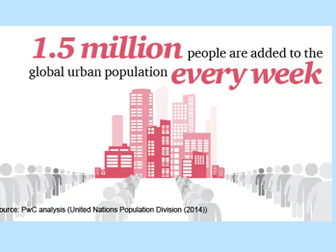
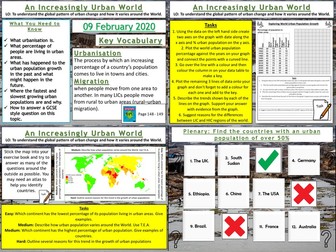
AQA GCSE Geography lesson for the new specification Unit 2A: In this lesson we look at the increasing number of the global population living in urban areas. We start with a quick quiz on global populations and a video to put global population increase into context for the pupils. We then look at how urbanisation varies around the world by plotting data on a graph. The pupils then describe the trends they have found. We then look at a map of the urban populations around the world and the pupils can tackle several different questions depending on ability. We then discuss how these patterns might be explained. We then answer a GCSE-style question looking at the percentage of people living in urban areas on different continents using a bar chart. The pupils have guidance on how to answer the question if needed. We finish with a plenary quiz where the pupils have to find the countries with an urban population of over 50%. In a nutshell lesson includes: Quiz starter Video clip Graph plotting exercise with questions Map interpretation task GCSE-style question using graph with guidance Plenary quiz. Hope this saves you some valuable planning time. https://www.tes.com/teaching-resources/shop/markthegeographer
The Development Gap: What is the 'Development Gap'?Quick View
markthegeographer

The Development Gap: What is the 'Development Gap'?

(0)
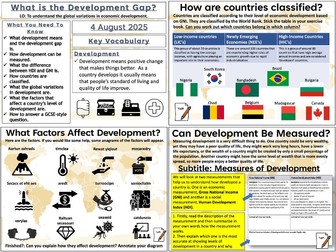
AQA GCSE Geography lesson for the new specification unit 2B. In this lesson we look at what development means and what the development gap is. We also look at the patterns of development globally and the reasons for uneven development. There is an Ordnance Survey-themed retrieval practice starter included. We begin by looking at how development can be measured and comapre HDI with GNI using a table and the students summarise the information and determine which they think is the better measurement. We look at the global patterns of HDI and the students have a map with a variety of questions around the outside for them to answer. Then we examine how countries are classified into LIC’s, NEE’s and HIC’s, the students subsequently try to determine which countries belong in which categories. After completing the definition of the development gap, the students then complete an activity where they consider the factors that affect the level of development of a country. The students categorise these factors into social (historical), environmental, political and economic categories. The next slide has some picture clues and anagrams for the students to work out what the factors are. We then tackle a 6-mark GCSE-style question. There is a writing frame for structure and guidance on points to use. hope this saves you valuable planning time. https://www.tes.com/teaching-resources/shop/markthegeographer
Sustainable Development and UrbanisationQuick View
SimpleGeography

Sustainable Development and Urbanisation

(0)
This lesson is designed to last for 50-60 minutes and is resourced with videos, extension questioning, deep thinking and uses graphs/images to aid learning. This lesson follows the Oxford KS3 curriculum and looks at the definition of sustainable before looking at sustainable development examples from various countries around the world. Students will be able to identify sustainable factors and unsustainable factors and explain why they are so. This lesson includes a starter, lesson objective, plenary and various student led activities. If you liked this resource please check out my other resources at https://www.tes.com/teaching-resources/shop/SimpleGeography
The Development Gap: MigrationQuick View
markthegeographer

The Development Gap: Migration

(0)
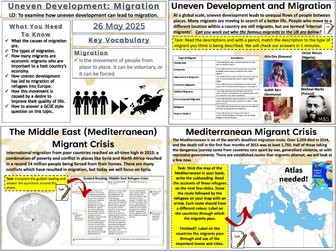
AQA GCSE Geography lesson for the new specification unit 2B. In this lesson we look at how uneven development causes international migration. there is a retrieval practice starter based on development indicators. We start the lesson with a match-up activity where the students match the type of migration to the descriptions. The students then create a diagram that looks at the positives and negatives of international migration for the country and origin and the host country. We then complete a cloze exercise looking at economic migration to the UK. We then introduce the Middle East (Mediterranean) migrant crisis. The students complete a guided reading task then use an atlas to plot the routes of migrants in three example stories on a map of Europe. We then tackle a 4-mark GCSE-style question and the pupils use a writing frame and some points suggestions to help answer the question if needed. hope this saves you valuable planning time. https://www.tes.com/teaching-resources/shop/markthegeographer
The Development Gap: Wealth and HealthQuick View
markthegeographer

The Development Gap: Wealth and Health

(0)
AQA GCSE Geography lesson for the new specification unit 2B. In this lesson we look at why there are disparities in wealth and health both within and between countires. There is a rivers themed retrieval practice starter. We then look at the global state of wealth inequality and where the world’s wealth is and isn’t. We then look at how economic development has created inequalities in the USA. The students watch a video and note down the different types of inequality. The students complete a match-up activity identifying some of the main factors that lead to inequalities in wealth. We then look at health, the students complete a diagram using hexagons that shows how development might be linked to health. We then look at what malaria is and the students complete a colouring by numbers exercise to show the global distribution of malaria. They then watch the Disney information film ‘The Winged Scourge’ and answer questions. We then complete a mind map to show how some less developed countries are more at risk from malaria and categorise these into social, economic and environmental reasons. We then tackle a 6-mark GCSE-style question and the pupils use a writing frame and some points suggestions to help answer the question if needed. hope this saves you valuable planning time. https://www.tes.com/teaching-resources/shop/markthegeographer
The Development Gap: Changing Population StructuresQuick View
markthegeographer

The Development Gap: Changing Population Structures

(0)
AQA GCSE Geography lesson for the new specification unit 2B. In this lesson we look at how population pyramids can reveal changing population structures and levels of development. There is a literacy starter based on the content learned so far in the unit. We begin with an introductory video on population pyramids and the students have a question sheet to answer whilst they watch the video. Using the information they have gleaned from the video they then annotate two contrasting population pyramids to consolidate how the graphs can reveal a great deal about a country’s level of development. We briefly look at dependency rations and the students have a go at calculating a simple example ratio. We then construct a population pyramid for Nigeria using a worksheet and the students can then consider what it reveals about the country. The students then examine an ageing population but looking at Japan’s changing population structure and the students complete a task looking at the factors that have contributed top this. We then tackle a 6-mark GCSE-style question using the population pyramids they annotated earlier. There is a writing frame for structure and guidance on points to use. . hope this saves you valuable planning time. https://www.tes.com/teaching-resources/shop/markthegeographer
AQA GCSE Geography: The Development GapQuick View
markthegeographer

AQA GCSE Geography: The Development Gap

11 Resources
Complete sequence of lessons for Unit 2, Section B (The Development Gap) of the AQA GCSE. Jamaica is the case study for tourism. The lessons included are detailed below. What is the Development Gap? Measuring Development The Demographic Transition Model Changing Population Structures Wealth and Health Migration Foreign Investment and Industrial Development Aid and Intermediate Technology Fair Trade Debt Relief and Microfinance Tourism in Jamaica Hope this saves you some valuable planning time. https://www.tes.com/teaching-resources/shop/markthegeographer

KS3 UrbanisationQuick View
sapnaharia91

KS3 Urbanisation

(0)
FULLY resourced lesson. An observation lesson for urbanisation in the unit of Population. Students look at a made up scenario about the teacher (you can edit the name) and their decision about moving from a rural area to an urban area. This was taught at KS3 and students loved the idea of their teacher being in the lesson. The following ideas are explored: What is urbanisation? Push factors from rural areas Pull factors into urban areas Lots of AFL, reviewing key terms, challenge and literacy.
The Development Gap: The Demographic Transition ModelQuick View
markthegeographer

The Development Gap: The Demographic Transition Model

(0)
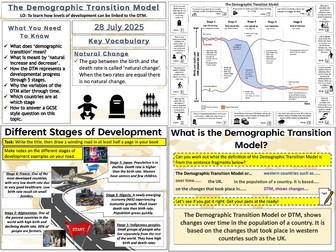
AQA GCSE Geography lesson for the new specification unit 2B. In this lesson we look at the Demographic Transition Model. There is a multiple choice retrieval practice starter before we look at what the term ‘demographic transition’ means. The students have some sentence fragments to put in order. We then look at some key terminology that is needed for the lesson and the students match the description up to the term. We then look at the model itself an the students have a large A3 sheet to draw the model onto the template. The model is explained in stages and students make notes as they go along, drawing the three lines on too. There is a living graph activity to do when they have finished, by reading the statements in the boxes, they then have to work out which stage it applies to. We then look at examples of countries in the various stages of transition and the students create a diagram titled ‘The Road to Development’. We then tackle a 6-mark GCSE-style question. There is a writing frame for structure and guidance on points to use. hope this saves you valuable planning time. https://www.tes.com/teaching-resources/shop/markthegeographer
The Development Gap: Foreign Investment and Industrial DevelopmentQuick View
markthegeographer

The Development Gap: Foreign Investment and Industrial Development

(0)
AQA GCSE Geography lesson for the new specification unit 2B. In this lesson we look at how foreign investment (FDI) and industrial development can help to close the development gap. We start with a short task where students look into the different types of investments that can be made by foreign entities and TNC’s. Students use images to help complete a short paragraph. We then look at the reasons why TNC’s might choose to locate in an NEE or LIC and the students create a mind map. The students then create a diagram of the multiplier effect, annotating it by filling in the blanks on the slide. We then briefly look at the positive and drawbacks of TNC’s investing in countries, using Shell Oil as an example. We then use a map of investments in Africa, the students use an atlas to plot where the investments have been made. We then look at Chinese investment in Africa and the students complete a pictogram worksheet highlighting their reaction to the statements and recording why they reacted the way they did. We then look at Malaysia and industrial development. The students look at some development indicators, plot the economic sectors on a pie chart and then we briefly look at the drawbacks of the growth of the palm oil industry there . We then tackle a 9-mark GCSE-style question and the pupils use a writing frame and some point and evidence suggestions to help answer the question if needed. hope this saves you valuable planning time. https://www.tes.com/teaching-resources/shop/markthegeographer
UrbanisationQuick View
chri2834

Urbanisation

(16)
This is designed as the first lesson in the AQA A specification topic 'Change in urban environments'. It introduces urbanisation and its causes.
UrbanisationQuick View
TheGeographyOasis

Urbanisation

(0)
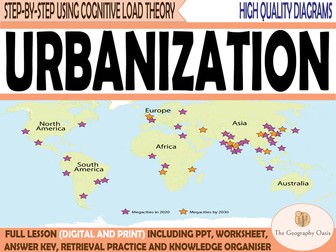
Urbanisation Content: A description of the growth of the proportion of people living in urban areas since 1700. A comparison of rates of urbanization between continents and countries at different levels of development. Reasons for urbanization including natural increase and rural-to-urban migration. Geographical skills including line graphs, pie charts, scatter graphs. Each resource includes: Worksheet with activities. Teacher PowerPoint with diagrams and answer key provided directly onto the slides or in notes section of each slide. Activate- a starter, an introduction, a stimulus. Content- The Geographical knowledge- supported by short activities, images, graphs, diagrams. Review- a plenary, recall activity, AFL, knowledge check. Useful links- to video clips, websites etc. Bonus Materials: Knowledge Organiser Interactive assessments (Self-marking Google Form, Keyword Quizlet, Multiple Choice Quizizz) Don’t want to purchase the full resource? CHECK OUT THE ‘MINI’ RESOURCE (Knowledge organiser and AFL activities) What’s included: A word document worksheet that includes activities that introduce key terminology, helps students to describe the growth of urban populations, describe and explain differences between continents and countries, and an explanation of reasons for this growth. The word document is 8 pages. The word document is provided in colour and grayscale. This worksheet is also provided as a PDF. A PowerPoint version of diagrams and answers The PowerPoint is 23 slides Other settlement geography resources: Settlement Patterns, Site and Function Settlement Hierarchies and Services Urban Land Use (Models) Urban Problems and Solutions megapack Urban Problems and Solutions in London Congestion in London Urban decline and regeneration in the East End of London Decentralisation of retail (Out of Town shopping centre) Urban Sprawl in Kuala Lumpur Rapid Urban Growth and Slums in Mumbai SETTLEMENT BUNDLE
UrbanisationQuick View
LesleyRitchie

Urbanisation

(0)
KS 3 Urbanisation Future of cities Reasons for rapid urban growth video links Questions summary Enjoyed by my Year 8 class
UrbanisationQuick View
TheGeographyShopOriginal

Urbanisation

(3)
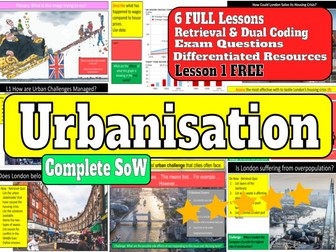
Geography: How can London Solve its Housing Crisis? KS3- Urbanisation - Population - Gentrification A review would be amazing! This unit is created in line with my personal passion for urban challenges and sustainability. This unit is framed around the varying challenges London faces in terms of housing, enabling learners to consider cause, effect and response. It is hoped the pupils will then be more equipped to understanding both London and the UK’s growing housing crisis. This Unit is my favourite to deliver and been streamlined over the last two years. Happy to answer questions and any feedback welcome… thegeographyshoporiginal@gmail.com SoW: L1: How geographers manage the challenges of urban population? L2: Why London becoming overpopulated? L3: How does London respond to a housing crisis? L4: (Assessment) How do we save London’s house crisis? L4.5: Feedback L5: Does London belong to Londoners any more? L6: Summative Independent learning (Computers) It is worth noting that some of these lessons require two lessons to be delivered. Thanks for looking and any feedback welcome… thegeographyshoporiginal@gmail.com Leave a review for any single resource FREE! Best FREE Resources (The Geography Shop) https://www.tes.com/teaching-resource/-12899088 (Climate Change SoW) https://www.tes.com/teaching-resource/-12899440 (Development SoW) https://www.tes.com/teaching-resource/-12638984 (Waste SoW) https://www.tes.com/teaching-resource/-12451443 (Britain Globalisation SoW) https://www.tes.com/teaching-resource/-12741793 (Local Area Investigation SoW) https://www.tes.com/teaching-resources/bundler/12949461 (Cambridge International) https://www.tes.com/teaching-resource/-12922653 (Israel & Palestine) https://www.tes.com/teaching-resource/resource-12485457 (What is Geography?) I hope you find this SoW useful. If you have, I have created a series of resources, one for each unit of the Edexcel B Geography course, as well as many KS3 units, all to the same standard. You can check them out here… https://www.tes.com/teaching-resources/shop/TheGeographyShopOriginal
UrbanisationQuick View
Ms_Tracy

Urbanisation

3 Resources
Small bundle containing information about world and megacities, impacts of rapid urbanisation in LICs and a case study about rapid urbanisation in Lagos, Nigeria.
Challenges of an Urbanising World - UrbanisationQuick View
thisisgeography

Challenges of an Urbanising World - Urbanisation

(1)
6 part lesson series for the Edexcel GCSE module Challenges of an Urbanising World. This is part of the module to be taught alongside the Mumbai case study. Specifically designed for the new Edexcel Geography GCSE but also suitable for AQA and OCR. All lesson are for 50 minutes to 1 hour of teaching time. Includes supporting worksheets for lessons - no additional resources are required. All lessons have a starter and lesson aim. Extension tasks and homework also included. All PowerPoints in the same signature style. Lesson sequence: 1 - The urban world 2 - Megacities 3 - Urban process and change 4 - How urban economies differ 5 - The changing face of New York ICT 6 - Land use of cities For more resources visit This is Geography. Full SoW for all new GCSE specifications - AQA, Edexcel, OCR, CIE IGCSE, Edexcel IGCSE and Eduqas. As well as over 200 lessons for KS3 and KS2. Want something bespoke designing? Email us for further details info@thisisgeography.co.uk
Urbanisation WorldQuick View
TheGeographyShopOriginal

Urbanisation World

(0)
L1 - 3.1 : Why is the world becoming increasingly urbanised? Unit 3: Challenges of an Urban World. This is a GCSE Edexcel B unit, created to a high standard and has been delivered to my GCSE classes over the last two academic years. This SoW work has been differentiated, with with both support and challenge throughout. Retrieval Practice and Duel Coding Theory are incorporated and as well as regular links to other parts of the syllabus, this is in line to my recent academic readings. Geographical and numeracy skill have been planned for. Thanks for looking and any feedback welcome… thegeographyshoporiginal@gmail.com Leave a review for any single resource FREE! Best FREE Resources (The Geography Shop) https://www.tes.com/teaching-resource/-12899088 (Climate Change SoW) https://www.tes.com/teaching-resource/-12899440 (Development SoW) https://www.tes.com/teaching-resource/-12638984 (Waste SoW) https://www.tes.com/teaching-resource/-12451443 (Britain Globalisation SoW) https://www.tes.com/teaching-resource/-12741793 (Local Area Investigation SoW) https://www.tes.com/teaching-resources/bundler/12949461 (Cambridge International) https://www.tes.com/teaching-resource/-12922653 (Israel & Palestine) https://www.tes.com/teaching-resource/resource-12485457 (What is Geography?) I hope you find this SoW useful. If you have, I have created a series of resources, one for each unit of the Edexcel B Geography course, as well as many KS3 units, all to the same standard. You can check them out here… https://www.tes.com/teaching-resources/shop/TheGeographyShopOriginal