Volcanoes & Earthquakes - KS2Quick View
TeachItForward

Volcanoes & Earthquakes - KS2

14 Resources
Volcanoes & Earthquakes is an exciting extended Geography unit designed for students in KS2. The planning overview, topic title page and vocabulary page can be downloaded for free here. Lessons include: L1 – Understanding the structure of the Earth L2 – Investigating the structure of a volcano (FREE) L3 – Locating the world’s famous volcanoes L4 – Investigating the five deadly features of a volcanic eruption L5 – Understanding tectonic plates L6 – Exploring the effects of volcanic eruptions on Montserrat L7 – Why do people live near volcanoes? L8 – Understanding the causes of earthquakes L9 – Investigating the five deadly features of an earthquake L10 – Researching earthquakes using Wikipedia L11 – Locating the world’s biggest earthquakes using latitude & longitude L12 – Writing a fact file about a famous earthquake Each lesson includes a presentation and differentiated activities/worksheets. A FREE newspaper report template is also included in this unit. If you like this resource, we would appreciate a review! We will happily send you a free resource in return for a review or useful suggestions/feedback. Contact us at ed@teachitforward.co.uk.
Volcanoes and Earthquakes WorksheetsQuick View
bethgrace2312

Volcanoes and Earthquakes Worksheets

(1)
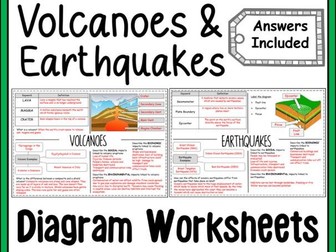
Volcanoes and Earthquakes Worksheets Summary worksheets with full comprehensive answers. Editable, A4 PowerPoint files. Included in the Volcano worksheet: Keyword definitions Label a volcano diagram Shield and cone volcano comparison Volcano examples Social, economic and environmental impacts Included in the Earthquake worksheet: Keyword definitions Label an earthquake diagram Oceanic vs land earthquakes Earthquake examples Social, economic and environmental impacts
Understanding the causes of an earthquake - KS2Quick View
TeachItForward

Understanding the causes of an earthquake - KS2

(3)
This lesson is designed for KS2 children. It can be taught as a stand alone lesson but is also available as part of two wider units, both of which are available on TES: -Earthquakes -Volcanoes & Earthquakes First the presentation looks at how the Earth’s crust is split into tectonic plates. It then examines the causes of earthquakes, how they occur at the fault lines between tectonic plates and what the hypocentre and epicentre of an earthquake are. There are three different activities to choose from which can be done in Geography and/or Literacy lessons. These include: Quiz Activity Students watch a video clip about earthquakes and answer comprehension questions about it. This is differentiated two ways. Cloze Procedure Activity Students fill in the blanks in an explanation text about earthquakes. This is differentiated two ways. Writing Activity Student write an explanation text about earthquakes. This is differentiated three ways and comes with vocabulary and sentence starter prompts. If you like this resource, we would appreciate a review! We will happily send you a free resource in return for a review or useful suggestions/feedback. Contact us at ed@teachitforward.co.uk.
Tectonic Hazards: The Distribution of Earthquakes and VolcanoesQuick View
markthegeographer

Tectonic Hazards: The Distribution of Earthquakes and Volcanoes

(0)
AQA GCSE Geography lesson for Unti 1A: The Challenge of Natural Hazards. there is a retrieval practice starter grid which will just need filling out by the teacher with appropriate questions. Pupils begin by looking at the location of earthquakes and volcanoes by plotting their location on a map using longitude and latitude. Pupils then describe the pattern using T.E.A (trend, examples, anomaly). We then look at the plates and margins. The pupils use description of the plates locations to work out where they are then descriptions of their movements to draw on arrows of the plates direction of travel. We examine the link between the locations and plate margins and briefly explain the anomalies by looking at hotspot volcanoes. We then tackle a GCSE-style question with guidance for the pupils if needed. In a nutshell lesson includes: Retrieval practice starter Longitude and latitude skills task plotting tectonic hazards Map task using descriptions of plate locations and movements Hotspot diagram drawing GCSE-style question with guidance. Hope this saves you valuable planning time. https://www.tes.com/teaching-resources/shop/markthegeographer
The 2023 Turkey-Syria EarthquakeQuick View
jakesteel401

The 2023 Turkey-Syria Earthquake

(0)
Complete lesson covering the 2023 Turkey-Syria earthquake, with a focus on the causes, impacts and factors affecting vulnerability. Lesson includes: Do Now - locating Turkey and Syria Short video clip Timeline of events and student activity on Mercalli Scale and earthquake depth Map of the tectonic boundaries and questions Think, pair, share activity on vulnerability Printable worksheet on factors affecting vulnerability Check for learning - correct the mistakes Printable worksheet on impacts, with sorting activity and challenge questions News article about vulnerability with questions as a challenge task Plenary questions
Measuring earthquakesQuick View
Geo360

Measuring earthquakes

(0)
This is a KS3 lesson on the mercalli scale and the magnitude scale (richter scale) however, it is appropriate for a GCSE group as well. Key facts about the lesson are: 1. The content covered by the lesson are; description and use of seismometers, descriptions of the mercalli scale and the magnitude (richter) scale, comparison of damage done by earthquakes of similar size. 2. Learning resources used in the lesson are; keyword matching task, images, video clips, sketching task and a writing task. 3. Differentiation used in the lesson are: challenge tasks and differentiated information sheets. 4.The lesson is planned in detail and all the resources for teaching the lesson are included in the ppt; starter, learning activities with resources, clear outline of learning tasks and a plenary. Just download and teach!
Volcano and Earthquake Full Scheme of WorkQuick View
jillyjones1987

Volcano and Earthquake Full Scheme of Work

(7)
A full Scheme of work with differentiated assessment and mark scheme. Written for KS3 SEN students, the SOW could be easily adapted for KS2. 10 colourful and animated PowerPoints, with worksheets and teacher notes, this SOW is easy to follow and engaging for all learners. All lessons come with learning objectives, success criteria, activity worksheets, starters and plenaries. At the end of the unit there is an assessment, and a differentiated assessment. For this Scheme of Work students will need access to an Atlas and a laptop.
Earthquakes - KS2Quick View
TeachItForward

Earthquakes - KS2

8 Resources
Earthquakes is an exciting Geography unit designed for students in KS2. The planning overview, topic title page and vocabulary page can be downloaded for free here. Lessons include: L1 – Understanding the structure of the Earth L2 – Understanding tectonic plates L3 – Understanding the causes of earthquakes L4 – Investigating the five deadly features of an earthquake L5 – Researching earthquakes using Wikipedia L6 – Locating the world’s biggest earthquakes using latitude & longitude L7 – Writing a fact file about a famous earthquake Each lesson includes a presentation and differentiated activities/worksheets. If you like this resource, we would appreciate a review! We will happily send you a free resource in return for a review or useful suggestions/feedback. Contact us at ed@teachitforward.co.uk.
Mexico Earthquake 2017 -  Case Study - Natural HazardsQuick View
jillyjones1987

Mexico Earthquake 2017 - Case Study - Natural Hazards

(1)
Created Sept 2017 this lesson has been created for upper KS3 SEN students. With a brightly coloured animated powerpoint, this lesson is designed to engage learners who learn visually. It enables students to learn about the earthquake, discuss the social, economic and environmental impacts and complete a case study. The lesson contains a powerpoint slide, learning objective, success criteria, lesson plan, sources, a reading comprehension and research activities. Adaptable for those studying natural hazards in KS3 and KS4.
Volcanoes and Earthquakes bookletQuick View
DanGooding

Volcanoes and Earthquakes booklet

(0)
This is a booklet on volcanoes and earthquakes that follows the Hodder KS3 scheme of learning. It includes 8 sections and includes a range of activities and tasks that enable student’s to develop and consolidate both their geographical knowledge and skills. This booklet is suitable to be used as a home learning resource, as it includes all the information within it, or can be used as a homework booklet.
Comparing the impacts of the Haiti and Christchurch earthquakesQuick View
amac89

Comparing the impacts of the Haiti and Christchurch earthquakes

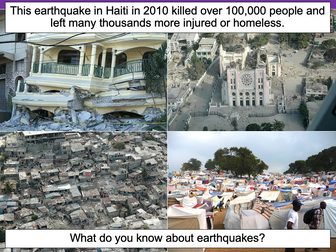
(3)
A lesson originally taught to year 10 GCSE Geography students (for AQA). It introduces the two earthquakes and allows students to see how levels of development affect the scale of the damage. The lesson includes a card sort activity, peer teaching and examination practice. This lesson could also be adapted for KS3 Geography classes. Fully resourced.
SEN Geography Lesson: EarthquakesQuick View
TessyTeacher

SEN Geography Lesson: Earthquakes

(0)
Editable powerpoint with images and videos about earthquakes. Includes brain break ideas e.g shaking dance. Visual content and Widgit visuals for young people with special education needs (SEN/SEND).
Earthquakes PowerPointQuick View
emercullen

Earthquakes PowerPoint

(0)
An 18 slide PPT on Earthquakes- suitable for junior students/1st years. Includes images, keywords and video clips. There are some ‘to do’ and ‘homework’ slides which refer to our textbook and workbook (Geography in Action), but these can be adapted to suit your own book. Also attached is a short visualisation. For more PPTs on plate tectonics and for a bundle including this PPT, see ‘My Shop’.
Lesson 5 Haiti Earthquake Case StudyQuick View
Emsie125

Lesson 5 Haiti Earthquake Case Study

(1)
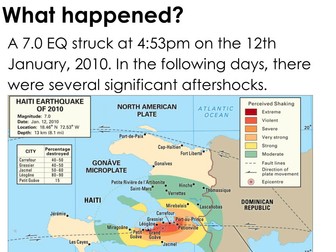
Lesson 5 Haiti Earthquake Case Study Deemed an outstanding lesson in my recent PM review, students are to complete a mystery activity and find out why Emmanuel died in the Haiti Earthquake. The mystery includes clear facts about the earthquake, effects on the people and the environment. The card sort is differentiated so all students can access this and depending on the ability of the students you will receive a different answer to the key question. Students can show their understanding of the mystery by completing an exam questions. Example questions are attached to the PowerPoint which students can mark and use as a model when writing their own answers.
Earthquakes: Causes, Measurement & ImpactsQuick View
SimpleGeography

Earthquakes: Causes, Measurement & Impacts

(0)
This lesson is designed to last for 50-60 minutes and is resourced with videos, extension questioning, deep thinking and uses graphs/images to aid learning. This lesson follows the Oxford KS3 curriculum and looks at how earthquakes are caused, keywords needed for the topic, how they are measured and the impacts of various magnitudes. This lesson includes a starter, lesson objective, plenary and various student led activities. If you liked this resource please check out my other resources at https://www.tes.com/teaching-resources/shop/SimpleGeography
EarthquakesQuick View
willemmacau

Earthquakes

(0)
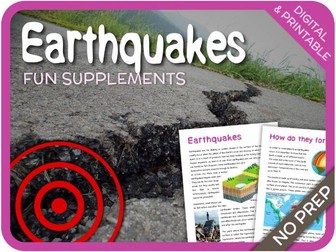
Let's learn about Earthquakes! These NO PREP materials contain informative exercises about earthquakes. Lots of puzzles and other fun activities are included to make it a fun class. The answers and an answer sheet are included. GOOGLE SLIDES WITH PREMADE TEXTBOXES INCLUDED! Overview: Page 1-2: Introduction to earthquakes Page 3-4: How do earthquakes form? Page 5: Dangerous earthquakes in history Page 6-7: Interesting Facts Page 8: How to survive an earthquake? Page 9: Word Search Page 10: Reflection Extra: Natural Disaster Puzzles
EARTHQUAKESQuick View
omereonye

EARTHQUAKES

(0)
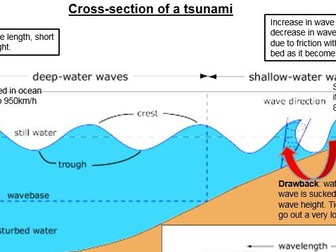
At the end of the lesson the students should be able to : (i) Define the term earthquakes (ii) Explain the causes of earthquakes (iii) Give examples of earthquakes (iv) Explain the effects and impacts of earthquakes (v) Examine the case study on an earthquake in an LEDC and MEDC (vi) What causes a tsunami?
EarthquakesQuick View
Ayalalucy

Earthquakes

(3)
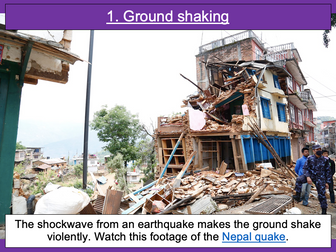
Year 7 Science lesson, could be adapted to use with other year groups Students work in groups, each group is researching a different type of plate boundary (conservative, constructive, destructive, collision). They then move around the room and teach other groups about what they have learnt. Focus if the Nepal Earthquake, and students use their learning from the lesson to explain what plate boundary there is in Nepal and why the Earthquake occurred.
Earthquakes, Nepal earthquakeQuick View
afee646

Earthquakes, Nepal earthquake

(2)
This PowerPoint includes tasks surrounding earthquakes. It has a focus on the Nepal earthquake. Objectives are: Bronze - I can identify that earthquakes are caused by shockwaves Silver - I can explain how earthquakes are produced – and I know how they can be detected Gold - I can reconstruct a series of events to put together exactly how an earthquake happens, how it is detected, and what it can cause For year 9 foundation OCR Gateway