Internal EnergyQuick View
BrainJar

Internal Energy

(0)
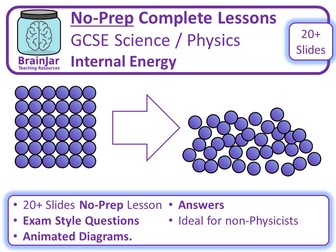
Complete No-Prep lesson with exam questions, tasks and answers on Internal Energy for AQA GCSE (9-1) Science / Physics. This lesson covers all of AQA GCSE Physics 4.3.2.1 / Combined Science 6.3.2.1 As a Secondary Science teacher and Deputy Headteacher for many years I make high quality no-prep lessons so busy teachers can teach outstanding lessons without spending hours planning. This high quality lesson includes explanations, different types of in-lesson assessment (all with answers) and unique exam questions. My lessons are ideal for non-Physicists - as a Biologist who retrained as a Physics teacher I know how to take learners on a journey that builds up their understanding step by step, while still going into a lot of depth. The preview video shows a representative sample of slides from the resource so that you get a good idea of what it includes before you buy. What’s Included: • Starter / Do Now Activity • Explanation slides in “chunked” sections with animated diagrams. • Multiple questions in different question styles and difficulties - no need for worksheets. Each “chunked” explanation section typically includes a set of “learning check / quick questions” followed by a set of in-depth questions on the learning from that “chunk” of the lesson. All questions have answers. • Exam-style questions on the whole lesson at the end of the lesson- these are unique, based on real exam questions but not just copied from exam boards. • Answers for all questions • All easily editable to adapt to your teaching or to use in existing lessons. • Slightly humorous, at points, if you like that sort of thing. Learning objectives: Define Internal Energy. Explain why heating a substance increases its internal energy. Explain why heating a substance until it changes state increases its internal energy. Written for AQA GCSE Science and Physics but likely to be applicable to other exam specifications. Please leave a rating / review and all other feedback gratefully received!
Efficiency (Energy)Quick View
BrainJar

Efficiency (Energy)

(1)
Complete No-Prep lesson with exam questions, tasks and answers on Efficiency for the Energy topic of AQA GCSE (9-1) Science / Physics. This lesson covers all of AQA GCSE Combined Science 6.1.2.2 / GCSE Physics 4.1.2.2. As a Secondary Science teacher, Deputy Headteacher, writer and examiner for many years I make high quality no-prep lessons so busy teachers can teach outstanding lessons without spending hours planning. This high quality lesson includes explanations, different types of in-lesson assessment (all with answers) and unique exam questions. My lessons are ideal for non-Physicists - as a Biologist who retrained as a Physics teacher I know how to take learners on a journey that builds up their understanding step by step, while still going into a lot of depth. The preview video shows a representative sample of slides from the resource so that you get a good idea of what it includes before you buy. What’s Included: • Starter / Do Now Activity • Explanation slides in “chunked” sections with animated diagrams. • Worked examples of calculations / questions. • Multiple questions in different question styles and difficulties - no need for worksheets. Each “chunked” explanation section typically includes a set of “learning check / quick questions” followed by a set of in-depth questions on the learning from that “chunk” of the lesson. All questions have answers. • Exam-style questions on the whole lesson at the end of the lesson- these are unique, based on real exam questions but not just copied from exam boards. • Answers for all questions • All easily editable to adapt to your teaching or to use in existing lessons. • Slightly humorous, at points, if you like that sort of thing. The lesson was written for AQA GCSE Science / Physics but is very likely to be applicable to other exam specifications. Please leave a rating / review and all other feedback gratefully received!
Energy Changes - AQA ChemistryQuick View
lewistull

Energy Changes - AQA Chemistry

(8)
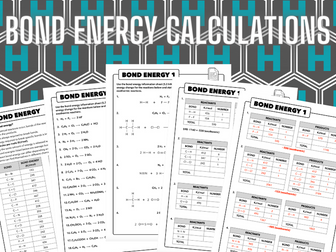
This pack contains a plethora of powerpoints, worksheets, and mark schemes for all of the content in unit 5 - Energy changes of AQA 8462 Triple Chemistry, and 8464 Combined Science Trilogy. For those of you whom regularly purchase my resources, you will know that I hold off releasing my resources until I am happy that you will be satisfied with the quality, quantity and ease of deliverance of your purchase - I’m now happy, I hope you are too! Lesson packs include: 4.5.1.1 Energy transfer during exothermic and endothermic reactions 4.5.1.2 Reaction profiles 4.5.1.3 The energy change of reactions (HT ONLY) 4.5.2.1. Cells and batteries (Chemistry only) 4.5.2.2. Fuel cells (Chemistry only) Required practical 4 worksheet pack All folders organised into zip folder Resources are checked against the specification, and income tax is paid on all my sales. As always your feedback is greatly appreciated as good reviews really aid sales. I hope you enjoy Lewis
Power (Energy Topic)Quick View
BrainJar

Power (Energy Topic)

(0)
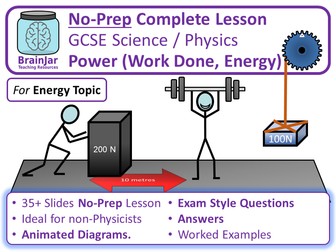
Complete No-Prep lesson with exam questions, tasks and answers on Power (including Work Done) for AQA GCSE (9-1) Science / Physics. This lesson covers all of AQA GCSE Combined Science 6.1.1.4 / GCSE Physics 4.1.1.4. This lesson was updated and improved slightly 01.05.23 As a Secondary Science teacher, Deputy Headteacher, writer and examiner for many years I make high quality no-prep lessons so busy teachers can teach outstanding lessons without spending hours planning. This high quality lesson includes explanations, different types of in-lesson assessment (all with answers) and unique exam questions. My lessons are ideal for non-Physicists - as a Biologist who retrained as a Physics teacher I know how to take learners on a journey that builds up their understanding step by step, while still going into a lot of depth. The preview video shows a representative sample of slides from the resource so that you get a good idea of what it includes before you buy. What’s Included: • Starter / Do Now Activity • Explanation slides in “chunked” sections with animated diagrams. • Worked examples of calculations / questions. • Multiple questions in different question styles and difficulties - no need for worksheets. Each “chunked” explanation section typically includes a set of “learning check / quick questions” followed by a set of in-depth questions on the learning from that “chunk” of the lesson. All questions have answers. • Exam-style questions on the whole lesson at the end of the lesson- these are unique, based on real exam questions but not just copied from exam boards. • Answers for all questions • All easily editable to adapt to your teaching or to use in existing lessons. • Slightly humorous, at points, if you like that sort of thing. The lesson was written for AQA GCSE Science / Physics but is very likely to be applicable to other exam specifications. Please leave a rating / review and all other feedback gratefully received!
Bundle: Energy TopicQuick View
BrainJar

Bundle: Energy Topic

9 Resources
Bundle of 9 complete No-Prep lessons with exam questions, tasks and answers on Energy for AQA GCSE (9-1) Science / Physics, covering the complete topic (all of AQA 4.1 / 6.1) As a Secondary Science teacher, Deputy Headteacher, writer and examiner for many years I make high quality no-prep lessons so busy teachers can teach outstanding lessons without spending hours planning. These high quality lessons include explanations, different types of in-lesson assessment (all with answers) and unique exam questions. My lessons are ideal for non-Physicists - as a Biologist who retrained as a Physics teacher I know how to take learners on a journey that builds up their understanding step by step, while still going into a lot of depth. The preview videos show a representative sample of slides from each resource so that you get a good idea of what it includes before you buy. Teaching Order Energy Stores and Transfers Kinetic, Elastic and Gravitational Potential Energy Specific Heat Capacity (please note this lesson is also included in the Particle Model of Matter topic bundle). Power (Energy Topic) Useful and Wasted Energy Thermal Conduction and Insulation Efficiency National and Global Energy Resources: Non-Renewables National and Global Energy Resources: Renewables Note: I have not written lessons for the Required Practicals. What’s Included in each lesson: • Starter / Do Now Activity • Explanation slides in “chunked” sections with animated diagrams. • Worked examples of calculations / questions.where applicable • Multiple questions in different question styles and difficulties - no need for worksheets. Each “chunked” explanation section typically includes a set of “learning check / quick questions” followed by a set of in-depth questions on the learning from that “chunk” of the lesson. All questions have answers. • Exam-style questions on the whole lesson at the end of the lesson- these are unique, based on real exam questions but not just copied from exam boards. • Answers for all questions • All easily editable to adapt to your teaching or to use in existing lessons. • Slightly humorous, at points, if you like that sort of thing. The lessons were written for AQA GCSE Science / Physics but are very likely to be applicable to other exam specifications. Please leave a rating / review and all other feedback gratefully received!
Work Done and Energy TransferQuick View
BrainJar

Work Done and Energy Transfer

(0)
Complete No-Prep lesson with exam questions, tasks and answers on Work Done and Energy Transfer for AQA GCSE (9-1) Science / Physics. This lesson fully covers the GCSE Physics exam spec 4.5.2 / Combined Science 6.5.2 in the Forces topic. Note: This lesson sits within the Forces topic, however some of the content overlaps slightly with parts of the power lesson in the Energy topic, as work done is mentioned in the exam spec at that point as well. As a Secondary Science teacher and Deputy Headteacher for many years I make high quality no-prep lessons so busy teachers can teach outstanding lessons without spending hours planning. This high quality lesson includes explanations, different types of in-lesson assessment (all with answers) and unique exam questions. My lessons are ideal for non-Physicists - as a Biologist who retrained as a Physics teacher I know how to take learners on a journey that builds up their understanding step by step, while still going into a lot of depth. The preview video shows a representative sample of slides from the resource so that you get a good idea of what it includes before you buy. What’s Included: • Starter / Do Now Activity • Explanation slides in “chunked” sections with animated diagrams. • Worked examples of calculations. • Multiple questions in different question styles and difficulties - no need for worksheets. Each “chunked” explanation section typically includes a set of “learning check / quick questions” followed by a set of in-depth questions on the learning from that “chunk” of the lesson. All questions have answers. • Exam-style questions on the whole lesson at the end of the lesson- these are unique, based on real exam questions but not just copied from exam boards. • Answers for all questions • All easily editable to adapt to your teaching or to use in existing lessons. • Slightly humorous, at points, if you like that sort of thing. The lesson was written for AQA GCSE Science / Physics but is very likely to be applicable to other exam specifications. Please leave a rating / review and all other feedback gratefully received!
Electrical Currents and Energy TransferQuick View
OuttheBoxScience

Electrical Currents and Energy Transfer

(4)
New for the AQA GCSE Combined Trilogy unit ‘P5 Electricity in the Home’. Full lesson ready to use straight ‘out of the box’. Though designed for teachers to deliver (specialist and non-specialists), the lessons are structured in an intuitive way for students to navigate for independent/ remote learning/ homework covering missed content/recap Similar structure to my other power points following the input - activity - review phasing plenary sections for progress checking Clear learning objectives and outcomes Modern and engaging layout Little adaptation needed Covers an hour lesson of content matched to the specification 30 ppt slides Please give constructive feedback :D
Periodic table and energyQuick View
QualityResources

Periodic table and energy

13 Resources
Note re-numbering - if you have already paid for this resource you can download it again to get the updated version without further payment. My resources now cover the whole of OCR AS Chemistry. Each download includes a list of all available lessons and bundles. This bundle covers all of the OCR A level chemistry specification module 3. – periodic table and energy. Resources included are: • Periodic table past and present • Periodicity of ionisation energies and melting points • Group 2 • The halogens • Qualitative analysis • Introduction to enthalpy changes • Experimental determination of enthalpy changes • Bond enthalpies • Hess’ Law • Measuring rate of reaction • Collision theory and factors affecting rate of reaction • Introduction to chemical equilibrium • Le Chatelier’s principle and equilibrium constant Kc Each topic includes a fully interactive PowerPoint including starter, group activities, questions and plenary along with a worksheet. Answers to all exercises are provided. Some of the resources include a PowerPoint quiz and all are ideal for classroom or home learning. This bundle is part of a series covering the OCR AS Chemistry specification and relates to the following section: Module 3 – Periodic table and energy (all) Part 1 – The periodic table 3.1.1 Periodicity 3.1.2 Group 2 3.1.3 The halogens 3.1.4 Qualitative analysis Part 2 Physical chemistry 3.2.1 Enthalpy changes 3.2.2 Reaction rates 3.2.3 Chemical equilibrium Please review! Content covered: Periodic table past and present • The history of the periodic table, including Newlands’ and Mendeleev’s contributions • The structure of the modern periodic table – periods, groups and blocks • Relationship between electron configuration and the periodic table • Periodicity – the variation in properties when plotted against atomic number • Periodicity and metallic character • Metal and non-metals Periodicity of ionisation energies and melting point • First ionisation energy – definition • Factors affecting ionisation energies: nuclear charge, atomic radius and shielding • Explanation of shielding • Successive ionisation energies • Predicting group from successive ionisation energies • Periodicity of first ionisation energies • Trends across a period and down a group • Explanations of small decreases from group 2 to group 3 and from group 5 to group 6 • Periodicity of structure of elements: giant metallic, giant covalent and simple molecular structures • Periodicity of melting points and explanation in terms of structure. Group 2 • Structure and physical properties of group 2 elements • Electron configuration and formation of ions • First ionisation enthalpy and reactivity • Redox reactions of group 2 metals with oxygen, water and acids • Properties of group 2 compounds • Group 2 oxides and hydroxides – reactions with acids • Group 2 oxides – reaction with water • Solubility and alkalinity of group 2 hydroxides • Reactions of group 2 carbonates with acid • Uses of group 2 compounds The halogens • Structure and physical properties of group 17 elements • Electron configuration and formation of ions • Redox reactions of halogens • Reactivity of halogens • Displacement reactions • Disproportionation reactions of the halogens, including production of bleach • Benefits and hazards of treating drinking water with chlorine • Precipitation reactions of aqueous halide ions with aqueous silver nitrate • Use of silver nitrate as a test for aqueous halide ions Qualitative analysis • Precipitation and acid-base reactions • Tests for carbon dioxide and ammonia • Tests for anions including carbonate, sulfate, chloride, bromide and iodide ions • Sequence of tests for anions, with reasons • Analysing mixtures of anions • Tests for cations – ammonium ion Enthalpy changes • What is enthalpy • Law of conservation of energy • Enthalpy change • Enthalpy profile diagrams • System and surroundings • Exothermic and endothermic reactions and examples • Activation energy • Standard enthalpy changes • Standard conditions • Definitions of enthalpy changes • Simple calculations involving enthalpy changes Experimental determination of enthalpy changes • Energy exchange with the surroundings - heat loss in a chemical system = heat gain by surroundings • Temperature scales • Determining enthalpy changes using calorimetry • Calculations involving q = mc∆T . • Determining enthalpy changes in solution • Determining enthalpy of combustion • Errors associated with calorimetry experiments and how to minimise them • Cooling curves and how to find the temperature rise • Thermometric titration Bond enthalpies • Making covalent bonds (exothermic) and breaking covalent bonds (endothermic) • Overall enthalpy change linked to relative enthalpies of breaking and making bonds – enthalpy profile diagram • Average bond enthalpies and why they differ from actual bond enthalpies • Factors affecting average bond enthalpies • Calculations involving bond enthalpies • Limitations of bond enthalpy calculations • Plenary discussion about why there is a constant increase in the enthalpy change of combustion of alcohols for each CH2 group added Hess’ Law • Hess’ Law • Indirect determination of enthalpy changes • Enthalpy cycles • Calculating enthalpy changes from enthalpy changes of combustion • Calculating enthalpy changes from enthalpy changes of formation • Summary of types of enthalpy calculation • Calculating enthalpy changes from unfamiliar enthalpy cycles Measuring rate of reaction • Gradients • Definition , calculation and units of rate of reaction • Measuring rate of reaction experimentally using volume of gas, loss of mass or change in concentration • Determining rate from a graph of concentration (or gas volume or mass loss) against time using tangents • Smooth curve versus dot-to-dot Collision theory and factors affecting rate of reaction • Factors affecting rate of reaction • The collision theory of reactions • Activation energy and enthalpy profile diagrams • Effect of concentration and pressure on rate and explanation in terms of collision theory • Effect of temperature and catalysts on rate • Catalysts – how they work and their advantages • Using Boltzmann distribution curves and activation energy to explain the effect of temperature and catalysts on rate Introduction to chemical equilibrium • Static vs dynamic equilibrium • Irreversible and reversible reactions • Meaning of closed system • Examples of dynamic equilibrium and how it is reached • Definition of dynamic equilibrium • How rates vary with time (graph of rate against time) • How concentrations vary with time (graphs of concentration against time) • Position of equilibrium – illustrated by concentration-time graphs • Yield of reaction Le Chatelier’s principle and equilibrium constant Kc • Le Chatelier’s principle • Effect of changing concentration, pressure or temperature on position of equilibrium, predicted and explained using le Chatelier’s principle • Practical examples with colour changes • Effect of adding a catalyst on rate of reaction and position of equilibrium • Position of equilibrium and yield • Choice of conditions in the chemical industry - factors considered including yield, rate , costs and safety • How far, how fast? • The Haber process as example of an industrial process • The equilibrium constant Kc • The equilibrium law • Writing expressions for Kc and calculating values. Links Next topic: – Topic 34 - Introduction to organic chemistry (free resource) https://www.tes.com/teaching-resource/introduction-to-organic-chemistry-ocr-as-chemistry-12237143 Next large bundle: Core organic chemistry https://www.tes.com/teaching-resource/core-organic-chemistry-bundle-13353996
Energy Transfers and Power (Electricity Topic)Quick View
BrainJar

Energy Transfers and Power (Electricity Topic)

(1)
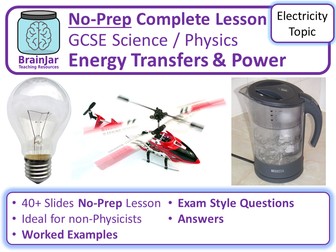
Complete No-Prep lesson with exam questions, tasks and answers on Energy Transfers and Power for the Electricity Topic of AQA GCSE (9-1) Science / Physics. This lesson covers exam spec points 4.2.4.1 and 4.2.4.2 (Physics) or 6.2.4.1 and 6.2.4.2 (Combined Science). As a Secondary Science teacher, Deputy Headteacher, writer and examiner for many years I make high quality no-prep lessons so busy teachers can teach outstanding lessons without spending hours planning. This high quality lesson includes explanations, different types of in-lesson assessment (all with answers) and unique exam questions. My lessons are ideal for non-Physicists - as a Biologist who retrained as a Physics teacher I know how to take learners on a journey that builds up their understanding step by step, while still going into a lot of depth. The preview video shows a representative sample of slides from the resource so that you get a good idea of what it includes before you buy. What’s Included: • Starter / Do Now Activity • Explanation slides in “chunked” sections with animated diagrams. • Worked examples of calculations / questions. • Multiple questions in different question styles and difficulties - no need for worksheets. Each “chunked” explanation section typically includes a set of “learning check / quick questions” followed by a set of in-depth questions on the learning from that “chunk” of the lesson. All questions have answers. • Exam-style questions on the whole lesson at the end of the lesson- these are unique, based on real exam questions but not just copied from exam boards. • Answers for all questions • All easily editable to adapt to your teaching or to use in existing lessons. • Slightly humorous, at points, if you like that sort of thing. Learning objectives: Describe how domestic appliances transfer energy. Describe how the amount of energy an appliance transfers depends on its power and how long it is on for. Describe how work is done when charge flows in a circuit. Calculate the amount of energy transferred by electrical work using: E = P t E = Q V. Calculate power using P = V I P = I2 R The lesson was written for AQA GCSE Science / Physics but is very likely to be applicable to other exam specifications. Please leave a rating / review and all other feedback gratefully received!
Energy StoresQuick View
AmigoEducation

Energy Stores

(0)
Explore Energy Stores with this jumbo-sized, double-sided A3 worksheet. Focused content: • Energy Stores (reference to conservation of energy) • Kinetic, Light, Thermal, Gravitational, Chemical, Electrical, Sound*. • Energy Transfer, loss, and efficiency. • Cloze procedure followed by a range of questions. • Fun crossword for keyword retention. *NB: sound is explained as a form of energy transfer/loss Aimed primarily at upper KS3 but frequently used as a revision for GCSE. This worksheet is designed to be used in landscape orientation and can be printed in A4 format but A3 is advised for the maximum learning experience of the student.
National and Global Energy ResourcesQuick View
OuttheBoxScience

National and Global Energy Resources

(4)
AQA GCSE Combined Science Trilogy unit ‘Energy’ Full lesson ready to use straight ‘out of the box’. Similar structure to my other power points following the input - activity - review phasing Plenary section for progress checking Clear learning objectives and outcomes Modern and engaging layout Little adaptation needed Please leave constructive feedback :D
Renewable Energy ResourcesQuick View
BrainJar

Renewable Energy Resources

(0)
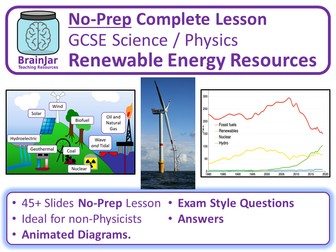
Complete No-Prep lesson with exam questions, tasks and answers on Renewable Energy Resources for AQA GCSE (9-1) Science / Physics. This lesson covers the parts of AQA GCSE Combined Science 6.1.3 / GCSE Physics 4.1.3 relating to renewables (the previous lesson covers non-renewable energy resources). As a Secondary Science teacher, Deputy Headteacher, writer and examiner for many years I make high quality no-prep lessons so busy teachers can teach outstanding lessons without spending hours planning. This high quality lesson includes explanations, different types of in-lesson assessment (all with answers) and unique exam questions. My lessons are ideal for non-Physicists - as a Biologist who retrained as a Physics teacher I know how to take learners on a journey that builds up their understanding step by step, while still going into a lot of depth. The preview video shows a representative sample of slides from the resource so that you get a good idea of what it includes before you buy. What’s Included: • Starter / Do Now Activity • Explanation slides in “chunked” sections with animated diagrams. • Multiple questions in different question styles and difficulties - no need for worksheets. Each “chunked” explanation section typically includes a set of “learning check / quick questions” followed by a set of in-depth questions on the learning from that “chunk” of the lesson. All questions have answers. • Exam-style questions on the whole lesson at the end of the lesson- these are unique, based on real exam questions but not just copied from exam boards. • Answers for all questions • All easily editable to adapt to your teaching or to use in existing lessons. • Slightly humorous, at points, if you like that sort of thing. The lesson was written for AQA GCSE Science / Physics but is very likely to be applicable to other exam specifications. Please leave a rating / review and all other feedback gratefully received!
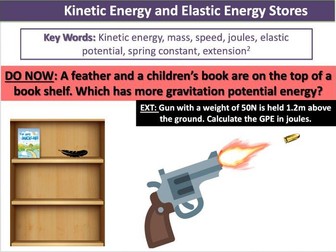
P1.5 Kinetic Energy and Elastic Energy StoresQuick View
OuttheBoxScience

P1.5 Kinetic Energy and Elastic Energy Stores

(0)
New for the AQA GCSE 1-9 Combined Trilogy Unit ‘P1 Conservation and Dissipation of Energy’. Full lessons ready to use straight ‘out of the box’. Lesson meets the full criteria for this unit Similar structure to my other power points following the input - activity - review phasing Plenary sections for progress checking Clear learning objectives and outcomes Modern and engaging layout Little adaptation needed Each lesson covers at least an hour of lesson time 46 ppt slides Please leave constructive feedback :D
Renewable EnergyQuick View
EC_Resources

Renewable Energy

(0)
Renewable energy, fossil fuels, and climate change lesson. A detailed, differentiated and editable 1 hour lesson all about the UK’s energy needs and the government’s plans to phase out the use of carbon-based fuels. In this lesson, the students will learn about the nation’s energy consumption of electricity, natural gas, and solid fuels. We will investigate the pros and cons of different energy sources including renewables and fossil fuels. We will reflect on the reasons why we are moving away from carbon-based fuels and discuss how easy it will be for the UK to achieve their carbon-neutral target. The lesson is ideally suited to students in UKS2 or younger students in KS3. The resources are fully editable, and therefore easy to amend should you wish to use the resources with other year groups. The lesson is well-differentiated with three-level challenges for each task, contains a variety of activities, an hour long PowerPoint, clips with differentiated questions, clear measurable LOs, new key-term introductions and other activities. Who are EC Resources? EC Resources are the top TES PSHE providers and are a group of teachers who work together to create easy to use, high quality and editable lessons and units of work. We have created lessons for The Children’s Commissioner, The Bank of England, MACS Charity, Tes, LikeToBe Careers, the Criminal Cases Review Commission (UK Gov) and have also completed PSHE and Citizenship commissions for schools across the UK. You can contact us at info@ecpublishing.co.uk Teaching PSHE, RE or Citizenship GCSE next year? Why not join our Citizenship and PSHE teachers Facebook group, with 8000 other teachers, for guidance, advice and resource sharing.
Non-Renewable Energy ResourcesQuick View
BrainJar

Non-Renewable Energy Resources

(0)
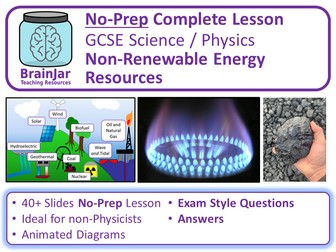
Complete No-Prep lesson with exam questions, tasks and answers on Non-renewable Energy Resources for AQA GCSE (9-1) Science / Physics. This lesson covers the parts of AQA GCSE Combined Science 6.1.3 / GCSE Physics 4.1.3 relating to non-renewables (the next lesson covers renewable energy resources). As a Secondary Science teacher, Deputy Headteacher, writer and examiner for many years I make high quality no-prep lessons so busy teachers can teach outstanding lessons without spending hours planning. This high quality lesson includes explanations, different types of in-lesson assessment (all with answers) and unique exam questions. My lessons are ideal for non-Physicists - as a Biologist who retrained as a Physics teacher I know how to take learners on a journey that builds up their understanding step by step, while still going into a lot of depth. The preview video shows a representative sample of slides from the resource so that you get a good idea of what it includes before you buy. What’s Included: • Starter / Do Now Activity • Explanation slides in “chunked” sections with animated diagrams. • Multiple questions in different question styles and difficulties - no need for worksheets. Each “chunked” explanation section typically includes a set of “learning check / quick questions” followed by a set of in-depth questions on the learning from that “chunk” of the lesson. All questions have answers. • Exam-style questions on the whole lesson at the end of the lesson- these are unique, based on real exam questions but not just copied from exam boards. • Answers for all questions • All easily editable to adapt to your teaching or to use in existing lessons. • Slightly humorous, at points, if you like that sort of thing. The lesson was written for AQA GCSE Science / Physics but is very likely to be applicable to other exam specifications. Please leave a rating / review and all other feedback gratefully received!
Energy Transfer KS3 Activate ScienceQuick View
ychebbout

Energy Transfer KS3 Activate Science

(0)
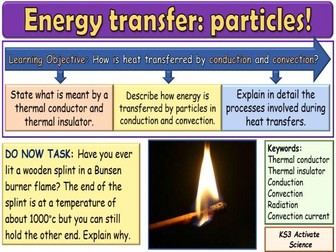
Perfect lesson resource for KS3 Physics! A fully differentiated and resourced lesson that assists students in learning about how energy is transferred. Great as an introduction to energy, students will describe energy before and after a change, explain what is meant by conservation of energy, calculate percentage efficiency and explain how energy is dissipated. The resource includes a detailed and engaging lesson PowerPoint with differentiated activities and quizzes for students to complete. This resource is part of the energy topic and has been created using the Activate 2 KS3 Science course and the new AQA Approved Activate 1. Also great for GCSE Science. 47 slides in total for the lesson PPT
Work, Energy, and Machines KS3 Activate ScienceQuick View
ychebbout

Work, Energy, and Machines KS3 Activate Science

(0)
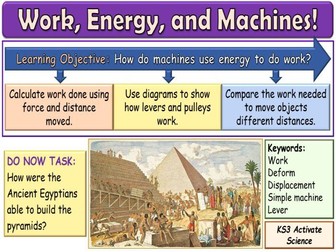
Perfect lesson resource for KS3 Physics! A fully differentiated and resourced lesson that assists students in learning about how machines use energy to do work. Students will practice calculations involving work done, use diagrams to show how levers and pulleys work, and compare the work needed to move objects different distances. The resource includes a detailed and engaging lesson PowerPoint with differentiated activities, worksheet and quizzes for students to complete. This resource is part of the energy topic and has been created for the delivery of the Activate KS3 Science course. Also great for GCSE Science. 20 slides in total for the lesson PPT
Types of EnergyQuick View
ljcreate

Types of Energy

(2)
Poster display showing symbolic representation and simple definitions of light energy, kinetic energy (KE), heat energy, sound energy, electrical energy and potential energy (PE).
GCSE Energy stores and energy equationsQuick View
EUP

GCSE Energy stores and energy equations

(0)
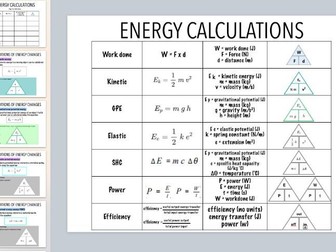
A fully-editable PowerPoint with 16 slides, that cover most of the content a GCSE student will need to know about different energy stores and equations to do with energy: How to calculate kinetic energy Work done Gravitational potential energy Elastic potential energy The relationship between power and time There are lots of example questions about energy stores and the different equations and each question has answers attached to it.
Energy Stores and TransfersQuick View
BrainJar

Energy Stores and Transfers

(12)
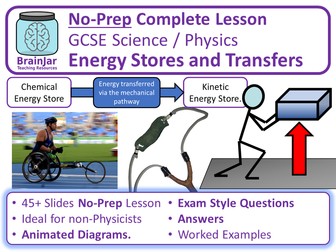
Complete No-Prep lesson with exam questions, tasks and answers on Energy Stores and Transfers for AQA GCSE (9-1) Science / Physics. This lesson covers all of AQA GCSE Combined Science 6.1.1.1 / GCSE Physics 4.1.1.1. and is fully compliant with the new “stores and transfers” way of teaching energy at GCSE. As a Secondary Science teacher, Deputy Headteacher, writer and examiner for many years I make high quality no-prep lessons so busy teachers can teach outstanding lessons without spending hours planning. This high quality lesson includes explanations, different types of in-lesson assessment (all with answers) and unique exam questions. My lessons are ideal for non-Physicists - as a Biologist who retrained as a Physics teacher I know how to take learners on a journey that builds up their understanding step by step, while still going into a lot of depth. The preview video shows a representative sample of slides from the resource so that you get a good idea of what it includes before you buy. What’s Included: • Starter / Do Now Activity • Explanation slides in “chunked” sections with animated diagrams. • Worked examples of calculations / questions. • Multiple questions in different question styles and difficulties - no need for worksheets. Each “chunked” explanation section typically includes a set of “learning check / quick questions” followed by a set of in-depth questions on the learning from that “chunk” of the lesson. All questions have answers. • Exam-style questions on the whole lesson at the end of the lesson- these are unique, based on real exam questions but not just copied from exam boards. • Answers for all questions • All easily editable to adapt to your teaching or to use in existing lessons. • Slightly humorous, at points, if you like that sort of thing. The lesson was written for AQA GCSE Science / Physics but is very likely to be applicable to other exam specifications. Please leave a rating / review and all other feedback gratefully received!
Energy in foodQuick View
seasquirt

Energy in food

(15)
This is a ppt used with a mixed Yr 7 class for a double lesson. Covers balanced diet, energy requirements of different groups of people and finishes off with burning food practical - questions to check progress/understanding on last slide