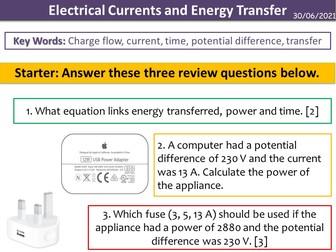
Energy Transfers and Power (Electricity Topic)Quick View
BrainJar

Energy Transfers and Power (Electricity Topic)

(1)
Complete No-Prep lesson with exam questions, tasks and answers on Energy Transfers and Power for the Electricity Topic of AQA GCSE (9-1) Science / Physics. This lesson covers exam spec points 4.2.4.1 and 4.2.4.2 (Physics) or 6.2.4.1 and 6.2.4.2 (Combined Science). As a Secondary Science teacher, Deputy Headteacher, writer and examiner for many years I make high quality no-prep lessons so busy teachers can teach outstanding lessons without spending hours planning. This high quality lesson includes explanations, different types of in-lesson assessment (all with answers) and unique exam questions. My lessons are ideal for non-Physicists - as a Biologist who retrained as a Physics teacher I know how to take learners on a journey that builds up their understanding step by step, while still going into a lot of depth. The preview video shows a representative sample of slides from the resource so that you get a good idea of what it includes before you buy. What’s Included: • Starter / Do Now Activity • Explanation slides in “chunked” sections with animated diagrams. • Worked examples of calculations / questions. • Multiple questions in different question styles and difficulties - no need for worksheets. Each “chunked” explanation section typically includes a set of “learning check / quick questions” followed by a set of in-depth questions on the learning from that “chunk” of the lesson. All questions have answers. • Exam-style questions on the whole lesson at the end of the lesson- these are unique, based on real exam questions but not just copied from exam boards. • Answers for all questions • All easily editable to adapt to your teaching or to use in existing lessons. • Slightly humorous, at points, if you like that sort of thing. Learning objectives: Describe how domestic appliances transfer energy. Describe how the amount of energy an appliance transfers depends on its power and how long it is on for. Describe how work is done when charge flows in a circuit. Calculate the amount of energy transferred by electrical work using: E = P t E = Q V. Calculate power using P = V I P = I2 R The lesson was written for AQA GCSE Science / Physics but is very likely to be applicable to other exam specifications. Please leave a rating / review and all other feedback gratefully received!
Electrical Currents and Energy TransferQuick View
OuttheBoxScience

Electrical Currents and Energy Transfer

(4)
New for the AQA GCSE Combined Trilogy unit ‘P5 Electricity in the Home’. Full lesson ready to use straight ‘out of the box’. Though designed for teachers to deliver (specialist and non-specialists), the lessons are structured in an intuitive way for students to navigate for independent/ remote learning/ homework covering missed content/recap Similar structure to my other power points following the input - activity - review phasing plenary sections for progress checking Clear learning objectives and outcomes Modern and engaging layout Little adaptation needed Covers an hour lesson of content matched to the specification 30 ppt slides Please give constructive feedback :D
Bundle: Static Electricity and Electric FieldsQuick View
BrainJar

Bundle: Static Electricity and Electric Fields

2 Resources
Two complete No-Prep lessons with exam questions, tasks and answers on Static Electricity (Static Charge and Electric Fields) for AQA GCSE (9-1) Physics, covering all of exam spec points 4.2.5.1 and 4.2.5.2. This mini bundle can be used with the following bundle so you have all the lessons for the Electricity Topic for GCSE Physics: https://www.tes.com/teaching-resource/resource-12660191 As a Secondary Science teacher, Deputy Headteacher, writer and examiner for many years I make high quality no-prep lessons so busy teachers can teach outstanding lessons without spending hours planning. These high quality lessons include explanations, different types of in-lesson assessment (all with answers) and unique exam questions. My lessons are ideal for non-Physicists - as a Biologist who retrained as a Physics teacher I know how to take learners on a journey that builds up their understanding step by step, while still going into a lot of depth. The preview videos show a representative sample of slides from the resources so that you get a good idea of what they include before you buy. What’s Included in each lesson: • Starter / Do Now Activity • Explanation slides in “chunked” sections with animated diagrams. • Multiple questions in different question styles and difficulties - no need for worksheets. Each “chunked” explanation section typically includes a set of “learning check / quick questions” followed by a set of in-depth questions on the learning from that “chunk” of the lesson. All questions have answers. • Exam-style questions on the whole lesson at the end of the lesson- these are unique, based on real exam questions but not just copied from exam boards. • Answers for all questions • All easily editable to adapt to your teaching or to use in existing lessons. • Slightly humorous, at points, if you like that sort of thing. The lessons were written for AQA GCSE Physics but are very likely to be applicable to other exam specifications. Please leave a rating / review and all other feedback gratefully received!
OCR AS level Physics: Electrical CircuitsQuick View
srshaw89

OCR AS level Physics: Electrical Circuits

6 Resources
OCR AS level Physics presentations for module 4: Energy, Power, and Resistance. All presentations come with worked examples, solutions and homeworks. This covers topics from Kirchhoff’s laws to potential dividers and sensing circuits.
Charging Up (Static Electricity)Quick View
OuttheBoxScience

Charging Up (Static Electricity)

(4)
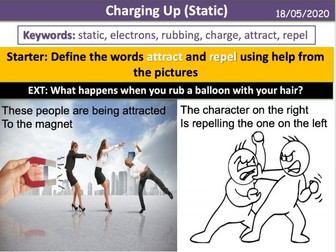
KS3 Activate 2 module ‘Electricity and Magnetism’ Full lesson ready to use straight ‘out of the box’. Similar structure to my other power points following the input - activity - review phasing Plenary section for progress checking Clear learning objectives and outcomes Modern and engaging layout Little adaptation needed Covers an hour lesson of content matched to the specification 36 ppt slides Please leave some constructive feedback :D
Alternating Current & Mains ElectricityQuick View
BrainJar

Alternating Current & Mains Electricity

(1)
Complete No-Prep lesson with exam questions, tasks and answers on Alternating Current and Mains Electricity for AQA GCSE (9-1) Science / Physics. This lesson covers all of AQA GCSE Physics 4.2.3.1 and 4.2.3.2 / Combined Science 6.2.3.1 and 6.2.3.2. As a Secondary Science teacher, Deputy Headteacher, writer and examiner for many years I make high quality no-prep lessons so busy teachers can teach outstanding lessons without spending hours planning. This high quality lesson includes explanations, different types of in-lesson assessment (all with answers) and unique exam questions. My lessons are ideal for non-Physicists - as a Biologist who retrained as a Physics teacher I know how to take learners on a journey that builds up their understanding step by step, while still going into a lot of depth. The preview video shows a representative sample of slides from the resource so that you get a good idea of what it includes before you buy. What’s Included: • Starter / Do Now Activity • Explanation slides in “chunked” sections with animated diagrams. • Multiple questions in different question styles and difficulties - no need for worksheets. Each “chunked” explanation section typically includes a set of “learning check / quick questions” followed by a set of in-depth questions on the learning from that “chunk” of the lesson. All questions have answers. • Exam-style questions on the whole lesson at the end of the lesson- these are unique, based on real exam questions but not just copied from exam boards. • Answers for all questions • All easily editable to adapt to your teaching or to use in existing lessons. • Slightly humorous, at points, if you like that sort of thing. Learning objectives: Explain the difference between direct and alternating potential difference / current. Describe the features of mains electricity in the UK including the potential difference and frequency. Describe how mains electricity is connected to appliances including the purpose of each part of a three-core cable and a three pin plug. Describe the potential dangers of electricity and the purpose of safety features including fuses and earthing. The lesson was written for AQA GCSE Science / Physics but is very likely to be applicable to other exam specifications. Please leave a rating / review and all other feedback gratefully received!
Electricity: Circuits, Current, ChargeQuick View
BrainJar

Electricity: Circuits, Current, Charge

(1)
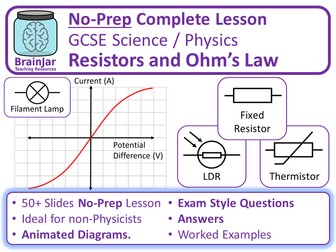
Complete No-Prep lesson with exam questions, tasks and answers on Circuits, Current and Charge for AQA GCSE (9-1) Science / Physics, covering all of exam spec points 4.2.1.1 and 4.2.1.2 / 6.2.1.1 and 6.2.1.2. This is the first lesson in the teaching sequence. As a Secondary Science teacher, Deputy Headteacher, writer and examiner I make high quality no-prep lessons so busy teachers can teach outstanding lessons without spending hours planning. This high quality lesson includes explanations, different types of in-lesson assessment (all with answers) and unique exam questions. My lessons are ideal for non-Physicists - as a Biologist who retrained as a Physics teacher I know how to take learners on a journey that builds up their understanding step by step, while still going into a lot of depth. The preview video shows a representative sample of slides from the resource so that you get a good idea of what it includes before you buy. What’s Included: • Starter / Do Now Activity • Explanation slides in “chunked” sections with animated diagrams. • Worked examples of calculations / questions. • Multiple questions in different question styles and difficulties - no need for worksheets. Each “chunked” explanation section typically includes a set of “learning check / quick questions” followed by a set of in-depth questions on the learning from that “chunk” of the lesson. All questions have answers. • Exam-style questions on the whole lesson at the end of the lesson- these are unique, based on real exam questions but not just copied from exam boards. • Answers for all questions • All easily editable to adapt to your teaching or to use in existing lessons. • Slightly humorous, at points, if you like that sort of thing. Learning objectives: Draw and interpret circuit diagrams, including by circuit symbols correctly. Describe the difference between a battery and a cell. Describe current as a flow of electrical charge and the size of the current as the rate of flow of electrical charge. Explain why current requires a source of potential difference. Explain why current has the same value at any point in series circuit. Recall and apply: Current Flow (Q) = Current (I) x time (t) The lesson was written for AQA GCSE Science / Physics but is very likely to be applicable to other exam specifications. Please leave a rating / review and all other feedback gratefully received!
National Grid (Electricity Topic)Quick View
BrainJar

National Grid (Electricity Topic)

(1)
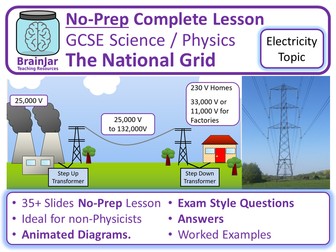
Complete No-Prep lesson with exam questions, tasks and answers on the National Grid for the Electricity Topic of AQA GCSE (9-1) Science / Physics. This lesson covers all of AQA GCSE Physics 4.2.4.3 / Combined Science 6.2.4.3 Please note that this lesson is for the Electricity topic - there is a similar lesson on Transformers and the National Grid for GCSE Physics only in the Magnetism and Electromagnetism topic. As a Secondary Science teacher, Deputy Headteacher, writer and examiner for many years I make high quality no-prep lessons so busy teachers can teach outstanding lessons without spending hours planning. This high quality lesson includes explanations, different types of in-lesson assessment (all with answers) and unique exam questions. My lessons are ideal for non-Physicists - as a Biologist who retrained as a Physics teacher I know how to take learners on a journey that builds up their understanding step by step, while still going into a lot of depth. The preview video shows a representative sample of slides from the resource so that you get a good idea of what it includes before you buy. What’s Included: • Starter / Do Now Activity • Explanation slides in “chunked” sections with animated diagrams. • Worked examples of calculations / questions. • Multiple questions in different question styles and difficulties - no need for worksheets. Each “chunked” explanation section typically includes a set of “learning check / quick questions” followed by a set of in-depth questions on the learning from that “chunk” of the lesson. All questions have answers. • Exam-style questions on the whole lesson at the end of the lesson- these are unique, based on real exam questions but not just copied from exam boards. • Answers for all questions • All easily editable to adapt to your teaching or to use in existing lessons. Learning objectives: Describe the structure and purpose of the national grid. Describe the difference between step-up and step-down transformers and how each is used in the national grid. Explain why the national grid is an efficient way to transfer energy. The lesson was written for AQA GCSE Science / Physics but is very likely to be applicable to other exam specifications. Please leave a rating / review and all other feedback gratefully received!
Bundle: Electricity TopicQuick View
BrainJar

Bundle: Electricity Topic

7 Resources
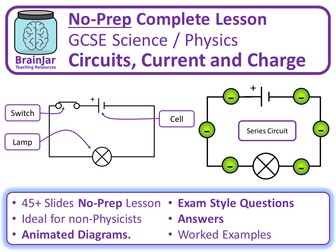
Bundle of 7 complete No-Prep lessons with exam questions, tasks and answers on Electricity for AQA GCSE (9-1) Science / Physics, covering all of AQA 4.2.1 to 4.2.4 / 6.2.1 to 6.2.4. This bundle covers the complete topic for Combined Science and GCSE Physics (except for Required Practical instructions) but does NOT contain the GCSE Physics only lessons on Static Charge and Electric Fields. The latter which can be found in this “add on bundle”: https://www.tes.com/teaching-resource/bundle-static-electricity-and-electric-fields-12671708 As a Secondary Science teacher, Deputy Headteacher, writer and examiner for many years I make high quality no-prep lessons so busy teachers can teach outstanding lessons without spending hours planning. These high quality lessons include explanations, different types of in-lesson assessment (all with answers) and unique exam questions. My lessons are ideal for non-Physicists - as a Biologist who retrained as a Physics teacher I know how to take learners on a journey that builds up their understanding step by step, while still going into a lot of depth. The preview videos show a representative sample of slides from each resource so that you get a good idea of what it includes before you buy. Teaching Order Circuits, Current and Charge Current, Potential Difference and Resistance Resistors and Ohm’s Law Series and Parallel Circuits AC and Mains Electricity Energy Transfers and Power National Grid What’s Included in each lesson: • Starter / Do Now Activity • Explanation slides in “chunked” sections with animated diagrams. • Worked examples of calculations / questions. • Multiple questions in different question styles and difficulties - no need for worksheets. Each “chunked” explanation section typically includes a set of “learning check / quick questions” followed by a set of in-depth questions on the learning from that “chunk” of the lesson. All questions have answers. • Exam-style questions on the whole lesson at the end of the lesson- these are unique, based on real exam questions but not just copied from exam boards. • Answers for all questions • All easily editable to adapt to your teaching or to use in existing lessons. • Slightly humorous, at points, if you like that sort of thing. The lessons were written for AQA GCSE Science / Physics but are very likely to be applicable to other exam specifications. Please leave a rating / review and all other feedback gratefully received!
Efficiency (Energy)Quick View
BrainJar

Efficiency (Energy)

(1)
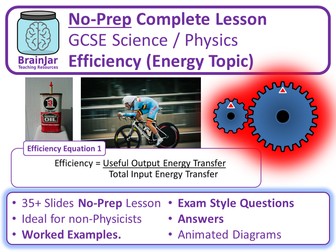
Complete No-Prep lesson with exam questions, tasks and answers on Efficiency for the Energy topic of AQA GCSE (9-1) Science / Physics. This lesson covers all of AQA GCSE Combined Science 6.1.2.2 / GCSE Physics 4.1.2.2. As a Secondary Science teacher, Deputy Headteacher, writer and examiner for many years I make high quality no-prep lessons so busy teachers can teach outstanding lessons without spending hours planning. This high quality lesson includes explanations, different types of in-lesson assessment (all with answers) and unique exam questions. My lessons are ideal for non-Physicists - as a Biologist who retrained as a Physics teacher I know how to take learners on a journey that builds up their understanding step by step, while still going into a lot of depth. The preview video shows a representative sample of slides from the resource so that you get a good idea of what it includes before you buy. What’s Included: • Starter / Do Now Activity • Explanation slides in “chunked” sections with animated diagrams. • Worked examples of calculations / questions. • Multiple questions in different question styles and difficulties - no need for worksheets. Each “chunked” explanation section typically includes a set of “learning check / quick questions” followed by a set of in-depth questions on the learning from that “chunk” of the lesson. All questions have answers. • Exam-style questions on the whole lesson at the end of the lesson- these are unique, based on real exam questions but not just copied from exam boards. • Answers for all questions • All easily editable to adapt to your teaching or to use in existing lessons. • Slightly humorous, at points, if you like that sort of thing. The lesson was written for AQA GCSE Science / Physics but is very likely to be applicable to other exam specifications. Please leave a rating / review and all other feedback gratefully received!
(Chapter 12 BUNDLE) A level Physics - Electricity - Electric currentQuick View
ThePhysicsmaster

(Chapter 12 BUNDLE) A level Physics - Electricity - Electric current

5 Resources
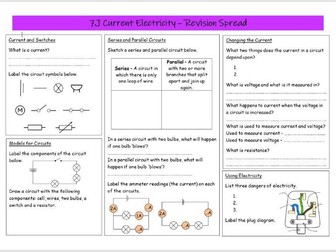
This bundle contains 4 lessons and an end of unit assessment Each lesson follows the AQA Physics: A Level Year 1 and AS textbook https://amzn.to/3BGFsD5 The lessons are complete and designed to be taught over a period of 90 minutes. They are fully animated and contains fully worked out answers to every question. The format A recall starter activity to help store key definitions and ideas to long term memory. Clear slides presented in a logical order, which can be used to talk through and explain the key concepts of the lesson. Questions and example slides, which can be used to model perfect exam ready answers. Summary questions to practice and consolidate the new knowledge gained from the lesson.
Energy and Electricity Project BookletQuick View
rubberchicken2

Energy and Electricity Project Booklet

(5)
This is a project booklet which pupils used to help them design a houes. They completed a project over a few weeks where they had to complete the tasks within the book and build a model house which was as energy efficient as possible. They then had to present their house to the class and were graded on their ability to present and explain their ideas scientifically. I did this with a year seven class who did struggle with a couple of bits but it can always be tweaked to suit.
OCR A level Physics: Electric FieldsQuick View
srshaw89

OCR A level Physics: Electric Fields

5 Resources
OCR A level Physics: Chapter 22 Electric Fields is apart of the Module 6: Particle and Medical Physics All presentations come with worked examples, solutions and homeworks. 22.1 Electric Fields 22.2 Coulomb’s Law 22.3 Uniform electric fields and capacitance 22.4 Charged particles in uniformed electric fields 22.5 Electric potential and energy Electric field line pattern from point charges, uniformly charged objects, and capacitors. Rules for electric field lines Interacting field lines for attraction and repulsion Detecting electric fields with a charged gold leaf Definition of electric field strength Explaining that electric field strength is a vector with magnitude and direction Apply the equation for electric field strength Electric force related to the product of charge and square of the separation The constant of proportionality 𝑘 Permittivity of free space Experiment for investigating Coulomb’s Law Electric Field Strength and Coulomb’s Law Liquid crystal displays (LCDs) Electric field between two charged parallel plates Deriving an equation for electric field strength of a parallel plate capacitor. Accelerating charged particles in a uniformed electric field Capacitance of a parallel plate capacitor with an insulating (dielectric) material - relative permittivity Millikan’s experiment Equations for constant acceleration Maximum kinetic energy of a charged particle in a uniformed field Sketching trajectories for charged particles in uniformed fields Calculating velocities for horizontal and vertical components Definition of electric potential energy Definition of electric potential. Definition of electric potential difference. Using a force-distance graph to determine electric potential energy Using electron-volts and joules in calculations Capacitance of an isolated charged sphere
Electricity: Current, Resistance and Potential DifferenceQuick View
BrainJar

Electricity: Current, Resistance and Potential Difference

(1)
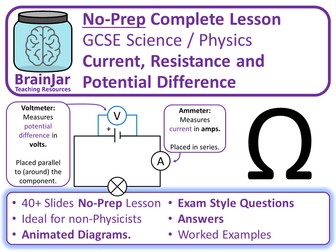
Complete No-Prep lesson with exam questions, tasks and answers on Current, Resistance and Potential Difference for AQA GCSE (9-1) Science / Physics. The lesson covers all of AQA GCSE Physics 4.2.1.3 and a small part of 4.2.4.2 (energy transferred = charge flow x potential difference) because this helps to explain potential difference. This lesson is the second in the Electricity sequence and follows on from Circuits, Current and Charge. As a Secondary Science teacher and Deputy Headteacher for many years I make high quality no-prep lessons so busy teachers can teach outstanding lessons without spending hours planning. This high quality lesson includes explanations, different types of in-lesson assessment (all with answers) and unique exam questions. My lessons are ideal for non-Physicists - as a Biologist who retrained as a Physics teacher I know how to take learners on a journey that builds up their understanding step by step, while still going into a lot of depth. The preview video shows a representative sample of slides from the resource so that you get a good idea of what it includes before you buy. What’s Included: • Starter / Do Now Activity • Explanation slides in “chunked” sections with animated diagrams. • Worked examples of calculations / questions. • Multiple questions in different question styles and difficulties - no need for worksheets. Each “chunked” explanation section typically includes a set of “learning check / quick questions” followed by a set of in-depth questions on the learning from that “chunk” of the lesson. All questions have answers. • Exam-style questions on the whole lesson at the end of the lesson- these are unique, based on real exam questions but not just copied from exam boards. • Answers for all questions • All easily editable to adapt to your teaching or to use in existing lessons. • Slightly humorous, at points, if you like that sort of thing. Learning objectives: Explain what potential difference is and how we measure it. Apply the equation energy transferred = charge flow x potential difference to describe how potential difference relates to energy transfer. Explain what resistance is, what causes it and how we measure it. Describe how the current through a component depends on both resistance and potential difference, and that a greater resistance will result in a smaller current for any given potential difference. Apply the equation potential difference = current x resistance. The lesson was written for AQA GCSE Science / Physics but is very likely to be applicable to other exam specifications. Please leave a rating / review and all other feedback gratefully received!
National and Global Energy ResourcesQuick View
OuttheBoxScience

National and Global Energy Resources

(4)
AQA GCSE Combined Science Trilogy unit ‘Energy’ Full lesson ready to use straight ‘out of the box’. Similar structure to my other power points following the input - activity - review phasing Plenary section for progress checking Clear learning objectives and outcomes Modern and engaging layout Little adaptation needed Please leave constructive feedback :D
Power (Energy Topic)Quick View
BrainJar

Power (Energy Topic)

(0)
Complete No-Prep lesson with exam questions, tasks and answers on Power (including Work Done) for AQA GCSE (9-1) Science / Physics. This lesson covers all of AQA GCSE Combined Science 6.1.1.4 / GCSE Physics 4.1.1.4. This lesson was updated and improved slightly 01.05.23 As a Secondary Science teacher, Deputy Headteacher, writer and examiner for many years I make high quality no-prep lessons so busy teachers can teach outstanding lessons without spending hours planning. This high quality lesson includes explanations, different types of in-lesson assessment (all with answers) and unique exam questions. My lessons are ideal for non-Physicists - as a Biologist who retrained as a Physics teacher I know how to take learners on a journey that builds up their understanding step by step, while still going into a lot of depth. The preview video shows a representative sample of slides from the resource so that you get a good idea of what it includes before you buy. What’s Included: • Starter / Do Now Activity • Explanation slides in “chunked” sections with animated diagrams. • Worked examples of calculations / questions. • Multiple questions in different question styles and difficulties - no need for worksheets. Each “chunked” explanation section typically includes a set of “learning check / quick questions” followed by a set of in-depth questions on the learning from that “chunk” of the lesson. All questions have answers. • Exam-style questions on the whole lesson at the end of the lesson- these are unique, based on real exam questions but not just copied from exam boards. • Answers for all questions • All easily editable to adapt to your teaching or to use in existing lessons. • Slightly humorous, at points, if you like that sort of thing. The lesson was written for AQA GCSE Science / Physics but is very likely to be applicable to other exam specifications. Please leave a rating / review and all other feedback gratefully received!
Renewable Energy ResourcesQuick View
BrainJar

Renewable Energy Resources

(0)
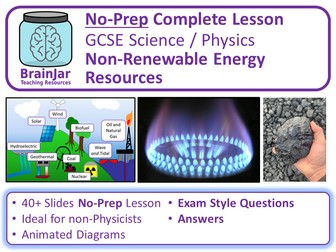
Complete No-Prep lesson with exam questions, tasks and answers on Renewable Energy Resources for AQA GCSE (9-1) Science / Physics. This lesson covers the parts of AQA GCSE Combined Science 6.1.3 / GCSE Physics 4.1.3 relating to renewables (the previous lesson covers non-renewable energy resources). As a Secondary Science teacher, Deputy Headteacher, writer and examiner for many years I make high quality no-prep lessons so busy teachers can teach outstanding lessons without spending hours planning. This high quality lesson includes explanations, different types of in-lesson assessment (all with answers) and unique exam questions. My lessons are ideal for non-Physicists - as a Biologist who retrained as a Physics teacher I know how to take learners on a journey that builds up their understanding step by step, while still going into a lot of depth. The preview video shows a representative sample of slides from the resource so that you get a good idea of what it includes before you buy. What’s Included: • Starter / Do Now Activity • Explanation slides in “chunked” sections with animated diagrams. • Multiple questions in different question styles and difficulties - no need for worksheets. Each “chunked” explanation section typically includes a set of “learning check / quick questions” followed by a set of in-depth questions on the learning from that “chunk” of the lesson. All questions have answers. • Exam-style questions on the whole lesson at the end of the lesson- these are unique, based on real exam questions but not just copied from exam boards. • Answers for all questions • All easily editable to adapt to your teaching or to use in existing lessons. • Slightly humorous, at points, if you like that sort of thing. The lesson was written for AQA GCSE Science / Physics but is very likely to be applicable to other exam specifications. Please leave a rating / review and all other feedback gratefully received!
Energy resources and electricity generationQuick View
Elanesque

Energy resources and electricity generation

(2)
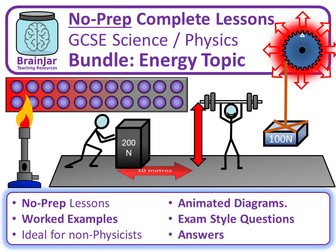
Lesson covering the following learning objectives: Recall how a coal power station generates electricity Compare pros/cons of nuclear power (C/B) Explain why we need renewable energy sources (B) and evaluate their uses in generating electricity (A) Calculate the cost of electricity using the formula: Cost = energy used x time x cost per kWh
Y10 Energy and electricity revision worksheets Quick View
deb1977

Y10 Energy and electricity revision worksheets

(13)
These relate to the old specification, but I will leave them available in case they are useful. These are worksheets that I prepared to revise the AQA y10 P1a topic of energy and electricity. It has questions for them to answer blanks to fill in, diagrams to complete etc.