Managing Floods - Soft EngineeringQuick View
markthegeographer

Managing Floods - Soft Engineering

(0)
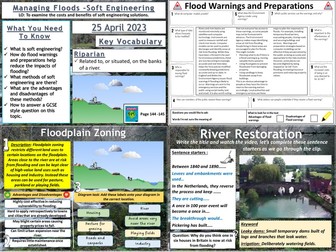
AQA GCSE Geography lesson for the 2016 specification Unit 1C: In this lesson we look at soft engineering methods of flood management. We start with a retrieval practice grid game based around the work we have undertaken in the rivers unit of work so far. The students then complete a cloze exercise to create a definition of what soft engineering is. The students then investigate flood warnings as issued by the Environment Agency and preparations by completing a guided reading exercise. We then look at three soft engineering strategies in turn: River restoration, flood plain zoning and afforestation. For each method, the students write a description, sort out the advantages and disadvantages and complete a task involving a diagram. There is a short video task on rover restoration. We finish with a 6-mark GCSE style question and there is some guidance for students who need it on how to answer it. Hope this saves you some valuable planning time. https://www.tes.com/teaching-resources/shop/markthegeographer
Managing Floods - Hard EngineeringQuick View
markthegeographer

Managing Floods - Hard Engineering

(0)
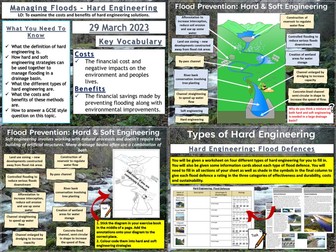
AQA GCSE Geography lesson for the new specification Unit 1C: In this lesson we look at hard engineering methods of flood management. We start with a retrieval practice grid game based around the processes and landforms of erosion. The students then complete a cloze exercise to create a definition of what hard engineering is. We briefly introduce soft engineering, then the students have a blank diagram of a drainage basin which has undergone both hard and soft engineering strategies to reduce flooding. The students have to annotate the diagram and work out which is hard and soft engineering. The students are then given some information cards and have to record details on four methods of hard engineering:- dams and reservoirs, flood relief channels, embankments and channel straightening. The students record the advantages and disadvantages and complete a rating exercise for various factors. We finish with a 9-mark GCSE style question and there is some guidance for students who need it on how to answer it. Hope this saves you some valuable planning time. https://www.tes.com/teaching-resources/shop/markthegeographer
Coasts: Hard EngineeringQuick View
markthegeographer

Coasts: Hard Engineering

(4)
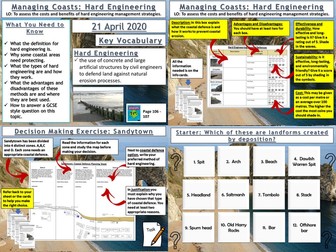
AQA GCSE Geography lesson for the new specification Unit 1C: In this lesson we look at types of hard engineering and where they are best applied. The starter is a quiz where the pupils need to select the squares that have a depositional landform. There are sound effects too so it’s all very exciting. We begin by looking at why certain areas of the coast need protecting and what factors go into consideration when planners are deciding whether or not to protect the coastline. The pupils are then given some information cards and a worksheet to fill in on the different types of hard engineering, they also have a visual scale to shade in for each one according to it’s effectiveness and durability, cost and sustainability. This can be done in a number of ways (group work, round the room, carousel etc). We then seek to apply this knowledge though the pupils completing a decision making exercise. This is based on a fictional town (Sandytown). The town has been divided into zones, the pupils read the information on each zone and decide what type fo hard engineering that zone needs and justify this. We finish with a 6 mark question on hard engineering with some guidance on how they can answer this. In a nutshell lesson includes: Interactive starter quiz on depositional landforms. Video clip. Hard engineering worksheet with visual scale. Decision making exercise activity. 6-mark GCSE-style question with guidance should the pupils need it. Hope this saves you some valuable planning time. https://www.tes.com/teaching-resources/shop/markthegeographer
Engineering homework sheetsQuick View
liamgregory

Engineering homework sheets

(0)
A bundle of 15 homework sheets designed to engaged KS4 engineering students with homework. Aimed at the new spec for Cambridge National Engineering manufacture students. Covering a range of topics including manufacturing processes, wasting processes, shaping processes, forming processes, engineering drawing, additive manufacture, risk assessments, CNC vs manual production, SOPs, engineering careers, tools, material categories.
WJEC Engineering complete PowerPointsQuick View
195fawcett

WJEC Engineering complete PowerPoints

(0)
Complete PowerPoints for Unit 1 (Design) Unit 2 (Manufacture) and Unit 3 (Exam solving problems) for WJEC Level 1/2 Award in Engineering. Each area of the specification criteria is broken down into a short description, lesson tasks, success criteria, background information and student worksheet. Videos could be used to add interest for students however these are not included due to copyright. Stretch and challenge activities also shown on majority of lessons and clear development of knowledge throughout.
Wood (Natural and Engineered)Quick View
AmigoEducation

Wood (Natural and Engineered)

(0)
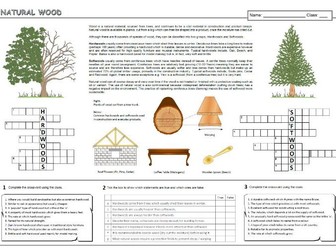
Introduce students to natural and man-made wood with this double-sided jumbo sized A3 worksheet. Recommended for upper KS3 and GCSE Wood and its application. Hardwoods and Softwoods explained. Crosswords Engineered woods (Plywood, Chipboard and MDF). Questions on key differences between wood types, properties, veneers, environmental impact etc. This worksheet is designed in landscape format and can be printed in A4 but A3 is strongly recommended for the maximum learning experience of the student.
The Ultimate Engineering Revision GuideQuick View
mr.simon.bull

The Ultimate Engineering Revision Guide

(1)
Over 70 Engineering questions covering materials, processes, isometric and orthographic drawing tasks and new technology. Covering all apsects of the specification for AQA and WJEC. Detailed and thorough with teacher answer booklet! PDF and Publisher files attached.
B14.4 Genetic engineeringQuick View
BioLabResources

B14.4 Genetic engineering

(0)
This lesson is designed for the NEW AQA Trilogy Biology GCSE, particularly the ‘Genetic engineering’ SoW Presentation contains: • Lesson objective • Success criteria • Information slides • Challenge activities • Demonstrate understanding tasks • Lesson resources (aimed at a mixed ability class covering content 1-8) It is available as a digital worksheet and its resources are designed to meet the needs of a mixed ability class If you require more assistance, please contact me at- BioLabResources@gmail.com
Genetic engineeringQuick View
CMGsSciencelessons

Genetic engineering

(0)
During this fully resourced lesson on genetic engineering GCSE students work through a variety of tasks to develop their understanding of how organisms can be genetically engineered to obtain a desired characteristic. This is the 4th lesson in a series of 7 and covers the content of - -AQA Spec Ref 4.6.2.4 Genetic engineering from B6 Inheritance, variation, and evolution unit. -AQA GCSE Biology OUP Scheme B14.4 Genetic engineering from B14 Variation and evolution chapter. Aimed at a mixed ability class covering content 1-8. -Level 1: Low demand -Level 2: Standard demand -Level 3: High demand Presentation contains (41 slides)- -Teacher and technician notes -Bell work activity -Clear lesson aims, objectives & success criteria. -Information slides with differentiated content -Differentiated activities (group work) -Differentiated questions with answers for self-assessment -Student worksheets / handouts This lesson is also available as a digital worksheet, which is ideal for absent students to catch-up missed work, distance learning, home schooling, or independent study. Genetic engineering Distance learning If you require more assistance, please contact me at- cmgeducationresources@gmail.com
Selective Breeding, Genetic Engineering & Cloning AQA GCSE (9-1) BiologyQuick View
ychebbout

Selective Breeding, Genetic Engineering & Cloning AQA GCSE (9-1) Biology

(0)
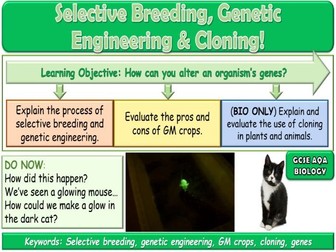
Perfect if you teach AQA GCSE Biology Combined Science or Single Science, this fully differentiated and resourced lesson supports your students in learning about selective breeding, genetic engineering and cloning. By the end of the lesson, students will be able to explain the process of selective breeding and genetic engineering, evaluate the pros and cons of GM crops and the use of cloning in plants and animals. In addition, the resource can easily be adapted to cover other exam boards. The resource includes a detailed and engaging PowerPoint Presentation with key points, differentiated activities, exam style questions and progress check questions/quizzes for students to complete. *INCLUDED IN RESOURCE: 35 slide PowerPoint Presentation with key points, progress checks and quizzes. * Enjoy and feel free to leave a review. For the full set of AQA Biology, Chemistry and Physics topic bundles please visit: https://www.tes.com/teaching-resources/shop/ychebbout
Engineering Drawings - Using and Interpreting Engineering DrawingsQuick View
Splashtag

Engineering Drawings - Using and Interpreting Engineering Drawings

(0)
I use these slides as an introduction to my GCSE Engineers on how to read the basics of an engineering drawing. The x14 slides consists of activities along the way for students to do, to reinforce their learning. The slides contain the following: Drawing Templates: Nomenclature, type face and template words explained. Drawing Zones explained: Unit of measurement, description of drawing, company name, projection symbols, zone references and parts lists. Design Activity: Design your own Drawing Template. Orthographic Projection Activity: Draw both first angle and third angle projection explaining how they differ from each other (example handout attached). Other activities include: Plan and Elevation Drawings, Lines and Line Styles, Types of Dimensioning, Calculating Radius, Dimensioning Radii, Dimensioning Circles and Dimensioning Holes.
Coasts: Soft EngineeringQuick View
markthegeographer

Coasts: Soft Engineering

(1)
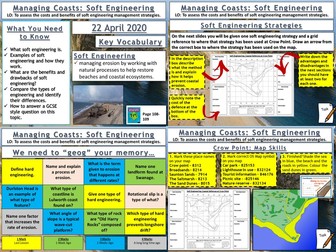
AQA GCSE Geography lesson for the new specification Unit 1C: In this lesson we look at types of soft engineering and look at an example where they have been applied. We also use the lesson as an opportunity to practice some map skills. The starter is a simple retrieval practice grid based on the coasts unit of work. We begin by locating Crow Point which is an area in North Devon at risk from coastal erosion where soft engineering strategies have been used to prevent further erosion to the fragile dune system. The pupils will be given a large A3 sheet of paper with an outline map of the area including the dune system. The pupils then use grid references to add labels and features onto their map. Once they have completed this we look at the different types of soft engineering strategies and the advantages and disadvantages. The pupils are given grid references to the location these strategies have been applied. They locate them on their map and write the details in the appropriate box. We do this four all four strategies. This could be done as an info gather, round the room, carousel etc. We finish with a 4 mark question comparing hard and soft engineering with some guidance on how they can answer this. In a nutshell lesson includes: Retrieval practice starter Map skills practice Soft engineering information gather task 4-mark GCSE-style question with guidance should the pupils need it. Hope this saves you some valuable planning time. https://www.tes.com/teaching-resources/shop/markthegeographer
NCFE engineering workbooksQuick View
jaspreet14

NCFE engineering workbooks

(1)
I found that the workbooks provided by the exam board are overwelming for the students as they contain so many pages, therefore, I have created 4 workbooks that cover the contents for the new specification, these include scaffolding which works well for 9 mark questions. I have also uploaded the teacher copies with answers so that students can self mark if required.
WJEC Engineering Level 1/2 Award Revision GuideQuick View
TheDTWorkshop

WJEC Engineering Level 1/2 Award Revision Guide

(0)
Clear and engaging revision guide designed for the WJEC’s Engineering Level 1/2 Award to help students prepare for their Unit 3 written exam. PDF and editable PowerPoint format so you can extract content to use in lessons. Covering all the key topics in a concise, student-friendly format. Included: Structural Design – Exploring the evolution of bicycles to understand how engineering meets function and form. Mechanical Design – Investigating theme park ride developments to see mechanical systems in action. Electronic Design – Tracking the progression of mobile phones and smart technology through the lens of electronic engineering. Material Classification & Properties – Clear explanations of material types, their uses, and how they behave. Testing Methods – Exploring how engineers test materials and components for strength, durability, and performance. Forming Processes – Understanding how raw materials are shaped into functional components. Health & Safety – Key safety considerations in engineering environments. Mathematical Techniques – Maths formula Technical Drawing Interpretation – Overview of styles of Engineering drawings Sustainability & Environmental Impact – Insights into eco-conscious engineering practices.
WJEC Engineering - Revision guideQuick View
Aye_up_resources

WJEC Engineering - Revision guide

(4)
A concise revision guide that focuses on all aspects of WJEC Engineering - Exam. This resources also includes the following areas: Investigation and development Environment Testing Materials Manufacturing Techniques Electronics New Technologies Maths techniques Working drawings
Genetic engineeringQuick View
amyk137

Genetic engineering

(51)
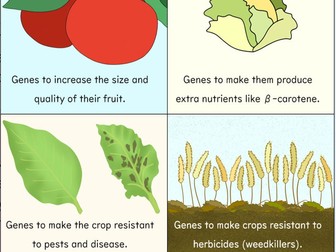
If you use this resource please let me know what you think! Print these slides off in colour and spread them around the room, students can then collect information from the sheet about the different genetically engineered organisms. I think this is a good activity to illustrate the wide variety of ways that organisms can be genetically engineered.
Genetic Engineering and Cloning - Ethical Dilemma - Agree or Disagree?Quick View
sam_512

Genetic Engineering and Cloning - Ethical Dilemma - Agree or Disagree?

(0)
This lesson is looking at Genetic Engineering and thinking about ethics as well as reasons to agree and disagree with Genetic Engineering. GM crops and Cloning. This lesson is following the British Curriculum. Within the 1 hour lesson (which can easily be adapted to be longer) caters for differing learning styles with a range of differing activities to target specific skills. All students seemed to enjoy the lesson and the activities within. The lesson is created with differing students in mind to allow all students to succeed and develop their geographical and wider knowledge. This lesson is easy to follow even for non-specialist teachers and can easily be adapted to increase challenge or to suit a nurture curriculum. All hand-outs are attached or within the PowerPoint. Enjoy.
WJEC Unit 3 Engineering revision booklet (for students)Quick View
Helen467

WJEC Unit 3 Engineering revision booklet (for students)

(0)
A booklet which covers all of the theory topics for best peparing students for unit 3 success on the WJEC level 2 Engineering course. The booklet breaksdown into the following topics: Effects of Engineering Achievements Introduction to Engineering Industry Environmental Issues Properties of Engineering Materials Industrial Material Testing Metals Polymers Composites Smart Materials Electronic Components Engineering Processes Measuring & Marking Joining Metals Cutting Metals Surface Finishes Coatings Industrial Processes CAD/CAM Solve Engineering Problems Use of Formulae Areas & Volumes
Human Genetic EngineeringQuick View
waynesworld015

Human Genetic Engineering

(7)
A lesson I created on Human Genetic Engineering. Let me know what you think. (I did use a variety of sweets instead of play-doh for starter - along with cocktail sticks and marshmallows)