This is a set of slides highlighting why we shouldn’t waste food and what it means to be malnourished.
The first few slides show how much a certain food is wasted in the UK each year and what this is equivalent to in weight. It then goes on to explain why wasting food is bad.
The rest of the slides explain what malnutrition is and what we can do to avoid waste and eat a healthy diet. There is also a final prayer slide if needed.
The entire presentation invites pupils to contribute answers and get involved and includes some interesting facts and information.
Perfect for world food day or simply highlighting the need for better diets and how to be a better citizen.
NB - world food day date can be changed
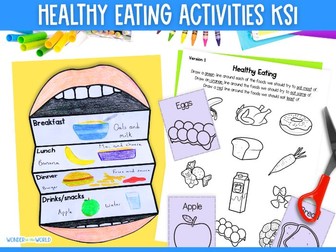
Teaching children about healthy eating and dental health is vital for their physical and mental wellbeing. This set of KS1 printable activities is designed to be used to support a healthy eating or myself topic.
My one-day food diary
This activity sheet is designed for children to keep a record of everything they eat in a day. Once complete, they cut out the template and fold it to create a mouth that closes, then opens to reveal their food diary inside. Use to encourage discussions about healthy choices.
Healthy food choices worksheet
Children identify which foods we should eat most, some, and least of. This includes a version for vegetarians and for vegans.
Food sort activity
Print out the 5 group labels (fruits, vegetables, grains, dairy, and protein), and the 27 food cards (8 to a page). Cut them out. Children can match the food cards to the group they belong to. Colour and black and white options included.
**Keeping my mouth healthy **
This activity sheet uses the same mouth design as above. Use as an opportunity to discuss good oral health. Children colour and cut the template, then fold it to create a mouth.
Please note, this 14-page PDF is not editable. US and UK versions are included.
Worksheets based on Wayland’s Popcorn series Good Food - 4 books introduces children to the foods they eat each day. Also covers: Growing Plants; Health and Growth and Plants in the environment. A photocopiable worksheet is available for each book that enables you to ensure that the children have grasped key ideas. Use the worksheets in a guided reading session, for topic-based group work or for homework.
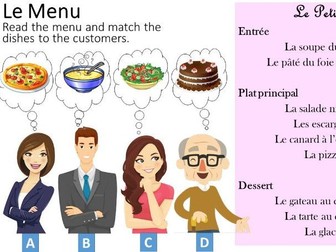
A series of 4 lessons on PowerPoint about food and eating out t in French. Lesson 1 - eating in a restaurant, lesson 2 - describing food, lesson 3 - healthy/unhealthy eating, lesson 4 - going to the supermarket. Resource contains Listening, Reading, Speaking and Writing tasks and has grammar explanations. An interactive lesson with lots of cultural references and a variety of skills used. Aimed at Y9 or Y10 but could be adapted for younger years.
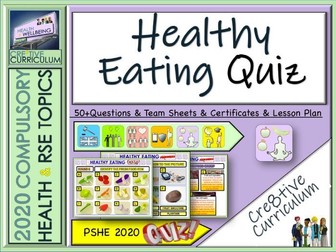
The Big Healthy eating Quiz - Fun Premium High Quality Quiz, Lesson PowerPoint on a variey of PSHE topics related to HEalthy eating suitable for upper KS2 or lower KS3.
Can be used alongside our 'HEalth & Wellbeing ’ PSHE 2020 Cre8tive Curriculum Core Theme
Contents of Quiz Resource
1 x 32 Slide Editable PowerPoint Quiz - (All the 50+ questions in 9 different fun and varied rounds. Followed by all the Answers and a Creative Tie Breaker)
1 x Lesson Plan (matched to PSHE Association Core themes & Links and DFE Statutory Guidance)
1 x Team Answer Sheets (print 1 per team for students to record their answers)
1 x Set of Optional Award Certificates (1st, 2nd and 3rd place team and Team leader Certificates)
1 x Extension PPT of Mindfulness activities for students.
1 x PowerPoint slide signposting extra online support for students & Teachers related to this topic.
Some PSHE Departments use this resource as an assessment opportunity or AFL.
Product Code RSE/C8/QZ/98
Check out some more of our most popular resources:
☞ MISOGYNY ANDREW TATE + TOXIC MASCULINITY UNIT
☞ Masculinity + Misogyny Explored (Ks4)
☞ Boys to men - Masculinity (Ks3)
☞ PSHE Masculinity + Men (Ks5)
☞ What is Toxic Masculinity? (Ks3)
☞ Incels Extremism Misogyny (Ks4) (Ks5)
☞ Sexism in society (Ks4) (Ks3)
☞ What is Feminism? (Ks4) (Ks3)
☞ Sexual Harassment (Ks4)
☞ Dealing with anger and Frustration (Ks3) (Ks4)
A bundle of 9 worksheets on the topic of Food for French GCSE/KS3 which will support pupils to talk about the food they like and eat in the present, past & future tenses.
Resource 1: Introducing types of food and the partitive article
Resource 2: Food routine and adverbs of frequency
Resource 3: Food and the immediate future tense
Resource 4: Types of food & cuisine and preferences
Resource 5: Adjectives and describing food
Resource 6: Food and le passé composé
Resource 7: A scaffolded writing task and model answer on food (past, present and future)
Resource 8: A revision worksheet on all aspects of this topic.
Resource 9: 4 pages of writing activities on food and fast food and a longer GCSE writing question with a model answer.
Format: Word and PDF documents with answers.
This 33-slide lesson explores Patience Agbabi’s poem, ‘Eat Me’.
Students begin by discussing key ideas around the relationship between sex and food and society’s beauty standards. We then learn about Agbabi’s work before delving into the poem and establishing its narrative.
The lesson then guides students methodically through extensive key ideas related to the poem, including title analysis; intertextual allusions; analysis of language; and analysis of form, structure, rhythm and rhyme. The nature of the dramatic monologue as a form is also discussed, before looking closely at some of the poem’s key images and the use of repetition. Each character in the poem is then dissected, while also looking at key symbols in the poem (eg. the cake, the bed). We also discuss the poem’s colonial undertones.
Students are given a list of key themes and key vocabulary to facilitate high-level analysis. There are then some important questions for students to answer once they have explored the whole poem, and a list of potential poems which could be used to compare to ‘Eat Me’ to strengthen comparative analytical skills.
This resource is particularly useful for those studying ‘Poems of the Decade’ with Pearson, but could easily be used for any purpose.
Two files are included: one has the PowerPoint saved as a PDF so that the fonts and layout are firmly in place; the other is saved as a normal PPT file so that you can edit it.
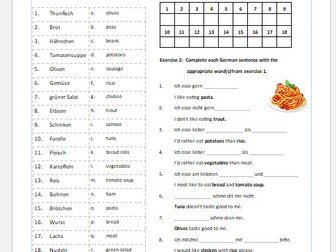
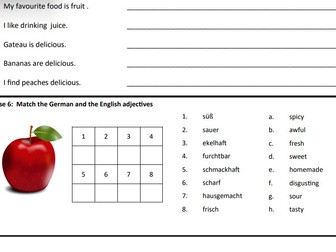
A four-page worksheet with answers practising commonly used German GCSE food and eating out vocabulary. Could be used for revision, consolidation, homework or cover.
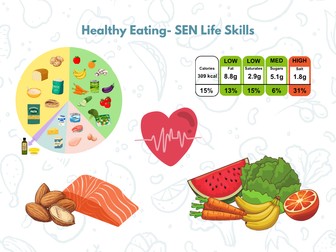
Healthy Eating SEN Life Skills | Functional Skills | Healthy Choices, Food Labels, Diet & Nutrition
Help SEN learners understand healthy eating, food labels, and making good choices at home, when shopping, and when eating out. Perfect for teenagers and young adults with special educational needs, and for learners working towards Functional Skills qualifications.
This engaging, accessible module includes reading comprehensions and interactive activities on:
Healthy cooking and eating
Calories and weight management
Heart health and blood pressure
Sugar and your health
The traffic light system on food packaging
Fast food and eating out
Authentic, real-world language is used throughout to give learners practical experience with everyday health and food-related information. Each section encourages discussion, reading comprehension, and decision-making through realistic life skills tasks.
A clear, easy-to-use glossary supports key words and vocabulary development.
Skills developed:
Making healthy food choices at home and when eating out
Reading and understanding menus and food packaging
Understanding calorie information and portion sizes
Reading and interpreting health information
Building independence and confidence with real-world food choices
Most text is set in a dyslexia-friendly 14pt font for improved accessibility and readability.
4 pages of activities on the topic of food and eating out with answer sheets useful for giving as homework or cover work to practice, consolidate or revise vocabulary for this topic.
A collection of photos that I took for my students as we learnt about food, nutrition, and the human body, including where the food we eat comes from.
Please leave me a review and I will send you any other resource of your choice for free (contact me: office@oceansproject.com). Check out my other resources at my shop: https://www.tes.com/teaching-resources/shop/sarah277
Let me know if you have any resource requests and I will tailor make a resource for you.
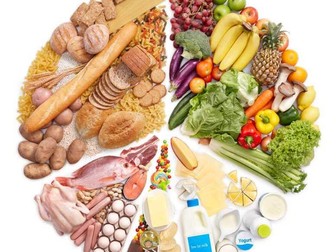
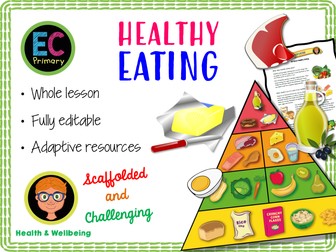
An introduction to the food pyramid and healthy eating. PPT has 12 slides with an activity at the end. Suitable for younger students as part of a personal care/social education lesson.
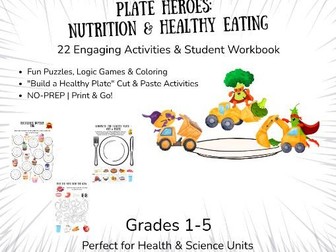
Make nutrition fun with the “Plate Heroes” – 22 Engaging Activities for Healthy Eating!
Description:
Help your students discover the power of healthy food with this comprehensive, no-prep workbook! Designed for students aged 6–11, “Plate Heroes” turns learning about nutrition into an exciting adventure full of puzzles, logic games, and creative tasks.
What’s Inside?
22 Diverse Activities: From “Build a Healthy Plate” to “Superfood Search.”
Logic & Fun: Crosswords, matching games, sequencing, and coloring pages.
Teacher-Friendly: Perfect for Health class, Science units, or morning work.
This is the second lesson in the diet and nutrition unit and focuses on healthy meal choices, calories and food labels.
The lesson has a introduction, learning objectives, retrieval task, starter task, main content, challenge questions, plenary task, summary and extension task.
The lessons are aimed for teachers delivering the new RSHE / PSHE curriculum.
Themed words to improve vocabulary power.
Helps improve writing skills by equipping students with a wide range of words.
Serves as an enrichment for students.
Healthy eating PSHE Lesson. A one-hour long, very detailed, fully resourced PSHE lesson suitable for KS2. This lesson has been created for Year 3, however, the contents of the lesson are suitable for students across KS2.
In this lesson, the students will learn about healthy eating and the different types of foods that we need to eat to keep ourselves healthy. We will discuss the main food groups: carbohydrates; proteins; fats; fruit and vegetables, and why our bodies need them.
We will also discuss appropriate quantities for each type of food with the help of a healthy food pyramid. The lesson includes an information sheet, a video clip task, a food pyramid puzzle activity, a reflection activity, and a debate plenary task.
The lesson has been left editable and is filled with engaging, well differentiated and fun activities. It is designed to be ‘no prep’, so you can just pick it up and use it, although it is still adaptable should you wish to.
Who are EC Resources?
EC Resources are the top TES PSHE providers and are a group of teachers who work together to create easy to use, high quality and editable lessons and units of work. We have created lessons for The Children’s Commissioner, The Bank of England, MACS Charity, Tes, LikeToBe Careers, the Criminal Cases Review Commission (UK Gov) and have also completed PSHE and Citizenship commissions for schools across the UK.
You can contact us at info@ecpublishing.co.uk
Teaching PSHE, RE or Citizenship GCSE next year? Why not join our Citizenship and PSHE teachers Facebook group, with 8000 other teachers, for guidance, advice and resource sharing.
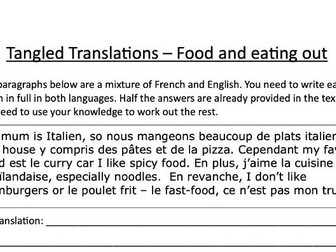
A worksheet to practice translation skills both from French to English and English to French. Ideal for cover, homework and revision. Answers included.
The worksheet contains two ‘tangled translations’ about food and eating out where the text is written in a mixture of French and English. Pupils must write the full translation for both languages.
Year 8 food rotation project
7 weeks (but could easily run over to 8-9 weeks)
Including:
A booklet with all tasks and teaching marking
Lesson by lesson power points (Lesson 1-7)
Recipies including:
STIR FRY
HEALTHY BURGERS
SPINACH AND CHICKPEA CURRY
CHILLI
Recipies include method, equipment and ingredients.