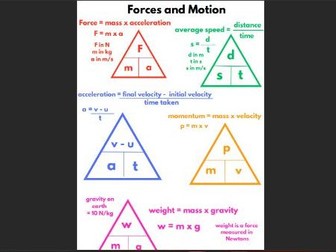
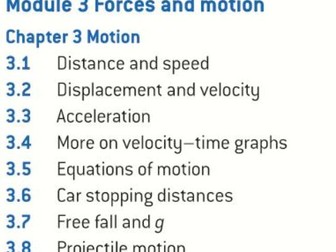
A complete bundle for the Smart Activate 3 topic Forces and motion. Includes lessons:
Reactivate
Forces and interactions
Mass, weight and fields
Speed, distance-time graphs
Balanced and unbalanced forces
Resultant forces
Acceleration and Speed-time graphs.
This pack of materials consists of nine worksheets and fully worked out answers.
Resultant Forces
Forces and Motion: Distance Time Graphs
Forces and Motion: Velocity Time Graphs
Forces and Braking
Forces and Terminal Velocity
Forces and Elasticity
Forces and Energy: Potential Energy
Forces and Energy: Kinetic Energy
Momentum
They have been designed to match the needs of the AQA Physics GCSE syllabus for the first half of module P2, but could be used with any GCSE Physics syllabus or appropriate unit from GCSE Double Science. They are suitable for use in class or as homework. They cover the areas of forces, motion and energy.
Each worksheet contains the relevant equation/s to complete the work, so that students should find the tasks accessible. The focus for calculation questions is on the process of getting to the answer rather than the answer itself. (Many answer guides or mark schemes simply quote the correct answer without the details to help a struggling student see how it was achieved).
My aim is to produce five more units of similar materials to complete the Physics GCSE. I would appreciate any feedback, errors or omissions to help me with this work going forward.
Lessons from the 9I unit in the new Exploring Science scheme of work all about forces and motion.
Including lessons for:
9Ia Forces and Movement
9Ib Energy for Movement
9Ic Speed
9Id Turning Forces
9Ie More Machines
*Some of the lessons have references to worksheets from the ActiveLearn but could be replaced with other worksheets or omitted from the lesson completely.
*
These task cards are a great way for students to improve their skills and knowledge of force and motion.
This product contains 24 cards with multiple choice questions about the different topics and concepts within force and motion. A recording sheet and an answer key are included. Blank cards are also included for questions to be added, if wanted. The same 24 cards are also available as open ended questions.
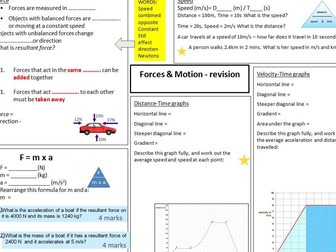
Forces revision resource with answers. . This resource should be printed on A3 paper.
All the other GCSE revisions mats are available as a bundle for £4:
OCR AS level Physics: Forces and Motion is a part of the Module 3: Forces and Motion.
All presentations come with worked examples, solutions and homeworks.
These are fully updated PowerPoints will all exercises with full worked solutions.
A presentation suitable for KS4 looking at forces and the laws of motion. Presentation includes multi-choice questions to engage students and get them thinking about the subject throughout the presentation.
Learning Objective(s):
Use the laws of motion to calculate forces.
Main Skills: Interpret written text and diagrams and perform calculations.
Duration: Approximately 45 mins
37 slides covering:
• Newton’s First Law of Motion
• Newton’s First Law of Motion - Inertia
• Newton’s Second Law of Motion
• Using Newton’s Second Law
• Newton’s Third Law of Motion
• Putting it all Together
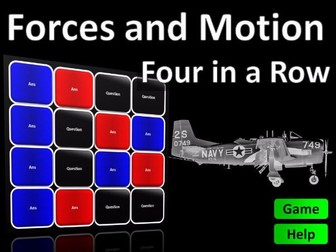
An exemplar FREE Four in a Row game on Radioactivity is available to try before you buy.
Four in a Row games on six other physics topics are available individually from my shop or as a bundle at a greatly reduced price.
Four in a Row is a game for your whiteboard. Nothing needs to be printed or prepared to play this game. The game-play is somewhere between noughts and crosses and blockbusters. Two teams alternate, competing to correctly answer questions on the grid. The board is interactive - clicking tiles changes the colours and also reveals answers.
Forces and Motion Four in a Row is designed primarily for GCSE Physics/ Combined Science courses but may be useful elsewhere.
Set of PowerPoints lessons to teach the EdExcel Physics topic 2 Forces and Motion.
These lessons go through;
Motion graphs
Newtons Laws
Weight
Stopping distance
Circular motion
Inertia
Momentum
Lesson 1 and 2 are free on my account
This FORCE AND MOTION BUNDLE bundle contains two resources:
Force and Motion PowerPoint
Force and Motion Flipbook
************************************************************************
FORCE AND MOTION FLIPBOOK
Force and motion is made easy with this resource All About Force: A Flipbook on Force. This packet is a 20-page resource that consists of foldables/templates that can be used to create a flipbook on force and motion. It can be used to summarize your students' key learnings or understanding.
Page 3 contains an Introduction.
Pages 4 -8 show the different parts of the force and motion flipbook:
*Cover
*Pages 2-5
Pages 9-13 feature the ready-made templates that you and your students can use to create your own flipbook on force and motion.
Page 14 contains the Credits.
Page 15 focuses on the Terms of Use.
Note: I came up with this flipbook to help my students summarize what they have learned about force and motion. I understand that not all Science classes are the same, but the sample work reflects the key learning by my fourth grade students for the term. I included an editable copy that you can modify if you wish to. However, take note that I used the font KG Miss Speechy. You would need to download this from Kimberly Geswein's store if you want the same font. I hope this force and motion resource suits your needs.
************************************************************************
FORCE AND MOTION POWERPOINT
"All About Force" is a PowerPoint presentation that can be used to learn about force and motion.
The 41-slide PowerPoint presentation on force contains a cover; a title page; 4 slides for Words to Know; 29 slides discussing what force is; what friction is, what it does and examples of what friction does; what gravity is and why it is important, and what push and pull are, and examples of these two forces; and 6 True or False questions.
This force and motion resource can be used as a whole lesson, starting from unlocking vocabulary, discussing key understandings about force, and assessing students' learning about force. You and your students will surely have a fun time with "All About Force".
Note: This force and motion resource is a PowerPoint file. Transitions and animations can be edited, as well as the fonts used.
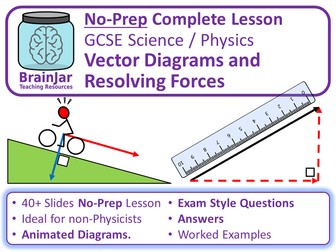
Complete No-Prep lesson with exam questions, tasks and answers on Vector Diagrams and Resolving Forces for AQA GCSE (9-1) Science / Physics. This lesson covers the second part of AQA GCSE Physics 4.5.1.4 / Combined Science 6.5.1.4 and is for higher tier students only.
As a Secondary Science teacher, Deputy Headteacher, writer and examiner for many years I make high quality no-prep lessons so busy teachers can teach outstanding lessons without spending hours planning. This high quality lesson includes explanations, different types of in-lesson assessment (all with answers) and unique exam questions.
My lessons are ideal for non-Physicists - as a Biologist who retrained as a Physics teacher I know how to take learners on a journey that builds up their understanding step by step, while still going into a lot of depth. The preview video shows a representative sample of slides from the resource so that you get a good idea of what it includes before you buy.
What’s Included:
• Teaching notes
• Starter / Do Now Activity
• Explanation slides in “chunked” sections with animated diagrams.
• Worked examples of calculations / questions.
• Multiple questions in different question styles and difficulties - no need for worksheets. Each “chunked” explanation section typically includes a set of “learning check / quick questions” followed by a set of in-depth questions on the learning from that “chunk” of the lesson. All questions have answers.
• Exam-style questions on the whole lesson at the end of the lesson- these are unique, based on real exam questions but not just copied from exam boards.
• Answers for all questions
• All easily editable to adapt to your teaching or to use in existing lessons.
• Slightly humorous, at points, if you like that sort of thing.
The lesson was written for AQA GCSE Science / Physics but is very likely to be applicable to other exam specifications.
Please leave a rating / review and all other feedback gratefully received!
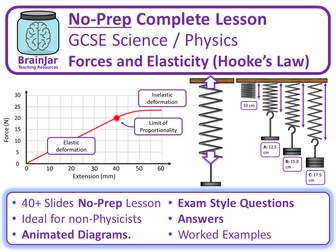
Complete No-Prep lesson with exam questions, tasks and answers on Forces and Elasticity (Hooke’s Law) for AQA GCSE (9-1) Science / Physics. This lesson covers GCSE Physics 4.5.3 / Combined Science 6.5.3.
The lesson covers:
Stretching, bending, compressing.
Elastic and plastic, elastically deformed and inelastically deformed.
Calculating extension
The limit of proportionality
Hooke’s Law Equation
Calculating spring constant
Calculating Elastic Potential Energy
As a Secondary Science teacher and Deputy Headteacher for many years I make high quality no-prep lessons so busy teachers can teach outstanding lessons without spending hours planning. This high quality lesson includes explanations, different types of in-lesson assessment (all with answers) and unique exam questions.
My lessons are ideal for non-Physicists - as a Biologist who retrained as a Physics teacher I know how to take learners on a journey that builds up their understanding step by step, while still going into a lot of depth. The preview video shows a representative sample of slides from the resource so that you get a good idea of what it includes before you buy.
What’s Included:
• Starter / Do Now Activity
• Explanation slides in “chunked” sections with animated diagrams.
• Worked examples of calculations.
• Editable diagrams and animations which help aid understanding.
• Multiple questions in different question styles and difficulties - no need for worksheets.
• Exam-style questions on the whole lesson at the end of the lesson- these are unique, based on real exam questions but not just copied from exam boards.
• Answers for all questions
• All easily editable to adapt to your teaching or to use in existing lessons.
• Slightly humorous, at points, if you like that sort of thing.
Learning objectives:
Give examples of the forces involved in stretching, bending or compressing an object and explain why, to change the shape of a stationary object, more than one force has to be applied
Describe the difference between elastic deformation and inelastic deformation caused by stretching forces.
Describe how the extension of an elastic object is directly proportional to the force applied, provided that the limit of proportionality is not exceeded using the formula force = spring constant × extension
Calculate work done in stretching (or compressing) using the formula: elastic potential energy = 0.5 × spring constant × extension2
Describe how the work done on the spring and the elastic potential energy stored are equal.
Prepare for the required practical on forces and elasticity.
The lesson was written for AQA GCSE Physics but is very likely to be applicable to other exam specifications.
Please leave a rating / review and all other feedback gratefully received!
Powerpoint covers;
vectors and scalars
speed, distance and acceleration
velocity and position
distance/speed - time graphs
Powerpoint includes;
videos and past paper questions (edexcel)(GCSE/IGCSE)
Powerpoint focuses on edexcel specification
A presentation suitable for KS4 looking at circular motion. Presentation includes multi-choice questions to engage students and get them thinking about the subject throughout the presentation.
Learning Objective(s):
Analyse accelerated motion in two dimensions using circular examples.
Main Skills: Interpret written text and diagrams and perform calculations.
Duration: Approximately 30 mins
23 slides covering:
• Acceleration
• Uniform Circular Motion
• Average Velocity
• Direction of Centripetal Acceleration
• Magnitude of Centripetal Acceleration
• Centripetal Acceleration and Rotation
A presentation suitable for KS4 looking at the effects of force. Presentation includes multi-choice questions to engage students and get them thinking about the subject throughout the presentation.
Learning Objective(s):
Identify the effects of force.
Explore the forces that affect objects and their motion.
Main Skills: Interpret written text and diagrams.
Duration: Approximately 30 mins
22 slides covering:
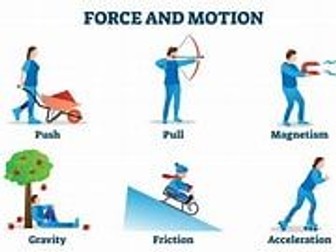
• What is a Force?
• Measuring a Force
• Effects of Force
• Gravity
• Everyday Types of Force
• Types of Force
Two lessons used as revision.
Success criteria-
Identify a range of forces.
Identify the forces acting on an object and represent them with force arrows.
Identify the forces acting on moving objects.
Relate the forces acting, in terms of balanced and unbalanced forces, to different kinds of motion.
A student book to complete, pitched at low ability Year 9 for OCR but suitable to teach Newton's Laws across different specifications.
Three presentations to accompany the booklet.
Some powerpoints were created by a different member of the team and edited by me to fit with the booklet I made (can't claim all the credit!)
A revision resource for Forces and Motion (Year 9), with numerous boxes to for students to independently complete.
Includes gap-fill equivalent and full answers sheet all in one powerpoint.
Originally designed for Edexcel 'transition content' for GCSE science.


 Quick View