Lesson Synopsis: Menu Planning
This lesson introduces students to the key factors involved in menu planning, with a focus on cost management, seasonal ingredient use, and adapting menus for different occasions and customer expectations.
Students will learn how ingredient costs, labor, and overheads influence the pricing of menu items, and why using seasonal ingredients can help keep costs low.
The lesson also explores how menus differ across various settings—such as fine dining, fast food, and catering services like hospitals or schools—based on budget and customer expectations.
Through discussions and scenario-based activities, students will explore how menus are planned for balance, cost efficiency, quality and consider how different occasions, such as weddings or large events, require specific planning to ensure smooth service. By the end, students will be able to outline key menu planning strategies for a variety of settings and occasions.
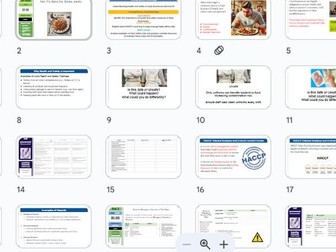
Introduction to HACCP and Food Safety
Understanding HACCP: Managing Food Safety in Food Businesses
Lesson Overview:
This lesson introduces students to the importance of health and safety in food businesses and the role of HACCP (Hazard Analysis and Critical Control Points) in managing food safety risks. Students will explore the 7 principles of HACCP, recognize different types of food hazards, and understand how these principles are applied to ensure safe food handling. Through guided activities, discussions, and critical thinking tasks, students will gain insight into real-world applications of food safety management.
Key Topics Covered:
Why Health and Safety is Important in Food Businesses:
Legal requirements to protect customers.
Examples of safe and unsafe practices.
Introduction to HACCP:
Definition and purpose of HACCP.
Simplified explanation of the 7 principles:
Hazard Analysis.
Determine Critical Control Points (CCPs).
Set Critical Limits.
Monitor CCPs.
Take Corrective Actions.
Verify the System.
Keep Records.
Types of Food Hazards:
Biological hazards (e.g., bacteria in raw meat).
Chemical hazards (e.g., cleaning agents in food).
Physical hazards (e.g., glass or nails in meals).
Practical Applications of HACCP:
Identifying risks in food handling.
Matching hazards to their types.
Real-life scenarios and corrective actions.
Learning Objectives:
All: Identify the importance of health and safety in food businesses.
Most: Explain what HACCP is and describe its 7 principles.
Some: Analyze real-world food safety risks and propose solutions using HACCP principles.
Activities:
Safe vs. Unsafe Practices Worksheet:
Pupils categorize examples of food handling practices as safe or unsafe and suggest improvements.
HACCP Principle Matching Activity:
Pupils match hazards (biological, chemical, or physical) to the corresponding HACCP principles.
Scenario-Based Critical Thinking Task:
Groups analyze food safety risks in real-world situations and present HACCP-based solutions.
Assessment Methods:
Participation in discussions and group tasks.
Accuracy in worksheet and matching activities.
Clarity and depth of scenario presentations.
Resource Summary:
The lesson resource includes:
A worksheet on categorizing safe/unsafe practices.
Simplified definitions and examples of HACCP principles.
A table of food hazards and matching activity.
Scenario cards for group work.
Teacher guidance notes and answer keys for activities.
This lesson provides an engaging and practical approach to understanding food safety and the HACCP system, helping students connect theory to practice.
Ultimate Revision Activities Pack – engaging, interactive worksheets covering every specification point WJEC H&C.
This bundle brings together a complete set of interactive activities designed to save teachers time and help students succeed. Covering all major specification points, this pack includes a wide variety of activity types to make revision structured, engaging, and exam-focused.
Great for independent work, cover, non specialist.
Included activity styles:
Revision Cards – ready-to-use templates to create personalised flashcards
PEE Paragraph Builders – guides to writing strong Point, Evidence, Explain answers
Odd One Out – critical thinking activities to spot links and justify reasoning
True/False – quick-fire checks to challenge misconceptions
Ranking & Diamond 9 – prioritisation tasks to develop evaluative skills
Spot the Mistake – accuracy checks to prevent common exam errors
Cause & Consequence – analytical tables linking causes with outcomes
Keyword Match-Up – vocabulary-focused recall and application
Card Sort / Categorisation – knowledge organisation tasks
Compare & Contrast – structured evaluation of similarities and differences
Misconception Buster – correcting false statements into accurate knowledge
Cloze Notes with Hints – scaffolded recall activities with key vocabulary support
Pros & Cons Grids – evaluative reasoning for balanced arguments
Agree/Disagree Continuum – evidence-based opinion and justification tasks
Mystery Cards – cause-and-effect reasoning activities
Each activity is designed to build essential exam skills such as exam writing practice, tackling extended response questions, improving essay structure, and developing strong writing skills.
These revision worksheets are flexible printable resources, ideal for classwork, homework, or independent learning. They encourage active recall and retrieval practice, ensuring complete specification coverage in a variety of engaging formats.
Teachers benefit from consistent, ready-to-use, time-saving resources, while students gain confidence, independence, and exam-ready knowledge.
Hidden within the creation process, AI helped to create these time saving resources – ensuring they are professional, accurate, and student-friendly.
Suitable for all students, this Ultimate Revision Activities Pack transforms revision into an interactive, effective, and enjoyable process – giving every learner the tools to reach their full potential.
One worksheet per topic per specification points, a huge bundle of worksheets with answers to save you time:
1.1.1 Hospitality and catering providers
1.1.2 Working in the hospitality industry
1.1.3 Working conditions in the
1.1.4 Contributing factors to the success
1.2.1 The ops of the front/back house
1.2.2 Customer requirements in
1.2.3 Hospitality and catering provision
1.3.1 Health and safety in hospitality
1.3.2 Food safety
1.4.1 Food related causes of ill health
1.4.2 Symptoms and signs of food-related
1.4.3 Preventative control measures of
1.4.4 The Environmental Health Officer
2.1.1 Understanding the importance of
2.1.2 How cooking methods can impact on
2.2.1 Factors affecting menu planning
2.2.2 How to plan production
2.3.1 How to prepare and make dishes
2.3.2 Presentation techniques
2.3.3 Food safety practices
2.4.1 Reviewing of dishes
2.4.2 Reviewing own performance
This has been edited using the NEW Unit 1 pass mark of 80, instead of previous 90 marks - If you have purchased before you can re-download for the updated version.
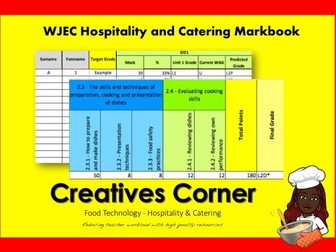
Created to support you with organising student grades on an Excel spreadsheet.
Practicals Tab:
Helps you to keep track of practical lessons.
Simply input a Y or N to record the practicals students have completed.
Assessment Record Tab:
Keeps all students grades in one place across Unit 1 -2.
There are 3 data drop entries for one academic year all formulas have been added to provide the most accurate predictions for end of KS4 grades using January 2025 grade boundaries UMS GRADES ONLY.
Spreadsheets are completely editable should you wish to change the grade boundaries.
**Unit 2 Tracker Tab: **
Helps to calculate final grade based on points gained using the 60% weighting.
This 69 page booklet has been created to support students and teachers with WJEC Hospitality. This is for the entire Unit 2 section of the course. My students complete the majority of this throughout year 10 and then use this as a revision tool in Year 11 prior to the live coursework completion.
It is fully adaptable to your own format if necessary.
Includes:
a contents page
a first year course outline with suggested practical dishes to accompany Unit 1 and 2
a glossary page where students can add key words
Teacher/student feedback pages
Supporting materials will be available very soon.
Enjoy
This 74 page booklet has been created to support students and teachers with WJEC Hospitality. This is for the entire Unit 1 section of the course. My students complete the majority of this throughout year 10 and then use this as a revision tool in Year 11 prior to the Winter or Summer exam series.
It is fully adaptable to your own format if necessary.
Includes:
a contents page
a first year course outline with suggested practical dishes to accompany Unit 1
a glossary page where students can add key words
Teacher/student feedback pages
Supporting materials and a Unit 2 booklet will be available very soon.
Enjoy
Revision Card Maker Bundle – student-friendly worksheets to help learners create their own personalised revision cards for every specification point.
This bundle provides everything students need to design and build their own revision cards, with clear, printable worksheets that guide them step by step. Each sheet prompts learners to record key terms, definitions, symbols, and exam-style questions, encouraging them to actively engage with the content and take ownership of their learning.
Perfect for exam preparation, retrieval practice, and active recall, the worksheets support knowledge retention and full specification coverage. Students can use them as flashcards, knowledge organisers, or quick-fire study cards for independent learning and class revision.
Teachers benefit from ready-to-use resources that save planning time, while students create revision cards tailored to their individual strengths and needs.
Hidden within the creation process, AI helped to create these time saving resources – ensuring they are consistent, engaging, and easy to use across the full specification.
Suitable for all students, these revision worksheets make study sessions more interactive, effective, and personalised – the perfect tool for exam success.
One worksheet for each part of the specification:
1.1.1 Hospitality and catering providers
1.1.2 Working in the hospitality industry
1.1.3 Working conditions in the
1.1.4 Contributing factors to the success
1.2.1 The ops of the front/back house
1.2.2 Customer requirements in
1.2.3 Hospitality and catering provision
1.3.1 Health and safety in hospitality
1.3.2 Food safety
1.4.1 Food related causes of ill health
1.4.2 Symptoms and signs of food-related
1.4.3 Preventative control measures of
1.4.4 The Environmental Health Officer
2.1.1 Understanding the importance of
2.1.2 How cooking methods can impact on
2.2.1 Factors affecting menu planning
2.2.2 How to plan production
2.3.1 How to prepare and make dishes
2.3.2 Presentation techniques
2.3.3 Food safety practices
2.4.1 Reviewing of dishes
2.4.2 Reviewing own performance
This pack of recipes is used to support the teaching of nutrition and life stages as well as providing ideas for Unit 2 linking to skills and the nutritional needs of customer.
These recipes have been used with our Yr 9/10 students as part of a recipe bank that they can they refer to in preparation for their Unit 2 practical exam.
They are based on one hour lessons with pupils working in pairs to help them to understand the demands of practical lessons that use a wide range of preparation and cooking skills. There is a focus on the presentation of each dish at the end of the lesson.
At the end of each half term, pupils are encouraged to choose a dish to cook independently to meet the needs of the consumers in a given brief. At the end of each full term, students in Yr 10 choose two dishes and spend lesson 1 completing mise en place and lesson 2 cooking and presenting all of their dishes.
This is a great way of preparing students for the demands of the Unit 2 practical exam whilst also providing them with a wide range of suitable recipes. It is also a good way to help students understand the range of skills that they are required to demonstrate in order to achieve the higher marks.
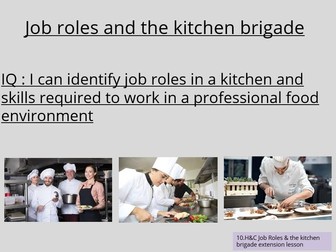
This cover lesson covers the Job roles in the kitchen brigade system Cover lesson fitting in with the specification of the WJEC Level 1/2 Hospitality and Catering qualification. There are starter questions (exam styyle questions) linked to the topic of job roles A video is embedded within the slides and questions for your students to answer with self assessment slides containing the answers. You can upload the slides within teams or Google Classsroom to enable students to add their answers on individual copies .
I have made a booklet for each Hospitality and Catering topic. This booklet focuses on Hospitality Operations. The booklet is fifty-two pages long. It contains the following information:
LO2 Understand how hospitality and catering provisions operate
AC2.1 describe the operation of the kitchen
AC2.2 describe the operation of front of house
AC2.3 explain how hospitality and catering provision meet customer requirements
I have made booklets for other topics including:
Understand how Hospitality and Catering provision operates.
Understand how Hospitality and Catering provision meets health and safety requirements.
Know how food can cause ill health.
Be able to propose a Hospitality and Catering provision to meet specific requirements.
I hope this helps.
Hospitality and Catering Knowledge Assessment
This test is designed to evaluate understanding of key topics covered in the Hospitality and Catering course. It includes questions across various skill levels to assess your knowledge and ability to apply what has been learned in practical and theoretical contexts. The test covers the following areas:
Introduction to the Course and Job Roles – Understanding different roles in hospitality and their responsibilities.
Types of Service – Exploring service styles like buffet, silver service, and family-style dining.
Working Conditions and Standards – Awareness of work environments and how standards and ratings impact the industry.
Food Provenance and Preparation – Knowledge of sourcing ingredients and creating dishes like vegetable soup.
Knife Skills and Practical Cooking – Evaluating your understanding of key kitchen techniques and safe practices.
Menu Planning and Cost Control – Understanding how to design a menu, portion control, and manage costs.
Food Safety and Health – Recognizing safe storage, causes of spoilage, and methods to prevent foodborne illness.
Pastry and Cooking Techniques – Applying knowledge of pastry types, including shortcrust and choux, and understanding heat transfer and the Maillard reaction.
Technology in Hospitality – Identifying how modern tools and systems improve efficiency.
Evaluation and Presentation – Developing the ability to assess and improve the quality of dishes and their presentation.
This is a package of resources (worksheets/crosswords) that you can use to help students remember/revise the different types of hospitality and catering establishments. ANswer sheets included. These could be used as lesson starters, class work or homework activities. They are planned to cover WJEC Level 1/2 Vocational Award in Hospitality and Catering - Unit 1 The Hospitality and Catering Industry. LO1 - Understand the environment in which hospitality and catering providers operate - AC1.1 describe the structure of the hospitality and catering industry. These resources are also great to use when you need a cover lesson.
Lesson Overview:
This Year 10 Hospitality and Catering lesson focuses on helping students understand the essential personal attributes, qualifications, and experiences needed for success in the hospitality industry. Students will explore key attributes such as teamwork, communication, adaptability, customer service, and punctuality, as well as how gaining relevant qualifications and hands-on experience through internships or part-time work can lead to better job prospects and career progression.
Lesson Objective:
Students will identify and explain the importance of personal attributes, qualifications, and experience in hospitality and catering, and understand how these elements contribute to employability and career advancement.
Learning Outcomes:
All students will be able to identify basic personal attributes and qualifications required for hospitality roles.
Most students will explain how personal attributes, qualifications, and experience affect employability and career progression.
Some students will evaluate the significance of these factors in different hospitality roles.
Lesson Resources Provided:
Introduction:
A matching activity where students pair personal attributes (e.g., teamwork, adaptability) with various hospitality roles (e.g., waiter, hotel manager).
Scaffolding Information:
Key points covering the importance of personal attributes, specific qualifications, and relevant industry experience.
Mini Review Task:
“Rank the Importance” task where students rank personal attributes, qualifications, and experience in order of importance for a chosen hospitality role.
Main Task:
Job advertisement creation, where students write job ads for different roles, including the required personal attributes, qualifications, and experience.
Plenary Discussion:
Class discussion on what makes them the “perfect candidate” for a hospitality role, summarizing the key attributes and qualifications discussed in the lesson.
Assessment Questions:
A set of 6 questions targeting different levels of understanding (easy, medium, hard) to assess student comprehension of the lesson material.
Visual Aids and Illustrations:
Images representing personal attributes like teamwork, punctuality, communication skills, adaptability, customer service, and industry-related qualifications.
Key Topics Covered:
The role of personal attributes (e.g., teamwork, punctuality, communication) in hospitality
Industry-specific qualifications and their impact on job prospects
The importance of gaining hands-on experience through internships, part-time jobs, and volunteering
How experience, skills, and qualifications together lead to employability and career advancement
Estimated Duration:
1 hour
This lesson includes engaging activities, visual aids, and differentiated tasks to ensure all students can grasp the concepts, making it suitable for a diverse range of learners in Year 10 Hospitality and Catering.
This bundle of lessons is written for the WJEC Hospitality and Catering Course.
It includes powerpoints, worksheets (which link to the text book), activities and a recall quiz.
It covers Chapters 1-5 in the book. Inc: Food Service, Job roles, Operations, why businesses are successful and dress code
It can all be edited.
I hope that this saves you time.
Supports Spaced Retrieval | Low-Stakes Quizzing | Interleaving Practice | Revision Made Easy
These retrieval grid worksheets are the perfect resource for GCSE and A-Level teachers looking to boost long-term memory, support knowledge recall, and improve exam performance. Ai was used to help make these resources. Each retrieval activity is carefully designed to match the official specification points from leading UK exam boards, making them ideal for Ofsted-ready planning, intervention, revision, and classroom assessment.
What’s Included:
A retrieval grid for every specification point
Covers all major topics from start to finish
4-question format per grid (recall, apply, explain, evaluate)
Editable in Word / Google Docs – fully customisable
Perfect for starter tasks, exit tickets, homework, or weekly revision
Can be used for self-assessment, peer review, or teacher-led quiz practice
Colour-coded or levelled for challenge and differentiation
Ideal For:
Teachers looking to embed retrieval practice and interleaving
GCSE revision resources and A-Level memory boosters
Knowledge organisers in action
Daily Do Nows, lesson starters, and plenary activities
Students preparing for mock exams, end-of-topic tests, and final assessments
One retrieval grid for each part of the specification:
1.1.1 Hospitality and catering providers
1.1.1 Hospitality and catering providers
1.1.2 Working in the hospitality and catering industry
1.1.2 Working in the hospitality and catering industry
1.1.4 Contributing factors to the success of hospitality and catering provision
1.2.1 The operation of the front and back of house
1.2.2 Customer requirements in hospitality and catering
1.2.3 Hospitality and catering provision to meet specific requirements
1.3.1 Health and safety in hospitality and catering provision
1.3.2 Food safety
1.4.1 Food related causes of ill health
1.4.2 Symptoms and signs of food-induced ill health
1.4.3 Preventative control measures of food-induced ill health
1.4.4 The Environmental Health Officer (EHO)
1.1.1 Hospitality and catering providers
1.1.2 Working in the hospitality and catering industry
1.1.3 Working conditions in the hospitality and catering industry
1.1.4 Contributing factors to the success of hospitality and catering provision
2.1.1 Understanding the importance of nutrition
2.1.2 How cooking methods can impact on nutritional value
2.2.1 Factors affecting menu planning
2.2.2 How to plan production
2.3.1 How to prepare and make dishes
2.3.2 Presentation techniques
2.3.3 Food safety practices
2.4.1 Reviewing of dishes
2.4.2 Reviewing own performance
2.4.1 Reviewing of dishes
2.4.2 Reviewing own performance
This lesson explores the roles within the brigade system, focusing on the daily responsibilities, skills, and challenges of different chef positions like the Sous Chef and Executive Chef. Students will reflect on the hierarchy’s importance in kitchen operations. Resources include role descriptions, posing questions, links to support videos, a written reflection activity, stretch it task, mini review and a comparison exercise.
We are trialling a new approach to revision this year and I am seeing some great results.
Give out key knowledge for pre reading ahead of lesson 1.
Lesson 1 - pupils make notes on pre reading knowledge information in books.
Lesson 2- pupils use SEND notes/Battle summary to test each other on key knowledge (speed dating style). If correct, pupils score a point, if not, partner provides answer.
Students revise the key information and are given the questions and answers to revise for homework.
Lesson 3 - pupils complete assessment which is based on the questions and answers provided for the revision homework.
Topics included:
Types of provides
Types of service
Standards and Ratings
This resource includes the following:
An overview of key topic information
Questions and answers (for revision)
A SEND summary version/Battle notes
Blank question sheet for testing/assessment
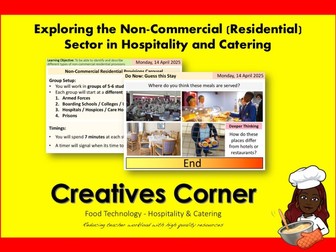
This free 1-hour lesson introduces students to the world of non-commercial residential catering—where food is served not for profit, but to support people in care, education, or service roles.
Students explore four key provision types—the armed forces, healthcare settings, educational institutions, and prisons. Ideal for classroom discussion or carousel activities.
Learning Objectives:
Identify different types of non-commercial residential provision
Understand who they serve and how food meets customer needs
Includes:
Lesson PPT with timings and activity ideas
“Guess the Place” image-based starter
Carousel research task
Plenary Exam question
Homework extension task
Key vocabulary for literacy support
Resources/Worksheets are not included.
An interactive lesson that breaks down the WJEC Hospitality and Catering course to students.
This resource provides a course outline for Year 10 as well as proposed dishes.
Students have a sound understanding of the courses requirements by the end of the lesson.
To deliver this lesson effectively you will need:
Post it notes
WJEC Unit 1 Sample Assessment with Mark Scheme
WJEC Hospitality and Catering - Self Assessment on Course Knowledge and Skills


 Quick View