This bundle includes:
A 13 page revision document containing all the necessary information for the characters. This is organised in a highly useful table. The characters in the document include; King Hamlet/the Ghost, Hamlet, Claudius, Gertrude, Ophelia, Polonius, Laertes, Rosencrantz and Guildenstern and Osric. The table is colour-coded to highlight different performances of the play and critical interpretations which are essential for the part b question.
A essay plan for a part b question on Claudius
A part b 15/15 model essay on Hamlet’s delay
A part b 15/15 model essay on Hamlet and Claudius
A table on the theme of masculinity
These notes were created for my own revision for OCR English Literature A-Level in which I got an A*.
A lesson that walks students through how to plan and structure an OCR English Language Topical Issue response.
‘We need to self-censor our public discourse in order to protect people.’
Write a broadsheet newspaper article, critically responding to this statement.
Includes, debate, talk point, theory, planning essay slide that can be printed as a worksheet and feedback lesson ideas and templates.simplified markschemes.
A selection of OCR extracts which have not appeared on past papers from Act 1, Act 4 and Act 5, ideal for revision, including:
Section A unseen extracts
linked (b) theme/character questions
1 model answer included
Word doc and PDF formats
This bundle includes:
15/15 essay on the similarities between Hamlet and Claudius
15/15 essay on delay
14/15 essay on Hamlet’s treatment of women
Essay plan on Claudius as a King
These essays are for the part b section of the OCR A-Level English Literature Hamlet paper.
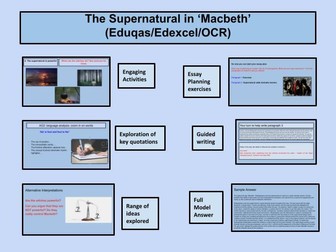
A super clear, colourful 44 slide powerpoint that covers the theme of the supernatural in ‘Macbeth’. This works best as a lesson after the class has read the whole play.
There are plenty of opportunities for students to work individually, in pairs or small groups, depending on the class dynamics. There are sample answers for all tasks and engaging activities which help students improve their skills.
There are guided writing tasks as well to support students.
There is an AQA/OCR style essay question at the end with structured guidance to help the students annotate an extract and plan an answer. There are guided writing tasks as well to support students.
There is a full sample answer at the end.
This lesson takes 1-2 hours, depending on how much writing you ask the students to complete.
My students have found it engaging and really helpful. I hope yours do too!
If you find it useful, please do leave a review and have a look at other lessons and activities in my shop.
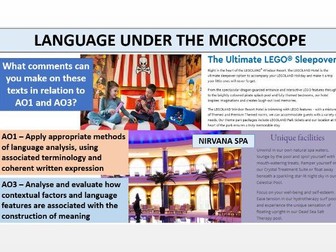
Lessons preparing students for the OCR English Language A Level Paper 2, Question 2 ‘Language in the Media’ question. All lessons linked to AOs and include model answers.
4 ‘Quotation Drills’ with activities to encourage close analysis (AO2) and wider understanding of the text (AO1).
I use these as a revision lesson (1 hour), or starter activites (4 lessons worth of 15 minute each) or homework activities.
Students find incredibly useful.
This is a model essay with annotations. The questions is:
Discuss Rossetti’s presentation of death in 'Remember'
In your answer explore the author’s use of language, imagery and verse form, and consider ways in which you find the poem characteristic of Rossetti’s work in your selection.
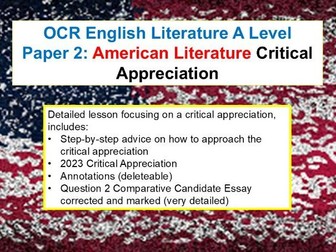
Detailed lesson for OCR English Literature A Level Paper 2: American Literature Critical Appreciation, includes:
Step-by-step advice on how to approach the critical appreciation
2023 Critical Appreciation
Annotations (deleteable)
Question 2 Comparative Candidate Essay corrected and marked (very detailed)
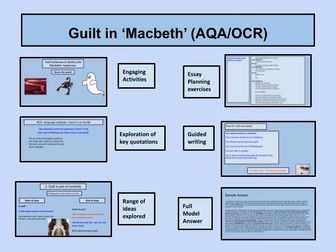
A super clear, colourful 43 slide powerpoint that covers the theme of guilt in ‘Macbeth’. This works best as a lesson after the class has read the whole play.
There are plenty of opportunities for students to work individually, in pairs or small groups, depending on the class dynamics. There are sample answers for all tasks and engaging activities which help students improve their skills.
There are guided writing tasks as well to support students.
There is an AQA/OCR style essay question at the end with structured guidance to help the students annotate an extract and plan an answer. There are guided writing tasks as well to support students.
There is a full sample answer at the end.
This lesson takes 1-2 hours, depending on how much writing you ask the students to complete.
My students have found it engaging and really helpful. I hope yours do too!
If you find it useful, please do leave a review and have a look at other lessons and activities in my shop.
A comprehensive and detailed unit of work taking Y12 students through the non-examination component (coursework). There are plenty of fun, engaging activities. This unit does not reference other publications, so is perfect used alongside a textbook. The unit covers topics, requirements examples, grammar, syntax, lexis, phonology and the ways in which to approach an investigation. Please note, videos have been removed as per TES guidelines but links provided where appropriate.
A super clear, colourful 39 slide powerpoint that covers the theme of the supernatural in ‘Macbeth’.
There are plenty of opportunities for students to work individually, in pairs or small groups, depending on the class dynamics. There are sample answers for all tasks and engaging activities which help students improve their skills.
There are guided writing tasks as well to support students.
There is a full sample answer at the end. Please note: this essay and the activities cover AO2 and AO3. Depending on whether you are teaching Edexcel or Eduqas, you would want to play up or down the AO2 or AO3. None of it is irrelevant- although context is not assessed in Eduqas, good use of it can enhance students’ points. Similarly, AO2 is assessed in the extract question for Edexcel which means the practice of the skills here for the essay question can help students improve these important skills.
This lesson takes 1-2 hours, depending on how much writing you ask the students to complete.
My students have found it engaging and really helpful. I hope yours do too!
If you find it useful, please do leave a review and have a look at other lessons and activities in my shop.
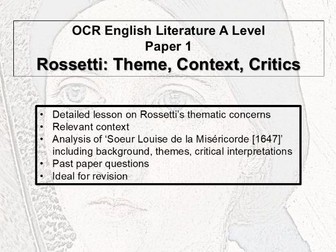
Detailed lesson for OCR English Literature A Level Paper 1 featuring Rossetti’s thematic concerns. Includes:
Relevant context
Analysis of ‘Soeur Louise de la Miséricorde [1647]’ including background, themes, critical interpretations
Past paper questions
Ideal for revision
Complete OCR A Level scheme on The Great Gatsby; context, chapter-by-chapter analysis, AO-focused tasks, and critical perspectives.
A fully resourced scheme of work for F. Scott Fitzgerald’s The Great Gatsby, tailored to the OCR A-Level English Literature specification, but adaptable to other A-Level exam boards. This unit blends detailed textual analysis with rich contextual study, critical perspectives, and exam-focused tasks.
What’s included:
Introductory lessons on the Jazz Age, Roaring Twenties, Prohibition, organised crime, and Fitzgerald’s biography
Chapter-by-chapter PowerPoints for the entire novel (Acts 1–9 equivalent) with guided discussion, close analysis, and AO1–AO5 coverage
Thematic explorations of The American Dream, wealth, class, gender, morality, and symbolism
Detailed contextual studies including women in the 1920s, the Midwest, old money vs new money, realism and modernism, and key historical references
Symbol analysis: the green light, cars, the Valley of Ashes, and the eyes of T.J. Eckleburg
Standalone resources such as Cars in Gatsby, Fitzgerald biography and thematic seminar notes, and a complete critical essay on the perils and possibilities of the American Dream.
Critical interpretations from key scholars woven into lesson materials
AO2-focused close reading activities and model responses
OCR Section B exam guidance, including example questions and essay planning
Ideal for:
OCR A Level English Literature (Component 2: American Literature 1880–1940)
First teaching of The Great Gatsby
Revision and exam preparation
Stretch and challenge for high-attaining students
Why it works:
Designed with OCR assessment objectives in mind, this scheme provides the knowledge, skills, and confidence students need for top-band responses. It balances historical and literary context with opportunities for independent critical thinking, ensuring students can engage with both the novel’s artistry and its social critique.
TES Search Tags:
The Great Gatsby OCR A Level | A Level English Literature Scheme | American Literature | Fitzgerald Context | The American Dream | Critical Perspectives
Comparison notes for help with subject knowledge, discussion, handouts, essay topics, and revision. PDF files. (See free download for an example.)
English literature → A-level → OCR → Paper 2: Comparative and contextual study → The Gothic →
Dracula and Beloved
Dracula and The Bloody Chamber
Frankenstein and The Bloody Chamber
The intellectual and historical context of The Picture of Dorian Gray
Outer Dark
The Picture of Dorian Gray and Dracula
The Picture of Dorian Gray and Beloved
The Wasp Factory
What ‘Gothic’ means
Section B) - The language of poetry and plays
This document includes how to score A* in your essay for Streetcar Named Desire e.g what each paragraph should include , how to weave in context within this etc.
OCR EMC language and Literature
Blake Poems Annotated
All of the poems from the Blake selection annotated.
useful for revision for students- I have mine add their own annotations and try and improve on these.
useful if you have not taught Blake before, can give you a strong overview of the poems and what you should have students concentrate on.


 Quick View