Perfect for Year 6 Teachers. Time-Saving. Professional & Parent-Friendly
This SATs Results Letter Template is the ideal way to communicate pupils’ end-of-Key-Stage 2 assessment outcomes clearly, sensitively and professionally to parents and carers. Designed to save you time during a busy term!
Includes:
Fully editable Microsoft Word document
Clear and parent-friendly explanations of SATs scaled scores
Space to personalise with individual pupil results (Reading, GPS, Maths, Writing Teacher Assessment)
Positive tone that celebrates effort, progress and achievement
Suitable for use on results day or as part of end-of-year reports
Why Teachers Love It:
Saves time writing individual letters from scratch
Maintains a consistent, professional tone across all letters
Helps support conversations with families about results and next steps
Easily customisable for your school tone and policies
Who It’s For:
Year 6 teachers and leaders
UK primary school staff preparing for SATs result day
Schools wanting a clear and supportive way to share KS2 outcomes
File Type: Editable Word Document (.docx)
Page Count: 1-page letter (fully customisable)
Space in the footer to include your own school logo/details if needed.
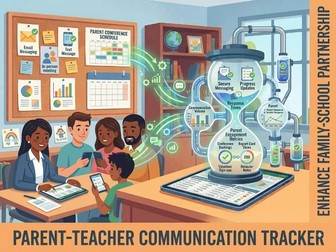
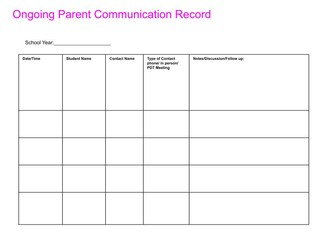
This is a document to keep track of each parent communication. This is a great way to help you remember and build that positive relationship with parents.
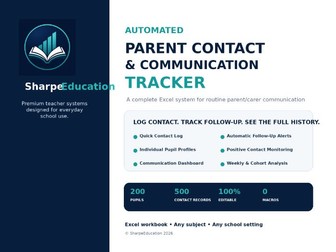
Keep a secure, professional, and chronological record of all home-school interactions with this comprehensive Parent-Teacher Communication Tracker. Built to reduce administrative friction, this template automatically formats your contact notes into professional summaries and follow-up actions.
Key Features:
Dynamic Communication Log: Easily record contact dates, communication types, stakeholder initiation, categories, and outcomes.
Auto-Generated Summaries & Next Steps: Built-in formulas instantly generate professional summary sentences, suggested follow-up actions, and next-review dates based on issue repetition.
Customisable Phrase Bank: Tailor the built-in template text to match your school’s tone and communication style while preserving automated tag insertion ({Name} and {Date}).
Student Summary View: Review pattern flags and total contact counts for individual students to prepare smoothly for pastoral meetings or report comments.
Macro-Free Reliability: Operates entirely on transparent Excel formulas without external add-ins.
Protect your workflow, maintain compliance with student data management practices, and ensure no home-school communication slips through the cracks.
A practical 44 page Parent Partnership & Communication Toolkit for Early Years settings, designed to support clear, respectful and consistent communication with families.
Created from real nursery practice, this editable toolkit is designed for nursery managers, room leaders, key persons and practitioners who want simple, usable systems for working in partnership with parents and carers.
The pack includes practical templates, prompts and records covering:
�� Parent communication preferences
• Key person partnership
• Family information and home knowledge
• Home languages and communication needs
• Daily handovers
• Significant handovers
• Parent meeting notes
• Follow up actions
• Parent voice and feedback
• Difficult conversation preparation
• Concerns and sensitive discussions
• Communication records
• SEND partnership with families
• Settling and transition conversations
• Reception transition preparation
• Parent information sharing
• Communication audits
• Worked examples
FILES INCLUDED:
• 44 page print ready PDF
• Fully editable Microsoft Word version
Designed for nurseries, preschools and Early Years group settings.
This resource is intended as practical support for Early Years settings. It does not replace the EYFS statutory framework, safeguarding procedures, local authority guidance or professional judgement. Settings remain responsible for checking that their own communication, confidentiality and information sharing procedures meet current requirements.
Current version: October 2026
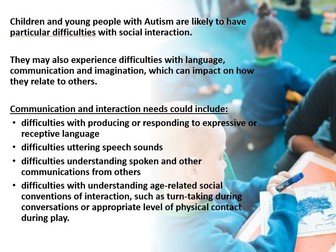
A comprehensive training PowerPoint for ‘communicating with parent/carers’ this will help improve the confidence of staff for dealing with parental/carer communications.
The Powerpoint can be edited to reflect your settings context.
This would be suitable for a whole school INSET, twilight, ECT training session or useful as a basis for a project for aspiring middle leader/senior leaders.
For more information, visit my instagram page @inclusiontrainingforall
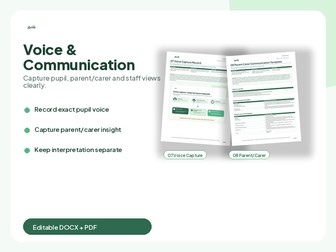
A practical pupil voice and parent communication pack for SEND evidence in primary schools.
This pack helps staff capture pupil, parent/carer and staff views while keeping exact words, adult interpretation and next steps separate.
It is designed for low-pressure pupil voice, parent/carer conversations, SENCO discussions, APDR evidence and inclusion reflection.
What’s included:
Editable Word DOCX files
Print-ready PDF files
Voice capture record
Parent/carer communication template
Documents included:
07 Voice Capture Record
08 Parent Carer Communication Template
This pack helps staff:
Capture pupil voice clearly
Record parent/carer insight
Keep exact words separate from adult interpretation
Identify practical next steps
Support SENCO and APDR conversations
Gather useful classroom-level evidence
This is useful for teachers, SENCOs, pastoral staff, inclusion leads and family-facing staff who need a clear structure for SEND-related voice and communication evidence.
Please note: These documents are also included in the full Learnella Include SEND Audit & APDR Toolkit.
This resource is not a diagnostic tool, legal document, risk assessment or safeguarding procedure. It supports reflective inclusive practice and classroom-level evidence gathering.
A short form to record notes from phone calls, emails or meetings with parents. I have found it very useful to keep track of and recall communication with parents.
Also a second form to help plan communication with Parents and record discussion highlights and action points.
Hope you find it useful,
Feedback welcome on resource.
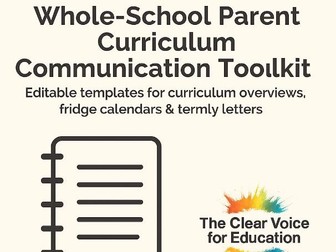
A calm, professional toolkit to help schools communicate clearly and consistently with parents across the year.
Created by a UK headteacher, this editable pack includes ready-to-use templates designed to save time while improving home-school engagement.
What’s included:
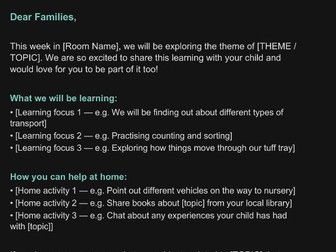
“What is my child learning this term?” template
Example version for Year 1
Annual parent-facing curriculum and enrichment overview
Editable “Dates for the Fridge” calendar
Template wording for school website or termly letters
Ideal for:
Headteachers and deputies
SLT, admin and office staff
Class teachers writing parent updates
All documents are in Word and fully editable.
Created by The Clear Voice for Education — practical, time-saving tools for school leaders and teachers, built from real experience in UK schools.
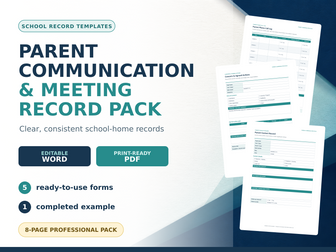
Parent Communication and Meeting Record Pack featuring five editable school-home communication templates, a quick-start guide and a completed example.
Designed to help teachers and school staff maintain clear, consistent and organised records of parent and carer communication.
WHAT IS INCLUDED
• Parent Contact Record
• Parent Meeting Notes
• Concern & Agreed Actions Record
• Follow-up Record
• Parent Phone Call Log
• Quick Start Guide with clear instructions
• One completed example
FILES INCLUDED
• Editable Microsoft Word document
• Clickable checkboxes in Microsoft Word 2010 or later
• Print-ready PDF document
• 8 pages in total
• 5 ready-to-use record forms
• 1 completed example
COMPATIBILITY
The editable DOCX file is designed for Microsoft Word 2010 or later. Compatibility with versions earlier than Word 2010 is not guaranteed.
The PDF version can be opened using Adobe Acrobat Reader or another standard PDF reader and is intended for printing. The PDF is not an editable Word document.
The Word version allows users to enter their own information, select or clear checkboxes, customise the wording and print additional copies as required.
Ideal for recording parent contact, meetings, agreed actions, follow-up conversations and telephone calls in a consistent format.
Please follow your school’s data-protection, safeguarding and record-retention policies. This resource is an organisational template and does not provide legal or compliance advice.
Parent Communication Templates – Ready-Made Scripts, Emails & Behaviour Messages- forms part of our SEMH bundles.
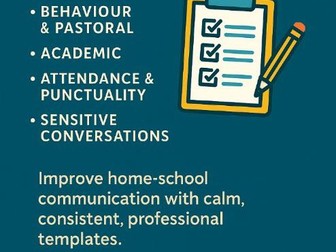
Improve home–school communication with calm, consistent, professional templates.
This pack contains a full set of editable parent communication templates designed to save teachers time while ensuring messages are clear, supportive and consistent.
Perfect for behaviour updates, praise messages, attendance concerns, academic feedback, meeting arrangements and sensitive conversations.
These templates follow a calm, neutral and non-confrontational tone that helps maintain positive relationships with families — even during challenging situations.
What’s Included
A full collection of templates for:
Behaviour & Pastoral Communication
Low-level behaviour reminder
Repeated concerns
Positive behaviour praise
Restorative follow-up message
Notification of removal / referral
Academic Communication
Missing work / incomplete homework
Poor effort or focus
Praise for progress or attitude
Requests for support at home
Attendance & Punctuality
Late arrival follow-up
Attendance concern message
Escalation stage communication
Sensitive Conversations
Emotional wellbeing concerns
Friendship issues
Social difficulties
Start-of-term check-ins
Preparing for meetings with parents
Meetings & Phone Calls
Requesting a meeting
Confirming details
Professional call script
After-meeting follow-up
General Templates
First contact
Newsletter-style updates
Positive shout-outs
Achievement postcards
Why Teachers Love This Resource
Saves hours of drafting messages
Ensures calm, predictable and consistent language
Reduces miscommunication and tension
Suitable for all staff, including ECTs and pastoral teams
Fully editable to match your school’s tone
Perfect For:
Class teachers
Pastoral & behaviour staff
Form tutors
ECTs needing confidence with wording
SEN/SEMH communication
Whole-school behaviour systems
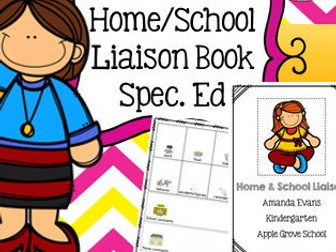
This is an editable communication book (although you can not edit/extract clipart - these are protected to reserve the rights of the fantastic clip artists), for you to be able to communicate with students families/carers back and fore School and home, keeping everyone up to date on student(s) individual progress, behaviors/behaviours, moods etc. You can add text and change text for different parts of the home/school book. It comes in PDF (non editable), Keynote (editable) and Powerpoint (editable) options for your preference.
It comes with British & American spellings.
This is especially great for a special education class, the pages come as the following;
♦ choice of covers
♦ staff in class, students in class
♦ weekly planner
♦ daily conversation page
The daily conversation page is laid out with different boxes and two comment boxes; one for school to fill in and one for parents to fill in.
This is a maths booklet to help parents when aiming to support their child. It is a great resource to send home with children at half terms or during the summer holidays. Through using the National Curriculum for Year 2, I produced a detailed booklet on how parents can support their child in key areas of the curriculum (addition, subtraction, multiplication, division, problem solving, place value, geometry and many more). Feedback from parents has been great as they said it helped increase their own subject knowledge providing them with the skills to support their child further. The booklet also includes ways to make maths fun in real-life contexts.
A 24 slide lesson achieving the following objectives:
By the end of this session you will be able to:
Define Parental Care
Explain the Different Forms of Parental Care
Give Example of Species which use the Different Types of Parental Care
Every difficult parent meeting you dread is costing you confidence, energy, and trust you cannot afford to lose.
This prompt deploys a world-class educational communication specialist directly into your workflow, delivering conflict resolution frameworks, word-for-word language scripts, emotional regulation strategies, and a full 30-60-90 day mastery roadmap calibrated entirely to your profile.
Stop surviving parent meetings. Start leading them with the precision, warmth, and strategic skill that builds lasting home-school partnerships.


 Quick View