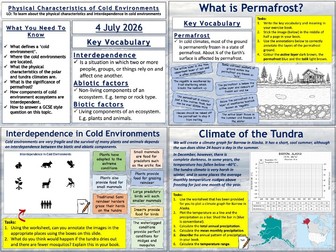
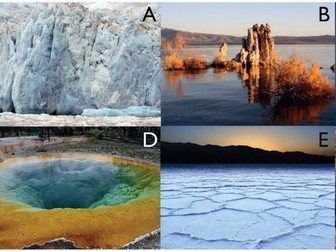
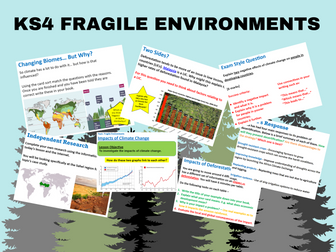
8 part lesson series for the whole of the GCSE module People and the Biosphere. This is first unit in the module to be taught alongside Forests Under Threat and Consuming Energy Resources. Specifically designed for the new Edexcel Geography GCSE but also suitable for AQA and OCR. All lesson are for 50 minutes to 1 hour of teaching time. Includes supporting worksheets for lessons - no additional resources are required.
All lessons have a starter and lesson aim. Extension tasks and homework also included. All PowerPoints in the same signature style.
Lesson sequence:
1 - Biomes
2 - Local factors and biomes
3 - How does change affect ecosystems?
4 - Desert biomes (hot and cold)
5 - Challenges in a biomes
6 - Development in a biome
7 - Sustainable management of the world
8 - Population vs resource theories
**If you have previously purchased my GCSE 2016 unit 5 and 7 resources, please get in touch if you are interested in upgrading to this new version. **
In this digital product:
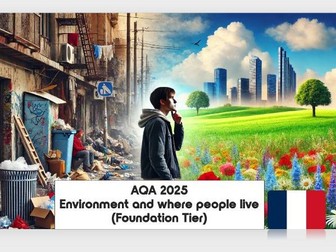
You will find everything you need to teach Topic 9: The Environment and Where people live (third topic of Theme 3 of the new GCSE course (with AQA): Communication and the World around us.)
The Presentation (approx. 190 slides, including answer slides) covers the whole topic and is composed of 4 parts:
A: Where people live
B: My local area
C: Social and Environmental issues
D: Possible solutions
There are 4 folders (A, B, C and D) containing the relevant files for that part.
It includes:
• a range of Listening, Speaking, Reading, Writing and Translation activities
• grammar points including: Revision of present, perfect, imperfect, near future and future tenses.
• Revision of most elements of phonics
• retrieval activities, cultural aspects and homework tasks
• QR codes/ links for independent study
• vocab lists (full topic list or 4 lists for the 4 parts) + link to online course
• comments under the slides for notes and worksheet location
• answers
• audio files and transcripts
• .pdf and editable versions of the worksheets (with the exception of the Puissance 4 games, which are only available as .pdfs)
Activities are differentiated and exam style.
The first 15 files are a preview of what is included in the .zip folder: Topic9.zip.
After downloading, save the .zip file in your computer (in “documents” for example), then right-click and select “extract all” to access all the resources.
For the full overview, you can check the free SOW available for download here
If you have any questions or if you are interested in more resources like this one, you can check this Facebook page: @Frenchresources, where links to resources and freebies are posted regularly.
Mountain Environments is a Geography unit suitable for KS2 (Y4-6) and has everything you need for covering a mountains topic.
The planning overview, topic title page and vocabulary page can be downloaded for free here. Lessons include:
L1 – Identifying the key features of mountains
L2 – Identifying the world’s major mountain ranges
L3 – Locating the world’s famous mountains using latitude and longitude
L4 – Understanding how fold mountains are formed
L5 – Investigating the structure of a volcano (FREE)
L6 – Researching famous world mountains (FREE)
L7 – Investigating mountain climates
Each lesson includes a presentation and differentiated activities/worksheets.
If you like this resource, we would appreciate a review! We will happily send you a free resource in return for a review or useful suggestions/feedback. Contact us at ed@teachitforward.co.uk.
This resource contains a 105-slide PowerPoint presentation and a set of six follow-up tasks/activities.
Powerpoint Presentation
This is a fully editable 105-slide PowerPoint presentation on World Environment Day which takes place on 5th June each year. The PowerPoint focuses on:
The origin of World Environment Day
The aims of World Environment Day
The issues affecting the environment - global warming, air pollution from factories and traffic, fracking, deforestation
How we can help to look after our wonderful planet earth - recycling, re-using and reducing
The PowerPoint also contains links to a breath-taking, 4-minute video of our planet and a link to a moving song.<
Set of Six Follow Up Tasks/Activities
Presentation Reflection Activity
Issues Impacting on the Environment Task
Environmental Issues Research Task
Quiz Preparation Activity
Poster Design Task
Personal Action Plan
Please note, the watermark on the preview images is not present on the resource itself.
If you buy this resource and are pleased with your purchase, I would be extremely grateful if you could leave a review. As a token of appreciation, you can have a free resource of your choice up to the same value as your purchased resource. Just email inspireandeducate@aol.co.uk with your user name, the resource you have reviewed and the resource you would like for free.
You may also be interested in:
World Environment Day Puzzle Pack
World Environment Day Bundle
World Oceans Day Presentation
Climate Change
Greta Thunberg
World Ocean Day Resource Pack
Thinking of publishing your own resources or already an author and want to improve your resources and sales? Check out this step-by-step guide:
How to Become a Successful TES Author: Step-by-Step Guide
This resource contains a highly visual, fully editable 105-slide PowerPoint presentation on World Environment Day which takes place on 5th June each year. The PowerPoint focuses on:
The origin of World Environment Day
The aims of World Environment Day
The theme for World Environment Day
The issues affecting the environment - global warming, air pollution from factories and traffic, fracking, deforestation
How we can help to look after our wonderful planet earth - re-recycling, re-using and reducing
The PowerPoint also contains links to a breath-taking, 4-minute video of our planet and a link to a moving song.
Please note, the watermark on the preview images is not present on the resource itself.
If you buy this resource and are pleased with your purchase, I would be extremely grateful if you could leave a review. As a token of appreciation, you can have a free resource of your choice up to the same value as your purchased resource. Just email inspireandeducate@aol.co.uk with your user name, the resource you have reviewed and the resource you would like for free.
You may also be interested in:
World Environment Day Puzzle Pack
World Environment Slideshow
Save money and buy all three resources at a discounted rate:
World Environment Day Bundle
World Ocean Day Presentation
Climate Change
Greta Thunberg
Thinking of publishing your own resources or already an author and want to improve your resources and sales? Check out this step-by-step guide:
How to Become a Successful TES Author: Step-by-Step Guide
This powerpoint covers the GCSE topic of Environment and where I live in FRENCH, and follows the NEW GCSE AQA SPEC, with even extra chunks/words added! All exercises include the answers. The AQA mentions 293 words for Foundation, I have added 250+ of those words in this unit, constantly recycled.
Activities include:
Sentence builder
White board translations
Fill in the missing letters
Beat the teacher
Multiple choice
Gapped translation
Choose the missing words (x2 slides)
Spot the difference (x2 slides)
Choose the correct translation
Narrow Reading: 5 different texts based on the sentence buidler (100% comprehensible input)
Reading 1: Find the French for
Reading 2: Answer the questions in French
Reading 3: True or false
Reading 4: Multiple choice
Reading 5: Bad translation - Find and correct the mistakes in the English
Mind Reader
Multiple choice quiz
Sentence Bingo
Narrow Listening: 4 different listening tasks
Listening 1: Find the French for (audio included)
Listening 2: Multiple choice (audio included)
Listening 3: Fill the gaps (Audio included)
Listening 4: Listen and answer in French (audio included)
NEW Added October 2025 - Listening Podcast
Podcast Exercise 1: Listen and multiple choice
Podcast Exercise 2: Listen and tick who says what
Podcast Exercise 3: Choose the 4 correct statements
Podcast Exercise 4: Answer in French
Structured production: Narrow translation
Sentence Stealer
One pen one di
Oral Ping Pong
Trapdoor
Delayed dictation
Autonomy Routinisation: Full circle
Autonomy Routinisation: Paragraph translation (Eng - FR)
Spontaneity: Speaking challenge (2 minutes)
Spontaneity: Speed dating
Spontaneity: Interactive city planning (conditional practice)
Spontaneity: Social media simulation
Spontaneity: Vocabulary word hunt
Spontaneity: Problem solver
Spontaneity: Flashcard race
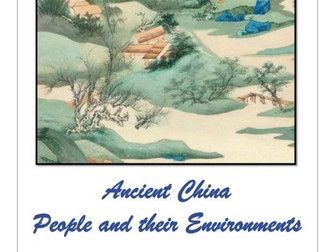
Ancient China for Junior History - Stage 4 - Years 7 and 8
Included in this Zip are two files.
18 Page Word document Handout for students - worksheets and information.
Word Document answers for all questions
The Student booklet includes;
Introduction to Ancient Chinese Architecture - with a selection of famous buildings that embody the principles of Chinese design.
Understanding architecture and philosophy
Domestic dwellings
Chinese peoples relationship with the land
There are 13 Short Response Questions for students - All answers included
Sources included for students are both historical visual sources and written sources.
Wonderful overview for students with inquiry questions based on information presented in the booklet. Students will understand the important role of both landscape and architecture to the ancient Chinese.
A lesson designed for KS3 Geography. This is lesson 6 from a unit titled Extreme Environments.
This lesson will allow students to answer the following key questions:
Who lives in extreme environments?
How are their cultures different?
A comprehensive student booklet to accompanying the People and The Biosphere topic of the new Edexcel B specification.
Includes a whole range of independent, structured tasks and activities that can be completed either at home or in the classroom. Also includes a Personal Learning Checklist for the topic.
This booklet accompanies the CGP revision guide and students will need a copy or photocopies of the relevant pages to complete the tasks.
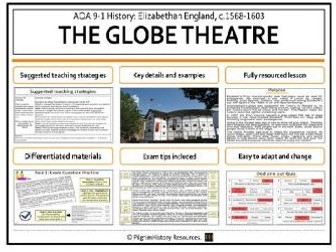
AQA GCSE 9-1 Elizabethan England, 1568-1603, Historic Environment Question 2026
This lesson explores the significance of the Globe Theatre in Elizabethan England and will prepare students fully for the historic environment question in 2026. This lesson has 38 slides and therefore is best to be delivered over at least two. The lesson has been revised since I first published it in 2019
Students will discover how the Globe became a major hub of entertainment, attracting audiences from all levels of society and helped shape the popularity of the English theatre. Through the works of playwrights like William Shakespeare, the theatre reflected the values, culture, concerns and politics of the time, making it a powerful mirror of Elizabethan society.
The lesson begins by examining two previous student answers, which students have to annotate and decide the marks they could award for each. They will show the common mistakes they make on this question from previous years. There is a simplified markscheme to consult as well as that supplied from AQA.
Two model answers are also analysed which will reflect the higher Level 4 marks awarded for a ‘complex explanation of the consequences leading to a sustained judgement’. Students are given tips and focus on how to achieve these higher marks.
Students are also required to fill in a grid to help them research the ‘5 P’s’, which focus on the main concepts of location, function, structure, design, people connected with the site, how the site reflects culture, values and fashions of the time and how the site links to important events and/or developments of the Elizabethans in the 16th Century. This will help them to gain the knowledge needed to write the question set from the exam board. The answer will also include the
Students are finally given a choice of 6 GCSE practice exam questions to complete with some scaffolding to help if required. Tips are given how to make a sustained line of argument rather than list the people, plays and the entertainment on offer from the Globe and other surrounding theatres.
The resource is differentiated and gives suggested teaching strategies. It comes in PowerPoint format which can be edited and changed to suit.
Any reviews on the resource would be greatly appreciated.
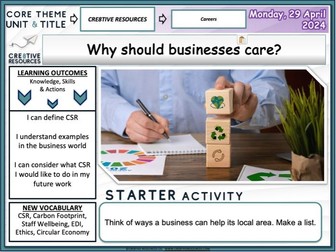
Why Should Businesses Care (People/Environment) - Primary Careers / PSHE . A fully-resourced editable PowerPoint lesson for Ks2 Students (1 hour +) which can be used by teachers to deliver a detailed workshop / session on the importance of this topic.
Learning Outcomes:
Define CSR, Understand examples in the business world, Consider what CSR I would like to do in my future work
Key terms
"CSR, Carbon Footprint, Staff Wellbeing, EDI, Ethics, Circular Economy "
Homework Activity
Find an example of CSR in your local business community. Which company in your area is caring for the local people and/or environment? How are they doing this? Find out information on their website to share when you are next in class.
Each Lesson Pack Contains:
1 Fully Editable Careers PowerPoint (Learning Outcomes, Confidence Checkers, Assessment of Learning, Variety of Tasks, Video Embedded URL Clips, Engaging Premium Quality Slides, Extra Support Websites, Challenging & Thoughtful Questioning)
Assessment Opportunity (Confidence Checker)
The lesson includes a detailed PowerPoint, variety of student facing tasks and comprehension tasks These resources have been designed to be engaging, informative and pick up and teach.
Why not check out some of our latest PRIMARY super bundles below:
The World I live in - Ks2 Bundle
My Skills & Qualities - Ks2 Bundle
Transition & Friends - Ks2 Bundle
Understanding Money & Finance - Ks2 Bundle
Linking School & Careers - Ks2 Bundle
Introduction to Careers Education - Ks2 Bundle
If you need any support with this lesson or would like to find out more about what Cre8tive Resources can offer your school please email: thecre8tiveresources@gmail.com
This lesson is part of a brand new range of Primary Careers and Primary PSHE resources for schools.
This Revision Guide on the Globe Theatre is aimed at students to help them study, revise and be prepared for the AQA Elizabethan Historic Environment question for 2026.
I have broken down the main details into manageable chunks using an amalgamation of P words including place, patronage, protests, popularity and purpose.
This guide has been revised from my 2019 version and these P words focus on the main concepts of location, function, structure, design, people connected to the Globe, the culture, values and fashions of the time and how the site links to important events of the period.
There is clearly a lot more information in the AQA guidance now included from 2019, such as the construction and function of the Globe, the surrounding theatres and their patrons, the famous actors and companies linked to each and the messages included in the plays written. I have added this to expand the Guide from 6 to 8 pages and considered the exam questions that may be asked.
Therefore, this Revision Guide on the Globe Theatre is perfect for busy teachers as it includes all the key information needed and is tailored to support students of all abilities.
Furthermore, with a strong emphasis on how the site connects to the broader themes of the Elizabethan era, this resource will not only save you hours of planning but also help students gain a deeper understanding of how to approach the Historic Environment question with clarity and precision.
The Guide comes in Word and PDF format and can be edited and changed if required. Please feel free to edit and adapt the guide if needed.
I would welcome any reviews on this resource, which would be much appreciated.
This powerpoint recognises that environments can change and that this can sometimes pose dangers to living things.
Starts of with a key vocabulary slide which i expect them to know by the end of the lesson
section 2 - key facts
section 3 - why should we protect elephants
section 4 - what is endangering elephants in africa - discusses climate change, ivory trade and deforestation
section 5 - what is being done to protect the elphants
activity - children to write a short piece using all of this information - there is a slide with reminders on for them
Full unit of work for Hazardous Environments. Specifically designed for the new Edexcel IGCSE. This is to be taught alongside coastal or river environments. All lesson are for 50 minutes to 1 hour of teaching time. Includes supporting worksheets for lessons - no additional resources are required.
All lessons have a starter and lesson aim. Extension tasks and homework also included. All PowerPoints in the same signature style.
Lesson sequence:
1 - What are hazards?
2 - Structure of the earth
3 - Types of volcano
4 - Why we live in hazardous areas
5 - Volcano case study
6 - Earthquakes
7 - LIC earthquake case study
8 - HIC earthquake case study
9 - Atmospheric circulation and ocean current
10 - Coriolis effect and the ITCZ
11 - Measuring the weather
12 - Weather and climate in the UK
13 - Tropical storms
14 - Hurricane Katrina enquiry project
15 - Hurricane Katrina assessments and group work
This lesson is designed for KS2 students. It can be taught as a stand alone lesson but is also available as part of two wider units, both of which are available on TES:
-Volcanoes
-Volcanoes & Earthquakes
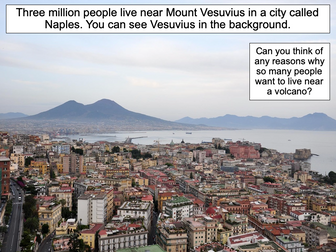
First the presentation looks at Mount Etna and Mount Vesuvius in Italy and asks why people choose to live so close to volcanoes.
The activities then challenges students to think about the advantages and disadvantages of living near a volcano:
Partner Activity:
Students sort statements and photos into advantages and disadvantages of living near a volcano.
Writing Activity:
Students write about the advantages and disadvantages of living near a volcano. Stickers and a vocabulary prompt are provided for this activity.
If you like this resource, we would appreciate a review! We will happily send you a free resource in return for a review or useful suggestions/feedback. Contact us at ed@teachitforward.co.uk.
This booklet looks primarily at the rainforest and covers how plants adapt to their environments, food webs, the water cycle, how humans us the rainforest and how it can be sustainable. Tasks include wordsearchs, word fills, match ups, comprehension and writing a report
Unlock Engaging Learning with Our Fully Resourced Svalbard Scheme of Work for AQA GCSE Geography
Are you looking for a comprehensive, engaging, and easy-to-deliver scheme of work for the Living World topic in AQA GCSE Geography? Look no further!
Our Svalbard Scheme of Work is designed to bring the fascinating Arctic landscape to life for your students, offering a clear structure for teaching this complex topic. With pacey lessons and fully resourced worksheets, this scheme is accessible for all learners and ensures an interactive, student-centered approach.
Key Features:
Paced Lessons: Designed to keep students engaged and moving forward with clear learning objectives and activities.
Fully Resourced: Every lesson comes with worksheets, presentations, and resources, so you’re prepared for each class.
Inclusive Design: Resources and activities cater to various learning styles and abilities, ensuring every student can grasp key concepts.
AQA Aligned: Fully aligned with the AQA GCSE Geography specification, covering all required content related to Svalbard in the Living World section.
Whether you’re new to teaching this topic or a seasoned educator, our scheme of work will save you time and elevate the quality of your lessons. Perfect for creating an immersive learning experience for your students!
Get started today and make Svalbard come to life in your classroom!
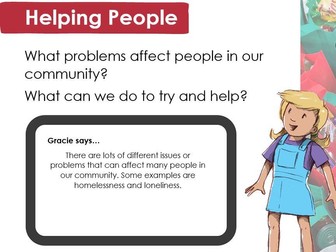
Community Matters is an exciting new free resource from the Archbishop of York Youth Trust providing activities and ideas to help pupils explore why community matters and how children and young people can play their part in creating positive change, particularly as we rebuild our communities post-Covid restrictions.
The KS1 resource has two packs focusing on Social Issues and Environmental Issues with a range of activities designed to ignite, inspire and empower children and young people to make community matter and explore what it means to live in the wider world, as active citizens. Each pack also contains ideas for collective worship.
Each pack contains:-
PowerPoint Presentation
PDF document with Teacher Notes
This activity is perfect for Art and Design students in Key Stage 5 (aged 16-17).
How does your environment make you feel? In this project you’ll explore the relationship between space and emotion.
Artists, designers and makers often challenge our understanding of space, place and the environment. Artists such as Olafur Eliasson transform spaces to explore people’s relationship to the environment.
Use recycled materials to create different spaces on a small scale. Consider colour, texture, light and dark. Adjust, repair, customize and repurpose found objects.