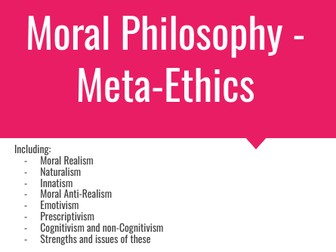
This resource contains all relevant materials for the ‘Meta-Ethics’ section of Moral Philosophy for the AQA A-Level Philosophy course. All theories, criticisms and defences are included alongside exam materials and questions to probe students for deeper thinking. For further activities, please use the official AQA A-Level Philosophy textbook.
Resource includes:
Moral Realism
Naturalism
Innatism
Moral Anti-Realism
Emotivism
Prescriptivism
Cognitivism and non-Cognitivism
Strengths and issues of these
Please note: any additional materials or images/videos use herewithin are not mine and I claim no ownership of them. Please use the URL to direct you to the original designer/creator.
4 ESSAY PLANS
These essay plans helped me get an A* overall in OCR Philosophy & Ethics (Full Marks on ethics paper).
Essay plans discussing the complexities surrounding the challenge of secularism. The essay plans have a particular focus on AO1, so that students are able to learn this topics content whilst acknowledging how they are going to categorise this information in an essay. This produces essays that contain the most relevant and well-organised information. These essay plans specifically target the knowledge that ‘learners should know’ as said on the specification.
These essay plans are VERY detailed. This is because I designed my essay plans so that they can be used without the aid of revision notes, in isolation. All the extra detail you need on the topics have been included in the essay plans.
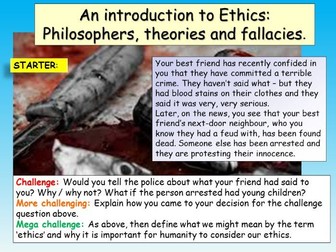
A fully-resourced, detailed and differentiated 2 hour lesson which serves as an introduction to Ethics. This is perfect as part of a KS3/KS4 RE or philosophy unit and focuses on philosophers, theories and fallacies.
This lesson is editable, so easy to adapt for your own planning and contains match up tasks, clip tasks, literacy and debate tasks, information sheets and more, as well as an engaging 2 hour PowerPoint. It is well-differentiated with three-level challenges for each task and very easy to follow.
Who are EC Resources?
EC Resources are the top TES PSHE providers and are a group of teachers who work together to create easy to use, high quality and editable lessons and units of work. We have created lessons for The Children’s Commissioner, MACS Charity, Tes, LikeToBe Careers, the Criminal Cases Review Commission (UK Gov) and have also completed PSHE and Citizenship commissions for schools across the UK.
Check out our RE and PSHE Packages here:
RE lessons and units
Complete KS3 PSHE and RSE
Complete KS4 PSHE and RSE
One Year of KS5 PSHE and RSE
One Year of Citizenship and British Values
Complete Year 7 and 8 RE
Complete Careers and Employability
AQA Citizenship GCSE Mega Pack
Check out the EC Publishing website for full, affordable PSHE, Citizenship and RE Packages for all year groups including the new 2024 Complete PSHE Package. You can contact us at info@ecpublishing.co.uk
Teaching PSHE, RE or Citizenship GCSE next year? Why not join our Citizenship and PSHE teachers Facebook group, with 8000 other teachers, for guidance, advice and resource sharing.
Full set of A* grade notes for Virtue Ethics for AQA Philosophy 7172
‘The good’ for human beings: the meaning of Eudaimonia as the ‘final end’ and the relationship between Eudaimonia and pleasure.
The function argument and the relationship between virtues and function.
Aristotle’s account of virtues and vices: virtues as character traits/dispositions; the role of education/habituation in the development of a moral character; the skill analogy; the importance of feelings; the doctrine of the mean and its application to particular virtues.
Moral responsibility: voluntary, involuntary and non-voluntary actions.
The relationship between virtues, actions and reasons and the role of practical reasoning/practical wisdom.
Issues including:
whether Aristotelian virtue ethics can give sufficiently clear guidance about how to act
clashing/competing virtues
the possibility of circularity involved in defining virtuous acts and virtuous persons in terms of each other
whether a trait must contribute to Eudaimonia in order to be a virtue; the relationship between the good for the individual and moral good.
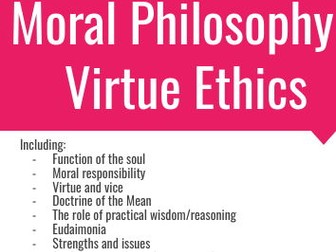
This resources contains all materials needed for Aristotelian Virtue Ethics, as part of the ‘Moral Philosophy’ section of the AQA A-Level Philosophy course. All theories, criticisms and defences are included, alongside relevant exam practice and questions to probe student understanding. For additional activities, please use the official AQA A-Level Philosophy textbook.
Resources includes:
Function of the soul
Moral responsibility
Virtue and vice
Doctrine of the Mean
The role of practical wisdom/reasoning
Eudaimonia
Strengths and issues
Application to the eight suggested scenarios
Please note: any additional materials or images/videos contained herewithin are not owned by me and I claim no ownership of them. Please follow the URL for direction to the original designer/creator.
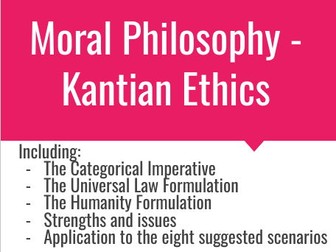
A complete collection of resources needed for studying Deontological Kantian Ethics for the AQA A-Level Philosophy course. This contains all relevant theories, criticisms and and defences. Whilst questions and activities are provided, please use the official AQA A-Level Philosophy textbook for additional activities.
Resource includes:
The Categorical Imperative
The Universal Law Formulation
The Humanity Formulation
Strengths and issues
Application to the eight suggested scenarios
Please note: any additional resources or images/videos contained herewithin are not mine and I claim no ownership of these. Please refer to the URL for direction to the original designer/creator.
Based around the question 'What is Philosophy and Ethics?', this display looks at RE/ Philosophy & Ethics from different viewpoints: politics, maths, history, writing, science etc to show why RE/ Philosophy & Ethics is important today!
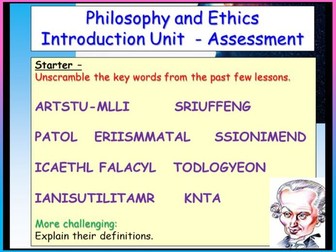
An easy to follow end of unit assessment, mark scheme and feedback sheet for an introduction unit on philosophy and ethics. It has been created for the EC Publishing Introduction to Philosophy unit, but is editable and can be tweaked to suit your own. This is perfect as part of a KS3/KS4 RE or philosophy unit and focuses on philosophers, theories and fallacies.
Who are EC Resources?
EC Resources are the top TES PSHE providers and are a group of teachers who work together to create easy to use, high quality and editable lessons and units of work. We have created lessons for The Children’s Commissioner, MACS Charity, Tes, LikeToBe Careers, the Criminal Cases Review Commission (UK Gov) and have also completed PSHE and Citizenship commissions for schools across the UK.
Check out our RE and PSHE Packages here:
RE lessons and units
Complete KS3 PSHE and RSE
Complete KS4 PSHE and RSE
One Year of KS5 PSHE and RSE
One Year of Citizenship and British Values
Complete Year 7 and 8 RE
Complete Careers and Employability
AQA Citizenship GCSE Mega Pack
We also run psheresources.com and you can contact us at info@ecpublishing.co.uk
Teaching PSHE, RE or Citizenship GCSE next year? Why not join our Citizenship and PSHE teachers Facebook group, with 8000 other teachers, for guidance, advice and resource sharing.
Set of lessons (all in one PP-102 slides/sectioned as below)
Lessons link
Re-cap throughout
Range of scaffolded activities
Teacher friendly/answers are revealed on hidden slides etc.
Lessons ready to go and well-resourced
Assessment throughout (could be done as a lesson or home learning if needs to be taught over one half term)
Taught all the way through - amazing pupil engagement
**Philosophy: **
L1 – What is Philosophy (Socrates)
L2 – Existence of God – Introduction to Arguments
L3 – The Design Argument
L4 – Miracles
L5 – Existence of God Extended Writing
Ethics:
L1 – Introduction to Ethics/Utilitarianism
L2 – Deontology
L3 – Utilitarianism and Deontology Extended Writing
Application:
L1 – Introduction to Capital Punishment and Debate
L2 and 3 – Documentary and Consolidation/Evaluation Activities
L4 – Capital Punishment Extended Writing and Speech
This printable textbook provides a systematic explanation for every point mentioned in the specification.
In the next section It then provides arguments for and against each point and, where appropriate, summarises arguments using premises and conclusions.
The file is a .doc Word file, 140 pages in length, 72000 words.
It is designed to be a comprehensive reader for AQA Philosophy students.
This should be viewed as a printable information book: it does not include learning activities or images. It aims to provide the necessary information as effectively and comprehensively as possible.
Note: it does not cover the Applied Ethics section which, if this resource succeeds, will be covered in a later volume.
A detailed scheme of work created for our [Introduction to Religion, Philosophy and Ethics Unit] which covers one term’s resources and includes an assessment and mark scheme. This was created for our Complete Year 8 RE package, which can be found on Tes here.
Who are EC Resources?
EC Resources are the top TES PSHE providers and are a group of teachers who work together to create easy to use, high quality and editable lessons and units of work. We have created lessons for The Bank of England, The Children’s Commissioner, MACS Charity, Tes, LikeToBe Careers, the Criminal Cases Review Commission (UK Gov) and have also completed PSHE and Citizenship commissions for schools across the UK.
Check out our RE and PSHE Packages here:
One Year of KS3 RE
Complete KS3 PSHE and RSE
Complete KS4 PSHE and RSE
One Year of KS5 PSHE and RSE
One Year of Citizenship and British Values
Complete Year 7 and 8 RE
Complete Careers and Employability
AQA Citizenship GCSE Mega Pack
We also run psheresources.com and you can contact us at info@ecpublishing.co.uk
Teaching PSHE, RE or Citizenship GCSE next year? Why not join our Citizenship and PSHE teachers Facebook group, with 8000 other teachers, for guidance, advice and resource sharing.
A range of revision worksheets that cover the Edexcel Catholic Christianity and Philosophy and Ethics sections of the Religious studies course. I use these for year 10 and 11 mock and GCSE Exam revision and independent study.
Included are:
Prayer, Creation, Pilgrimages, Visions,
Eschatology and Life after death
Forms of Expression
Religious Imagery and Symbols
Architecture and Design
Marriage and Divorce
Remarriage
Gender Prejudice and discrimination
The Design Argument
The Cosmological Argument
The Trinity
Evil and Suffering
A little simple power point with images a key ethical questions to be explored in most RS specifications. We are moving to AQA Unit 2 & 3. Contact @Mr_Betts to share resources!
Designed as an introduction to philosophy and ethics in year 9, looking at key philosophical skills and the types of ethical questions discussed at philosophy and ethics GCSE.
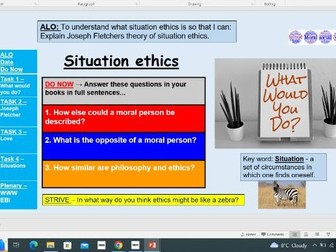
Fifth lesson in unit of work exploring what ethics is. Students will be exposed to the philosophies of Joseph Fletcher and his beliefs in Jesus’ teaching of “Love your neighbor”.
Features - On screen task management board for SEN students. Differentiated questioning for HAT/MAT/LAT students by Gold, Silver, Bronze task. Worksheets included in powerpoint ready to print.
This bundle is made up a detailed handbook which can easily work with both workbooks with matching headings to combined together. The Ethics quotes are a useful way of helping to share and display key religious teachings
The lesson discusses what it means to be a good person and ethics.
Level: Advanced (C1)
Time: 90 min+
Age: 15+
Language: discussing what it means to be a good person.
Additional resources: lesson uses YouTube.


 Quick View